How to Grow Cauliflower (Broccoli)? Planting Methods and Profit Analysis
Cauliflower, also known as broccoli or cauliflower, can be prepared in many ways and has a delicious flavor. It is a relatively popular vegetable with high nutritional value and good medicinal effects, and it is favored by many people and growers. So how do you grow cauliflower (broccoli)? How are the planting profits?
I. How do you grow cauliflower?
1. Planting time: There are many varieties of cauliflower, each corresponding to the climate of different seasons. Extremely early-maturing and early-maturing varieties are heat-tolerant and high-temperature-tolerant, suitable for planting in summer, with planting time from June to September. Mid-maturing and late-maturing varieties are not tolerant of high temperatures but are cold-resistant, suitable for planting in spring and winter, with planting time from November to February of the following year. In addition, different regions have slightly different planting times for cauliflower, so the planting time is determined by the variety and local climate.
2. Sowing: Cauliflower seeds can be sown directly without any treatment, but the seeds are relatively small, so the broadcast sowing method is used. When broadcasting, be sure to spread them evenly. After sowing, cover with a layer of organic soil. After watering, they will germinate in about 3-4 days.
3. Light: Cauliflower is not strict about light requirements and prefers an environment with sufficient light. With sufficient light, the plants grow robustly, the curds are compact, and the color is bright green. With insufficient light, the plants grow poorly, the curds are smaller, and the color is dull.
4. Temperature: Cauliflower prefers a warm environment. The suitable growth temperature is 20-25 degrees. At temperatures above 25 degrees, curd formation becomes relatively difficult. Low temperatures below 0 degrees will cause freezing damage to the plants.
5. Soil: Cauliflower has strong adaptability and does not have high soil requirements. It is best planted in deep sandy loam rich in organic matter, with a soil pH between 5.5-6.5.
6. Watering: Cauliflower has a relatively high water demand, so sufficient water must be maintained at all times. Lack of water affects curd formation or results in poor curd quality.
7. Cultivation and weeding: During the growth period of cauliflower, attention should be paid to removing weeds. This can be combined with weeding and loosening the soil 1-2 times.
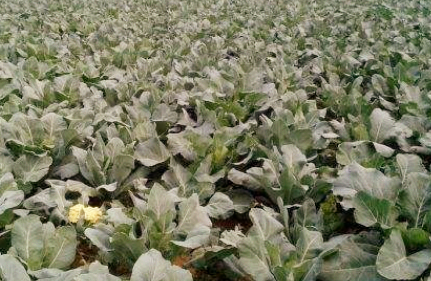
8. Fertilization: When planting cauliflower, rational fertilization is essential. One week after transplanting, a seedling fertilizer can be applied once. After three weeks, a compound fertilizer can be applied to promote rapid root growth.
9. Pests and diseases: Cauliflower leaves are broad and thick, fleshy and juicy, and are prone to pest damage, especially cabbage caterpillars, aphids, and others. Therefore, pesticides should be sprayed regularly to prevent and control pests.
II. How are the planting profits of cauliflower?
Growing cauliflower not only allows you to profit from its edible value, but also allows you to gain greater profit potential through its ornamental value. In addition, cauliflower is generally sown in early spring and autumn, and autumn yields are higher than spring-sown yields. Taking autumn sowing as an example, the harvest period for early-maturing varieties is 45-60 days. Taking Yamei as an example, the yield per mu is 4000-5000 jin; the harvest period for mid-maturing varieties is 65-80 days, and Huafei yields 4500-6000 jin per mu; the harvest period for late-maturing varieties is 85-100 days, and Baishengwang averages 6000-7000 jin per mu, while Dongjiang at 100 days yields 6500-8000 jin. In addition, the market price of cauliflower fluctuates relatively greatly, reaching a high of 10.08 yuan/kg, while at its lowest it is only 1.68 yuan/kg. At the same time, the pattern of cauliflower price movements throughout the year is also relatively unclear. But overall, from the above data, it can be seen that the profits from growing cauliflower are still good. However, growing cauliflower requires constantly paying attention to local market price fluctuations, with local market prices as the standard, and choosing the appropriate time to bring it to market. Generally, off-season cultivation is likely to obtain high prices and higher profits.