How to grow yew plum pine (Taxus)? Cultivation methods and precautions for the "golden plant"
Many people may not be very familiar with the yew plum pine (Taxus). In fact, the yew plum pine is a very precious ornamental plant, and it is also an ancient tree species left over from the Quaternary glaciation, so it is also known as the "golden plant." As a rare treasure in flower cultivation, it is liked by many people who want to grow it, so the editor will introduce the cultivation methods and precautions for the yew plum pine:
I. Cultivation methods for the yew plum pine
1. Soil
The yew plum pine likes to grow in loose, water- and fertilizer-retentive soil rich in humus with good air permeability. For this kind of soil, you can choose to mix peat soil or perlite with soil, but clay soil that is not breathable and has poor water retention is not suitable.
2. Light
What makes the yew plum pine different from other plants is that it likes to grow in a cool environment, so during cultivation it cannot be placed in direct sunlight, to avoid water evaporation causing branch and leaf dehydration and dry leaves. However, if there is no light at all, it will also be detrimental to the growth of the yew plum pine, so appropriate shading is enough. In hot summer, the yew plum pine can be placed in the living room and corners, and then moved to the windowsill at night for ventilation.
3. Fertilization
Fertilizing during the cultivation of the yew plum pine is a very key step. When fertilizing, applying 0.2 jin of organic fertilizer and 0.02 jin of compound fertilizer per plant is best. You can also add some farmyard manure and cake fertilizer, etc. During fertilization, it should be spread along the pot wall as much as possible, but it must not be close to the roots of the yew plum pine. In addition, newly purchased yew plum pine bonsai generally contain some nutrient soil, so you can wait 2-3 months before fertilizing.
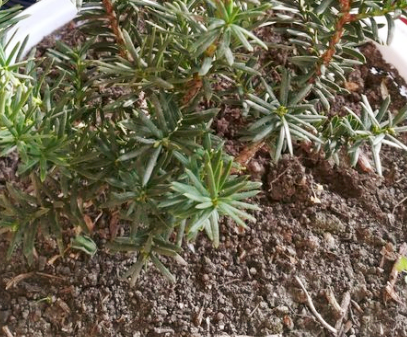
4. Watering
To judge whether the yew plum pine should be watered, you can observe whether the leaves appear wilted and drooping, or tap the pot and listen to the sound. If the sound of tapping the pot is very hollow, it means the soil is dry, and at this time it should be watered. Generally, a yew plum pine placed outdoors is watered once every half month, while one placed indoors is watered once every 20-25 days, keeping the soil moisture at about 40%.
5. Pruning
During the growth period of the yew plum pine, in order to reduce the consumption of nutrients by branches and leaves, quickly restore root growth, and maintain an attractive appearance, the bonsai needs to be pruned. The specific operation is: when the lower branches grow too densely or dry, yellow leaves appear and fall off, part of the overly dense branches can be pruned. The shape can be pruned into an umbrella shape, tower shape, or round shape, etc.
6. Repotting
After about one year of cultivation, the yew plum pine sapling will gradually grow larger, and the root system will gradually develop. At this time, it needs to be transplanted and repotted. When repotting, you can first break the old pot, but be careful not to damage the original soil ball, then move it into a new pot and water it to settle the roots so that the root system and soil are closely combined. In addition, if during repotting the yew plum pine temporarily cannot keep up with the nutrient supply to the roots and branches and leaves, causing leaf curling and drying, this can be solved by pruning.
II. Precautions for cultivating the yew plum pine
1. If yellowing or pests and diseases occur during the cultivation of the yew plum pine, the control measures can use thiophanate-methyl or monopotassium phosphate for watering or spraying. Note that during the rainy season, the yew plum pine, especially young trees, is prone to root and stem rot and root rot. At this time, dexon can be used for spraying and care. If leaf blight and red blight occur in high-temperature and dry seasons, Bordeaux mixture can be sprayed for control.
2. Although the yew plum pine does not have high requirements for the growing environment, in summer it cannot be exposed to the sun, nor can it be blown directly by an air conditioner. In winter, it cannot be placed close to heating, and cigarette butts and tea leaves and other debris cannot be thrown into the pot. These behaviors are all detrimental to the growth of the yew plum pine.
3. During the cultivation of the yew plum pine, the flower pot used can be slightly larger. In addition, several holes can be made in the bottom of the pot to enhance its water permeability and air permeability. If conditions permit, a purple clay pot is best, which is beneficial to its growth.
4. During the cultivation of the yew plum pine, care should be taken to place it in a place with good ventilation. If the indoor space is closed and not ventilated, or if it is placed in a drafty spot for growing, it will cause leaf curling and leaf drop in the yew plum pine due to water evaporation.
5. When watering the yew plum pine, it is best to use acidic nutrients or spray the leaves or water the pot soil with a 2 per thousand ferrous sulfate solution. If alkaline water is used for watering over a long period, it is likely to cause the leaves to turn yellow and even fall off.
Summary: The above is the relevant introduction to the cultivation methods and precautions during the cultivation process of the yew plum pine. I hope it is helpful to friends in need!