How to Grow Hollyhocks? A Full Guide to Watering and Fertilizing Techniques
In recent years, the development of the flower market has gradually brought many “little-known” flowers into people's view, and the growing area has become larger and larger. Hollyhock is one of them. So what are the ways to grow hollyhocks? How should you water and fertilize them?
I. Basic facts about hollyhocks
1. Origin and alternative names of hollyhock
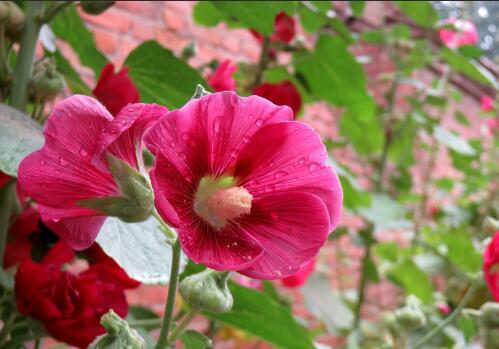
Hollyhock (Alcea rosea) is a herbaceous plant native to Sichuan in China. It is also called yizhanghong, dashuji, rongkui, wukui, weizukui, hukui, doupeng hua, and shujie hua. It is widely planted all over the world, and its distribution in China is also very broad, with it found in East China, Central China, and North China.
2. Physical characteristics of hollyhock
Hollyhock can grow to about 2 m at its tallest. Its stems and branches have long, dense bristles, and its leaves are nearly round-heart shaped. The upper surface of the leaves has rough, sparse soft hairs, while the lower surface is covered with stiff hairs or down. The leaf stalk is 5 to 15 cm long. The flowers of hollyhock are relatively large, with colors including red, purple, white, pink, yellow, and black-purple. The flowering period is fairly long, lasting from February to August.
3. Value of hollyhock
Besides its ornamental value, hollyhock also has a certain role in medicine. Its flowers and leaves have a certain auxiliary therapeutic effect in clearing heat and detoxifying, promoting diuresis and treating strangury, and treating carbuncles, sores, ulcers, small-area burns and scalds, and urinary tract infections.
II. How to grow hollyhocks, and how should you water and fertilize them?
There are many ways to propagate hollyhocks, including sowing, division, and cuttings, and you can choose according to different situations. If using division or cuttings, it is recommended to do so in spring, but production generally relies mainly on sowing, so the following mainly introduces the sowing method for growing hollyhocks and the key points of watering and fertilizing.
1. Hollyhock seeds can be sown after they mature and are collected in August and September of that year, and the plants can bloom the next year. If the seeds are bought and sown in spring, they will bloom the following year, and seedlings will generally emerge about a week after sowing. In the south, if sowing in autumn, pay attention to giving the seedlings a covering to protect them from the cold after winter begins.
2. Hollyhock likes a cool climate and light, is not tolerant of heat or frost, and is slightly shade-tolerant; it is best planted in deep, fertile, well-drained soil. When sowing, you can sow directly in an open-field seedbed to raise seedlings and then transplant, or you can sow directly without transplanting; transplanting should be properly combined with overcast and rainy days, which can help with thinning the seedlings.
3. Hollyhock does not need much water to grow, so do not let its growing environment become too moist. If there is too much standing water, be sure to drain it promptly to avoid root rot in hollyhocks that affects growth. During this process, the amount of watering should be appropriately increased or decreased according to the situation:
(1) Spring is its growing season. When there is relatively little rain, you can water a bit more as appropriate, but if there are many overcast and rainy days, make sure not to let standing water appear; if it is a potted hollyhock kept at home, water according to the dryness and moisture of the soil in the pot. If the soil is dry, add an appropriate amount of water; if the soil is moist, there is no need to water.
(2) During the flowering period of hollyhock, the water requirement is relatively large. At this time, you can water it once every few days, and each watering only needs to keep the soil moist. Ensuring moisture during the flowering period not only helps the plant grow better, but may also extend the flowering period.
(3) In autumn and winter, plants begin to enter dormancy, and hollyhock is no exception. At this time, reduce the amount and frequency of watering, and stop watering when deep winter arrives to keep it warm and protect it from the cold.
In addition, a reminder that in summer it is best to water in the morning and evening, and if the soil is relatively dry, water thoroughly.
4. The nutrients plants need for growth come not only from the soil and photosynthesis, but also from the fertilizer we apply:
(1) During the seedling growth period of hollyhock, you can apply 2-3 times a liquid fertilizer mainly based on nitrogen fertilizer, and at the same time pay attention to weeding and loosening the soil to promote robust plant growth.
(2) When flower buds form, apply additional phosphorus and potassium fertilizer, and ensure sufficient moisture to promote growth.
5. During the growth of hollyhock, pay attention to preventing and controlling invasions by pests and diseases such as hollyhock rust, red spider mites, and white spot disease, using different agents for different situations.
Friends who like hollyhocks can choose dwarf varieties for container growing; placing them on a balcony, in the living room, and other places makes a fine scenic touch!