Orange jasmine (Murraya paniculata) stays evergreen all year round: an introduction to its cultivation methods and precautions
Orange jasmine (Murraya paniculata) is actually also called "seven-mile fragrance" and belongs to the group of plants that stay evergreen through all four seasons. Because of its elegant plant shape, graceful branches and leaves, and strong floral fragrance, it is very popular with everyone, and many people want to grow it at home but do not know how to grow it or what to pay attention to. So let me introduce the cultivation methods and precautions for orange jasmine!
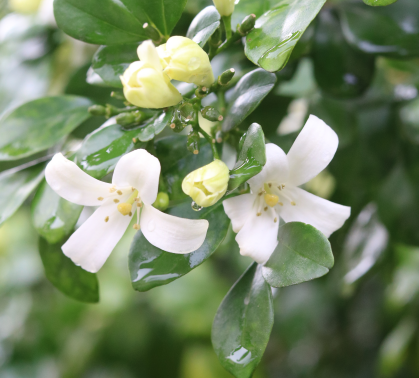
I. Cultivation methods for orange jasmine
1. Soil
The most suitable soil for growing orange jasmine is sandy soil with good drainage. Such soil can be mixed and prepared from sandy loam, fine furnace slag, and cake fertilizer residue in a ratio of 7:1:2, or soil mixed from pond mud, peat, and river sand in a ratio of 5:4:1 can also be used. After that, apply organic fertilizer rich in phosphorus and potassium fertilizer at the bottom of the pot as a base fertilizer.
2. Fertilizing
Fertilizing plays a key role in the growth of orange jasmine. Potted orange jasmine generally needs to be repotted once every 2-3 years. During repotting, bone meal, phosphate fertilizer, and cake fertilizer pieces can be placed at the bottom of the pot. If orange jasmine is planted in the ground, in order to promote seedling growth, organic fertilizer needs to be applied as a top dressing 2-3 times each year. When orange jasmine enters its growth period in May, the frequency of fertilizing should increase to once every 7 days, and the concentration of the fertilizer also needs to be slightly higher. The concentration ratio can be prepared from the original liquid fertilizer and clear water in a ratio of 4:6.
3. Watering
During the growth period of orange jasmine, cake fertilizer water should be applied once a month. As for watering, the requirements are not high; just water a little when the potting soil is slightly dry. Be careful not to water too much, because overly wet soil can easily cause leaf drop. During the flowering period of orange jasmine, watering needs to be timely and moderate so as to ensure it produces more flowers and that the flowers are fragrant.
4. Light
Orange jasmine is suited to surviving under conditions with sufficient light. Although orange jasmine very much likes sunlight, it can actually still grow with slightly poorer light. In addition, during midsummer when light and temperature are high, it must not be placed outdoors in direct sun exposure, so as to avoid causing the orange jasmine to wither and die. If you want to enjoy the flowers, you can place it in a spot with relatively good light that is not too intense.
5. Temperature
The growth characteristic of orange jasmine is that it is suited to growing under warm conditions and can tolerate cold slightly. The most suitable temperature for the growth of orange jasmine is between 18-28°C. Maintaining this temperature can allow it to grow well. In winter, it must not be placed in an environment below 5°C for a long time. If it is a short-term low-temperature environment of 0°C, that is still acceptable.
II. Precautions during the cultivation of orange jasmine
1. When growing orange jasmine, choose fertile soil as much as possible. It can be repotted every spring. During repotting, add an appropriate amount of phosphorus and potassium fertilizer at the bottom of the pot, or use decomposed stable manure as a base fertilizer. Note that during cultivation, fertilizer should mainly be organic fertilizer, and chemical fertilizer should be used less. Simply soak crushed cake fertilizer pieces in water or apply them directly into the soil.
2. Note that orange jasmine needs to be repotted once every 2-3 years. The soil for repotting can be prepared by mixing coniferous leaf mold, garden soil, fine yellow sand, and compost soil in a ratio of 5:2:2:1, sifting all of them and then thoroughly mixing them evenly. Repotting can be carried out in spring from April to May.
3. When growing orange jasmine, note its characteristics of being afraid of moisture, sun exposure, and cold, and take corresponding measures. That is, do not water too much, and it should be placed in a semi-shaded place. To avoid freezing damage, when the winter temperature is below 5°C, it should be moved indoors for cultivation, and the indoor minimum temperature should be maintained above 10°C. In addition, watering must be strictly controlled; when the potting soil is not dry, there is no need to water, and keeping a slightly dry environment is best.
4. When growing orange jasmine, note that timely pruning and shaping are needed. The best pruning times are spring and summer-autumn. During pruning, thin out excessively dense, leggy, and overlapping branches, as this can help orange jasmine produce abundant flowers and fruit during the flowering period.
5. Note that during the growth and development period of orange jasmine, the fertilizer used should be a mixed fertilizer of nitrogen, phosphorus, and potassium, and nitrogen fertilizer must not be applied alone. Before orange jasmine blooms and forms buds, apply more phosphorus and potassium fertilizer. If nitrogen fertilizer is excessive and phosphorus and potassium fertilizer are lacking, it can easily cause branches and leaves to grow leggy without forming buds or blooming. During the bud formation period of orange jasmine, watering should be appropriately reduced, as this helps bud formation.
6. Note that after the autumn turns cool, orange jasmine gradually stops growing. At this time, the frequency of watering should be reduced; generally, watering once every other day is enough. Fertilizing should also gradually be reduced until no fertilizer is applied. By the end of September, it should be moved indoors and kept in a sunny place for care. At this time, watering should be greatly reduced; generally, watering once every three or four days is enough. At this time, fertilizing needs to be stopped completely.
Summary: The above is the relevant introduction to the cultivation methods for orange jasmine and the precautions to note during cultivation. I hope it is helpful to friends who need it!