How to Grow the May Flower Goddess Peony? An Analysis of Planting Costs and Benefits
Paeonia lactiflora, also known as "Jiangli grass," enjoys the reputation of being the “May flower goddess” and has a long history of cultivation in China. Besides its high ornamental value, it also has considerable medicinal value, so many growers want to plant Paeonia lactiflora as a money-making project. So how do you grow Paeonia lactiflora? What about the planting costs and benefits?
I. How do you grow Paeonia lactiflora?
1. Soil
Paeonia lactiflora is a deep-rooted plant. It does best in neutral or slightly acidic sandy soil with deep, loose, well-drained layers, because choosing clay or sandy soil will make it grow poorly. Soil with high water content that drains poorly easily causes root rot, and saline-alkali land is also unsuitable for planting.
2. Cultivation and Weeding
After sowing, once the Paeonia lactiflora seedlings emerge, cultivation and weeding should be carried out promptly. However, to avoid damaging the young roots, cultivation and weeding should not be deep. In addition, during relatively dry summers, cultivation should be done to preserve soil moisture. The number of cultivation and weeding sessions is 3—4 times per year.
3. Watering
Paeonia lactiflora is suited to living in high, open and relatively dry environments, so it does not need frequent irrigation. Secondly, the fleshy roots of Paeonia lactiflora are not tolerant of waterlogging. If water accumulates for 6-10 hours, it easily causes root rot, so low-lying wet areas are not suitable for growing Paeonia lactiflora.
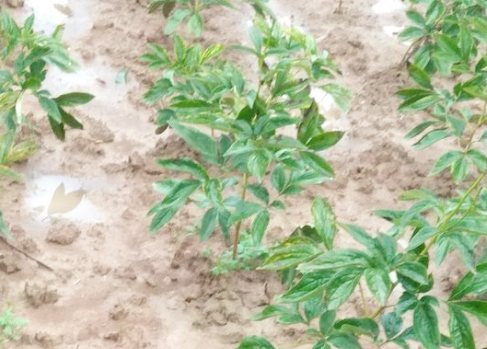
4. Light
Although Paeonia lactiflora can only have brilliant flower colors and grow luxuriantly under conditions of sufficient light, during its flowering period the temperature can be appropriately lowered and humidity increased to prevent damage from intense sunlight and extend the viewing period. It also must not be excessively shaded, to avoid sparse flowering or failure to bloom.
5. Temperature
Paeonia lactiflora is suited to living in warm conditions but is also extremely tolerant of high and low temperatures. It can safely pass the summer when the temperature reaches 42.1°C in summer, and under conditions with a minimum winter temperature of -46.5°C it can still grow and bloom normally and overwinter in the open field.
6. Timely Topdressing
During the growth period of Paeonia lactiflora, fertilizer needs to be applied at the right time, but in the first year, because the peony roots are still too tender, topdressing should be reduced or not applied. Starting from the second year, fertilizer needs to be applied 3 times each year. The first topdressing time is in late March, with an amount of 1000 kg of human and livestock manure water per mu. The second topdressing time is in mid-April, with an amount of 1500 kg of human and livestock manure water per mu plus 15 kg of superphosphate. The third topdressing time is in mid-October, with an amount of 2500 kg of barnyard manure applied in furrows per mu, followed by watering.
7. Bud Removal and Pruning
During the mature flowering period of Paeonia lactiflora, in order to promote the growth of the plant and roots and make the Paeonia lactiflora flowers large and beautiful, except when saving seeds, the flower buds need to be removed when they appear. When side buds appear, they should be thinned promptly, so that nutrients can be concentrated in the main bud.
II. What about the planting costs and benefits of Paeonia lactiflora?
1. Costs
The planting cost of Paeonia lactiflora varies to some extent by region. In general, taking the planting of one mu as an example, the investment cost of 4-year Paeonia lactiflora seedlings is 3200 plants per mu. Calculated at a seedling market price of 0.6 yuan per plant, the 4-year seedling cost is 1920 yuan, with an average annual seedling cost of 480 yuan. In addition, the fertilizer input cost is 300 yuan per mu, applied in two sessions, one as base fertilizer and one as topdressing two years later. The pesticide cost is 150 yuan per mu for insecticide, averaging 40 yuan per year. Adding a labor cost of 800 yuan, a planting cost of 100 yuan per mu of land, a management cost of 200 yuan, and 500 yuan combined for weeding and topdressing, a land leveling and digging cost of 2000 yuan, plus land rent and so on, the total cost of planting Paeonia lactiflora per mu is 4880 yuan. Seen this way, the cost per mu of planting Paeonia lactiflora can still be greatly reduced, and the cost is not very high.
2. Benefits
Planting Paeonia lactiflora is calculated on a 4-year benefit period. Each plant is calculated at an annual dry product yield of 2 kg. The number of surviving plants per mu is 3000. Calculated at a market price of 5 yuan/kg for fresh Paeonia lactiflora, the 4-year income is 30000 yuan/mu, averaging about 7500 yuan/mu per year. If calculated at a market price of 10 yuan/kg for annual dry product per kg, then 3000 plants × 2 kg/plant × 10 yuan/kg gives an income of 60000 yuan/4 years, averaging about 15000 yuan per year. After subtracting planting costs and land rent, the annual benefit per mu of planting white peony is about 6000-13000 yuan.
In addition, planting Paeonia lactiflora requires less effort and time in the early stage (the first 2 years), and management is simple in the later stage (the last two years). It is suitable for large-scale planting, and has good prospects, wide uses and much value. The roots of Paeonia lactiflora contain paeoniflorin and benzoic acid, and are not only crisp and juicy and usable as medicine, with effects such as antispasmodic, analgesic and menstrual regulation. The flowers of Paeonia lactiflora are also large and brightly colored with good ornamental value, and can also be used for specialized gardens, cut flowers, flowerbed flowers and so on. In addition, because pairing with tree peony can visually extend the flowering period, it is often planted together with tree peony. The seeds of Paeonia lactiflora can also be pressed for oil for making soap and mixed with paint as a coating. The roots and leaves of Paeonia lactiflora are rich in tannins and can be used both to extract tannin extract and as a traditional pesticide, killing soybean aphids and preventing wheat stem rust. Seen this way, the benefits of planting Paeonia lactiflora are still quite good, but the above data are for reference only, and the specific benefits should be based on actual planting benefits.
Summary: The above is a related introduction to the planting methods and prospect profits of Paeonia lactiflora. I hope it is helpful to friends in need!