A Detailed Guide to Wholesale Market Prices and Planting Techniques for Ginkgo Saplings
Ginkgo is a common economic tree species in China. Because it takes twenty years to bear fruit and forty years to bear fruit in large quantities, it is called the “gongsun tree” (grandfather-grandson tree), and it has high ornamental and medicinal value. It is now widely planted in parks, green spaces and other places. So how much does a ginkgo sapling cost? What are its planting techniques?
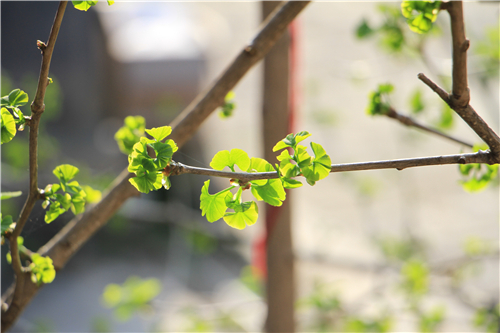
I. Introduction to the ginkgo tree:
1. What other names does the ginkgo tree have?
Baiguo tree, duck-foot tree, gongsun tree.
2. What are the characteristics of the ginkgo tree?
The ginkgo tree consists of four parts: roots, trunk, leaves and fruit. The bark of young trees is smooth and light gray, with a conical crown; large trees are grayish brown with a broad ovate crown and spur-like short shoots. The leaves are fan-shaped, light green on both sides, and turn yellow before leaf fall in autumn. The flowers are dioecious, growing in the axils of scale-like leaves in clustered form, and generally bloom in April. The seeds are elliptical, ovate, etc., with a white outer coat and 2 to 3 longitudinal ridges, and generally mature in October.
3. How big can a ginkgo tree grow in ten years?
Generally, a ginkgo tree with a diameter of about 5 to 10 cm can grow 1 to 2 cm per year, one of 11 to 15 cm can grow 2 cm per year, and one of 16 to 23 cm can grow about 3 cm per year. So how big a ginkgo tree can grow in ten years depends specifically on how thick the ginkgo tree is, which determines how much it can grow.
II. How much does a ginkgo sapling cost?
Ginkgo saplings are divided into seedling-grown saplings and grafted saplings. Seedling-grown saplings have a long lifespan, vigorous vitality and strong resistance, so their price is relatively higher, while grafted saplings also have a long lifespan but relatively weaker adaptability and resistance, so their price is relatively cheaper. The specific prices of seedling-grown and grafted saplings are as follows:
| Name | Specification | Price | Name | Specification | Price |
| Seedling-grown sapling | 1 cm | 1 to 3 yuan | Grafted sapling | 1 cm | 1 to 2 yuan |
| 2 cm | 3 to 5 yuan | 2 cm | 2 to 4 yuan | ||
| 3 cm | 5 to 8 yuan | 3 cm | 4 to 6 yuan | ||
| 4 cm | 8 to 11 yuan | 4 cm | 6 to 10 yuan | ||
| 5 cm | 30 to 35 yuan | 5 cm | 18 to 25 yuan | ||
| 7 cm | 60 to 70 yuan | 6 cm | 30 to 40 yuan | ||
| 8 cm | 100 to 120 yuan | 7 cm | 50 to 60 yuan | ||
| 10 cm | 160 to 200 yuan | 8 cm | 80 to 90 yuan | ||
| 12 cm | 250 to 300 yuan | 9 cm | 100 to 120 yuan | ||
| 14 cm | 400 to 420 yuan | 10 cm | 140 to 160 yuan | ||
| 16 cm | 500 to 700 yuan | 11 cm | 180 to 200 yuan | ||
| 18 cm | 800 to 1000 yuan | 12 cm | 240 to 280 yuan | ||
| 20 cm | 1800 to 2200 yuan | 13 cm | 300 to 350 yuan | ||
| 22 cm | 2400 to 3000 yuan | 14 cm | 450 to 550 yuan | ||
| 24 cm | 4000 to 5000 yuan | 15 cm | 650 to 750 yuan | ||
| 26 cm | 5500 to 7000 yuan | 18 cm | 1200 to 1600 yuan | ||
| 28 cm | 12000 to 20000 yuan | 20 cm | 1800 to 2200 yuan | ||
| 30 cm | 28000 to 40000 yuan | 25 cm | 3000 to 4000 yuan |
III. What are the planting methods for ginkgo trees?
1. Seedling selection
The ginkgo tree has a long growth cycle and slow growth rate, so when selecting seedlings, be sure to choose seedlings with relatively straight, thick trunks and relatively well-developed root systems for planting, in order to improve the later survival rate.
2. Site selection and land preparation
The ginkgo tree does not have high soil requirements; as long as it is not saline-alkali land or overly wet soil, it can be planted. So when selecting a site, try to choose loose, fertile, well-drained neutral or slightly acidic soil for planting. After selecting the site, level the land and dig field beds 60 cm deep and 60 cm wide, with a plant spacing of 2 to 3 m and a row spacing of 3 to 4 m, to facilitate later planting of seedlings.
3. Planting
Before planting the seedlings, it is best to spread some base fertilizer on the soil, cover it with a 5 cm thick layer of fine soil, then place the ginkgo sapling into the pit and fill it with soil, and finally water it once so it can grow slowly.
4. Field management techniques
(1) Light requirements: The ginkgo tree likes light, so sufficient light must be ensured to promote photosynthesis and accelerate growth. If it is in a shady area, it is best to find a way to provide light, so that the plant does not become weaker and weaker until it dies.
(2) Water requirements: The ginkgo tree has relatively high water requirements. Generally, watering once every 3 to 4 days is best, but do not water too much, so that excessive humidity does not affect plant growth. Especially during the plum rain season, drainage measures should be taken well, so that waterlogging does not affect plant growth.
(3) Fertilizer requirements: The ginkgo tree does not have high fertilizer requirements. Generally, applying organic fertilizer or farmyard manure twice a year is sufficient. When fertilizing, try to use ring fertilization or hole fertilization to facilitate nutrient absorption.
(4) Pest and disease control: During the growth period, the ginkgo tree may suffer from diseases and pests such as stem rot, leaf blight, spider mites and striped stem borers, so preventive measures should be taken in advance. For those already affected by disease, specialized agents can be used for control.
(4.1) Stem rot: Spray with a 200 to 300 times dilution of 50% carbendazim wettable powder once a week; spraying continuously 2 to 3 times can effectively control it.
(4.2) Leaf blight: Spray with a 100 times dilution of 50% carbendazim wettable powder or Bordeaux mixture powder, or apply quicklime to the wounds, to effectively control it.
(4.3) Spider mites: Spray with permethrin or fenpropathrin insecticides to kill them.
(4.4) Striped stem borers: Spray with 78% jingchongshashou soluble powder to kill them.