Hibiscus Planting and Care Methods and Solutions for Dropping Flower Buds
Hibiscus is Hibiscus rosa-sinensis, with bright flower colors, very large blooms, strong adaptability to the environment, and easy to grow and care for. The charm of hibiscus attracts most people; grown as a potted plant at home, it not only has a pleasing visual effect but can also absorb harmful gases from the air. So how do you grow hibiscus? What should you do if it drops flower buds?
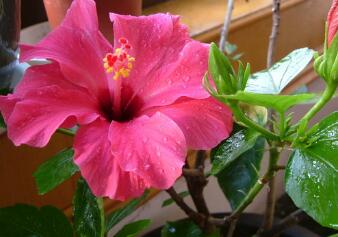
I. How do you grow hibiscus?
1. Watering
In the hot summer when the climate is dry, water once each in the early morning and in the evening every day. In spring and autumn, water once every afternoon. In winter, it depends on the specific condition of the plant: if it overwinters in a greenhouse, water once every 2 to 3 days. If it overwinters in an ordinary room, water once a week. During the growing season, mist the leaf surface regularly to increase the relative air humidity.
2. Temperature
Hibiscus likes warmth and cannot withstand cold. The suitable temperature for growth is 15 to 25°C. When the temperature is 2 to 5°C, its leaves will turn yellow and fall. When the temperature drops below 0°C, the plant will suffer cold damage.
3. Light
Hibiscus is a strongly sun-loving plant. During the growing season it needs to receive ample sunlight, which benefits both its growth and development and its flowering.
4. Fertilizing
During the growing season, apply liquid fertilizer once every 15 to 25 days. During the flowering period, do not apply fertilizer that is too concentrated.
5. Pest and disease control
For leaf spot disease, spray with a 1000-fold dilution of 70% thiophanate-methyl wettable powder. For aphids, use a 1000-fold dilution of 40% omethoate emulsifiable concentrate to kill them. Pest and disease control: for leaf spot disease, spray with a 1000-fold dilution of 70% thiophanate-methyl wettable powder. For aphids, use a 1000-fold dilution of 40% omethoate emulsifiable concentrate to kill them.
6. Pruning
In summer, pruning is usually not needed, otherwise the plant will produce fewer flowers. In autumn, it is only suitable to prune weak branches and diseased or pest-infested branches. When it is moved outdoors in spring, it can be heavily pruned. For each lateral branch, only 2 to 3 buds need to be kept at the base of the stem.
II. What should you do if hibiscus drops flower buds?
1. Improper watering
The soil for growing hibiscus should be kept in a moist state at all times. Even by the time of the next watering, the soil should still be slightly moist. Never wait until the soil has become somewhat dry before watering again, and at the same time there must not be water accumulation or waterlogging. The above situations will not only cause its flower buds to drop, but also cause its leaves to turn yellow over a large area and fall off.
Solution: When watering, you can record the cycle: how many days from watering to the next watering, and when the soil starts to become drier and drier. However, record it once for each season, so you can avoid watering too many times; when watering, also pay attention to how much water is needed to water thoroughly each time, so you can avoid water accumulation or waterlogging.
2. Unsuitable light
Hibiscus naturally likes sunlight. If it is placed in a place without sunlight for a long time, it is very easy for its flower buds to drop, and it will also affect the plant's growth.
Solution: Try to choose a place where sunlight can shine in directly to place the hibiscus. Hibiscus grows best between 20 and 35°C, and it also needs a well-ventilated environment. Add the previous three points, and you will grow very beautiful hibiscus.
3. Improper fertilizing
Hibiscus has a considerable demand for fertilizer. Because it blooms year after year, it needs nutrient support. If nutrients are insufficient for a long time, it is very easy to cause its flower buds to drop.
Solution: Fertilize once every half month. Each time you fertilize, the fertilizer must not be too concentrated. With sufficient fertilizer supply, hibiscus can bloom fuller and more brilliantly, and its leaves will also be greener.
4. Pest infestation
If hibiscus gets red spider mites, it will also drop flower buds. After using pesticide, the flowers will also take a long time to bloom. Usually pay more attention to pest prevention.