How much does a bayberry (Chinese bayberry, Myrica rubra) sapling cost? Detailed planting methods
Because of its tender and juicy flesh, sweet-and-sour taste and rich nutritional value, the bayberry has a wide range of uses and can be processed into foods such as canned goods, jam and candied fruit, making it very popular with many people and in strong market demand. Many growers also want to plant it, so how much does a bayberry sapling cost? How do you plant it?
I. How much does a bayberry sapling cost?
The market price of bayberry saplings varies. Prices change depending on variety, size and place of origin, but in general a bayberry sapling costs about 5-10 yuan each. Bayberry varieties include Mudong, Heitanmei and Dongkui bayberry, among others. The Dongkui bayberry variety has high yield and a high survival rate after planting, and its price is also higher. If cultivated well, a bayberry sapling generally bears fruit in 4-5 years. The flowering period is about April, and the fruit ripens around June-July. After 8 years it enters the full-bearing period, with a yield of 50-80 kg per tree; large trees with high yields can produce 300 or even 500 kg. In general, although the price of ripe fresh bayberries varies with region and quality, under normal circumstances fresh bayberries cost about 10-20 yuan per jin.
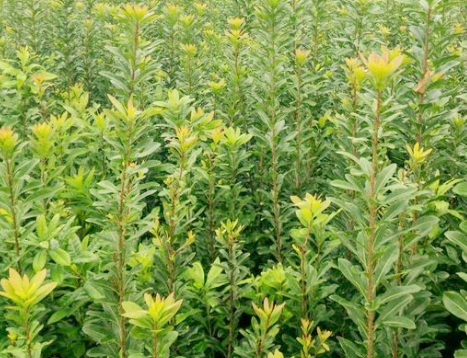
II. How do you plant bayberry?
1. Site selection
Although the bayberry is a fruit tree tolerant of poor soil and can be planted on most plots, if you want to improve its survival rate, the soil is best a slightly acidic soil on a hillside plot with deep, fertile soil layers close to a water source. Note, however, that planting plots need to be distinguished by variety. For example, at an altitude between 400-800 m, it is best to plant mid-to-late-maturing varieties, while below 400 m it is best to plant early-maturing varieties.
2. Planting
The planting time for bayberry saplings is generally best chosen during February-March in spring. This is after the freezing period and before the bayberry begins to sprout, and the temperature is also more suitable for the growth of young trees. In addition, to improve the survival rate of bayberry saplings, you can choose saplings with strong adaptability and strong disease resistance and stress resistance. When planting, pay attention to density; generally 25-30 bayberry saplings can be planted per mu. Since a grown bayberry tree has a large canopy and can reach 7-8 m in height, to ensure the airiness of each tree, when planting you should set the sapling upright and spread out the roots, and planting in large holes is best. In addition, apply enough base fertilizer and pay attention to the proportion of male trees and pollination with good pollen.
3. Fertilizing
To enable bayberry saplings to grow quickly after planting and increase yield, fertilizer and water management is a key step. Besides applying enough base fertilizer during planting, you also need to topdress according to their growth stage. Generally the topdressing fertilizers are mainly plant ash and farmyard manure, plus an appropriate amount of chemical fertilizer and organic fertilizer. Topdressing is done 2-3 times per year, and especially during the fruiting period, potassium fertilizer should be emphasized. In addition, 3-4 months after planting, the bayberry root system will fill the planting hole and hinder its growth. At this time, to benefit root growth, the surrounding soil needs to be deeply turned and loosened.
4. Training and pruning
To encourage the bayberry tree to branch more, form a canopy and bear fruit earlier, training and pruning are needed during the growth period. Specifically, after the bayberry sapling is planted and survives, cut off the top shoot of the trunk to encourage sprouting. After sprouting, keep only the upper buds and remove all the lower buds. This concentrates nutrients and produces thick, strong branches. In the second year, keep 2-3 strong main branches and keep 2-3 new buds on the main branches, so they continue to branch and quickly form a round canopy. While cutting off branches, you can also cut off all diseased, pest-damaged, weak, leggy, dead and crowded branches that hinder the growth of the main branches, to avoid excessive consumption of nutrients.
Summary: The above is an introduction to the price of bayberry saplings and planting methods. I hope it helps friends who need it!