Jerusalem Artichoke (Sunchoke) Planting Methods and 2019 Planting Prospect Analysis
Jerusalem artichoke, also called sunchoke, earth apple, topinambour, five-star grass, and wild sunflower, is a herbaceous plant of the genus Helianthus in the Asteraceae family. Its underground tubers can not only be eaten, but also used medicinally, and can also serve as a raw material for making starch and alcohol. So, how do you grow Jerusalem artichoke? What are its planting prospects in 2019?
I. Introduction to Jerusalem artichoke!
1. What does Jerusalem artichoke look like?
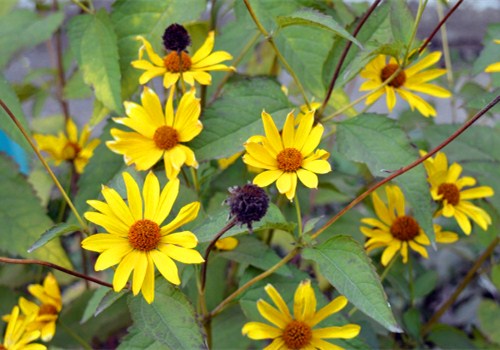
It is a perennial herbaceous plant with a height of 1-3 m. The stem is upright and branched, covered with short white stiff hairs or bristles; the leaves are ovate, ovate-elliptic, broadly lanceolate, or long elliptic, with short white coarse hairs on the upper surface and soft hairs on the lower surface; the flowering period is August-September, with flowers borne singly at the ends of the branches. The flower color is yellow, the bracts are lanceolate, the receptacle scales are oblong, and the ray florets are long elliptic; it has tuberous underground stems and fibrous roots.
2. How do you eat Jerusalem artichoke?
Its underground tubers are edible and can be eaten raw, stir-fried, boiled, or sliced and deep-fried, and can also be pickled into pickles or made into sunchoke preserves; in addition, its tubers, stems, and leaves can be made into silage to feed rabbits, pigs, sheep, donkeys, horses, and so on.
II. How do you grow Jerusalem artichoke?
1. Soil: It has low requirements for soil.
It tolerates poor soil and has low requirements for soil. Except for acidic soil, swamps, and saline-alkali land, where it is not suitable for planting, it can grow in other soils, such as ruins, around houses, and roadsides.
2. Sowing: Sow after the soil thaws in spring.
Generally, sowing is done after the soil thaws in spring. Tubers weighing 20-25 grams can be selected for sowing, requiring 50 kg of tuber seed per mu, with a plant spacing and row spacing of 0.5×0.5 m and a sowing depth of 10-20 cm. Seedlings emerge about 30 days after sowing.
3. Temperature: It can withstand low temperatures but must not be exposed above ground.
It has extremely strong cold resistance and can withstand temperatures of -40°C or even lower, but note that its tubers must be under sandy soil, covered with at least 1 cm of sandy soil, and must not grow exposed; in early spring, seedlings can endure light frost, and in autumn, mature leaves can endure short-term temperatures of -4 to -5°C. A temperature between 18-22°C and 12 hours of light are favorable for tuber formation.
4. Watering: Sufficient moisture can increase yield.
It is very drought-tolerant, but sufficient moisture can greatly increase yield. The seedling stage, jointing stage, budding stage, and tuber expansion stage are the 4 key periods for watering, with watering times in mid-April, late May, mid-August, and mid-October respectively; in years with normal rainfall, if there is no severe drought, watering is generally not needed. If there is a continuous summer-autumn drought, 1 budding-stage watering should be given in mid-to-late August.
5. Fertilizing: Sufficient nutrients can increase yield.
Although it tolerates poor soil, sufficient nutrients can increase yield; in the year before sowing, sufficient base fertilizer should be applied. Generally, in autumn, the land is prepared and 5000 kg of farmyard manure and 15 kg of potassium sulfate are applied per mu; during the growing period, fertilizer needs to be topdressed twice, in late May and at the early budding stage. For the former, 10 kg of urea is topdressed per mu, and for the latter, 15 kg of potassium sulfate per mu is sufficient.
6. Replanting, weeding, intertillage, and bud removal
Generally, seedlings emerge about 30 days after sowing. After emergence, replanting should be done promptly, and weeding should be done once during replanting; 30-40 days after sowing, carry out intertillage and loosening of the soil, and weed once while loosening the soil; before budding, carry out intertillage and loosening of the soil, and weed once while loosening the soil; during the tuber expansion stage, remove flowers and buds to promote tuber expansion.
7. Harvest: Harvest in early October.
Jerusalem artichoke has extremely strong regenerative capacity and can reproduce continuously after one planting; by early October, its leaves and stems are completely killed by frost, and the underground tubers can then be harvested; after harvesting, tubers remain in the soil, so it does not need to be sown again the following year.
III. What are the planting prospects for Jerusalem artichoke in 2019?
1. The underground tubers of Jerusalem artichoke are rich in various substances, and their texture is white, fine, crisp, and tender. They can be eaten raw, stir-fried, boiled, or sliced and deep-fried, and can also be pickled into pickles or made into sunchoke preserves. They are a superior raw material for making green foods; its tubers, stems, and leaves can all be used medicinally, with effects of clearing heat and cooling blood and setting bones, and can treat febrile diseases, intestinal heat with bloody diarrhea, bruises and bone injuries, and other conditions.
2. The stems, leaves, and root tubers of Jerusalem artichoke can be used as high-quality silage and can be used to feed rabbits, pigs, sheep, donkeys, horses, and so on. Its yield is very high, it can reproduce continuously after one planting, and its annual multiplication rate can reach 20 times. If you want to develop the breeding industry, planting this can solve the feed problem. In addition, it plays a positive role in windbreak and sand fixation and soil improvement.
3. Jerusalem artichoke can be ground to obtain Jerusalem artichoke powder, which is rich in inulin. This is a natural functional edible polysaccharide with the physiological functions of water-soluble dietary fiber and bioactive precursors, and has been widely used in low-calorie, low-sugar, and low-fat foods. Through enzymatic hydrolysis, it can directly produce high-purity fructose.
Jerusalem artichoke has been called by officials of the United Nations Food and Agriculture Organization a “crop for both humans and livestock in the 21st century.” It is now cultivated in most regions of China, and market demand for it is limited, but this does not mean its prospects are poor; as people pay more attention to health and Jerusalem artichoke deep-processing technology continues to develop, demand for it will continue to expand, and its market prospects are still very good.