How to grow lotus so it thrives? A detailed guide to the planting method
"The lotus leaves stretching to the horizon are endlessly green; the lotus flowers reflecting the sun are a distinctive red." This is what describes our beautiful lotus. The lotus grows in water, and most parks plant some so everyone can enjoy them. The lotus root beneath the lotus is also edible. Among flowers, the lotus counts as a very good cash crop. Below, the editor will explain the lotus planting method, so take a look together.
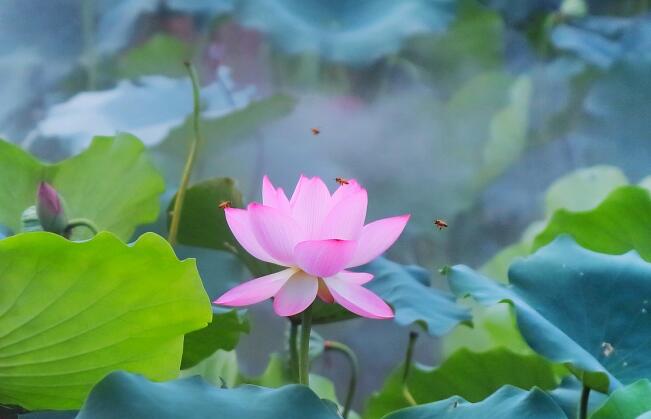
1. Site selection
The lotus is a plant that grows in water. We need to choose to plant it in a pond. When planting, the water flow does not need to be too strong, and its water level must be kept stable. When we plant lotus, the requirements for water quality are not high; as long as it is not dirty water or seriously polluted water, lotus can be planted.
2. Care and management
1. Although lotus does not have high requirements for water quality, we must always pay attention to changes in this water. If changes in water quality appear, they need to be dealt with promptly to prevent the lotus from rotting and dying, which would ultimately affect our returns.
2. While planting lotus, we also need to promptly remove the surrounding weeds so they do not affect the growth of the lotus. We can spray herbicide once a month, and also remove the algae and water moss and other aquatic plants on the water surface.
3. When the lotus leaves have grown to about five, we should carry out the first tilling. After that, we should till again every fifteen days, tilling several times in succession, until the lotus rhizomes fill the entire pond.
3. Water management
The lotus needs different amounts of water during its growth process. When it has just started growing, it needs shallower water; in the middle stage of growth, it needs a bit more water; in the later stage, it does not need too much water. The pond water only needs to be kept within 1.5 m.
4. Timely fertilization
1. Fertilizing while the lotus is growing is essential work. We can fertilize once before planting, which can promote the growth of the lotus.
2. We can apply about 3,000 of organic fertilizer per mu of land, and appropriately apply some phosphorus and potassium fertilizer as base fertilizer. When fertilizing, during the seedling stage it needs light application; per mu of land, 10 kg of nitrogen fertilizer and 30 kg of phosphorus and potassium fertilizer can be applied.
3. When the flower buds emerge, it needs heavy application; per mu of land, 20 jin to 30 jin of nitrogen fertilizer and 70 jin of phosphorus and potassium fertilizer can be applied. When the lotus sets fruit, it needs frequent fertilization, applying a top dressing once every half month or so.
All right. The above is the lotus planting method brought to you by the Tuliu.com editor. I do not know whether everyone has learned it. I hope this article of mine can help you. See you next time.
Is the Epiphyllum oxypetalum (orchid cactus) poisonous?
Is the orchid cactus poisonous? The orchid cactus has a certain cold resistance, comes in many varieties, and its flower colors are bright and colorful! The orchid cactus blooms in midsummer, beautiful and delightful! Is the orchid cactus poisonous? The editor will introduce information on whether the orchid cactus is poisonous through this article!
Is the orchid cactus poisonous?
The answer is that it is not poisonous! The orchid cactus has flat, lance-shaped stems that resemble a command arrow, and flowers like a water lily, hence the name orchid cactus. It is a clustered shrub form, about 50-100 cm tall. It likes light and a well-ventilated environment, but under hot, high-temperature, dry conditions it should be properly shaded, and it fears rain. It requires fertile, loose, well-drained soil and has a certain drought resistance. It originated mainly in Mexico, where it is most abundant; in our country it is mainly grown in pots. The orchid cactus has many flower color varieties, and the flowers are brilliantly colored.
How to grow the orchid cactus
Generally speaking, the orchid cactus is mostly potted, and here we can use the cutting method. In early spring, in March or April, we cut off a section of the orchid cactus stem as a cutting, then insert the bottom third into prepared thin mud and sand, spray a little water appropriately every day, and after about one month in succession it can roughly take root. We can also use grafting. The grafting method for the orchid cactus is generally cut grafting. We first choose a cactus with good growth as the rootstock, then make a cut on it, and insert the orchid cactus stem section into the cut, preferably inserting it firmly, then tie the joint with a wet cloth strip. After the joint slowly grows together, the wet cloth strip can be loosened.
The good growth of the orchid cactus is inseparable from our usual care work for it. The orchid cactus is a plant that likes light but is not cold-resistant, so we should usually let it receive plenty of sunlight. However, note that although it likes light, it fears sunburn, so shading work in summer is still necessary. If the orchid cactus we grow only grows leaves and does not bloom, then it is very likely caused by insufficient sunlight.
During the growth period of the orchid cactus, our fertilizer and water care work must be done well. On average, apply liquid fertilizer or thin fertilizer once every half month. If you find that the plant has already formed buds, then take the opportunity to apply phosphorus fertilizer once to prompt the orchid cactus to bloom larger, more colorful flowers. When fertilizing, note that if the fertilizer and water are too abundant, many small side shoots will grow on the stems. At this time, do not feel reluctant; the earlier these side shoots are removed, the better, otherwise they easily rob the nutrients of the main flowering stems, and after the side shoots grow larger they also affect the overall appearance. After fertilizing, remember to water; fertilizer diluted by water is more conducive to absorption by the rhizomes. Usually, watering until half dry and half wet is enough, to avoid water accumulation and root rot. When the weather is dry, you can separately spray some water on the flower stems of the orchid cactus. In winter, water and fertilizer can be omitted.
In addition, the best growing temperature for the orchid cactus is 15 degrees; being a little lower or a little higher is not a big problem, but if it is too high or too low, it will affect its growth. Either many abnormal stems grow, or the buds are frozen to death, so the temperature should also be controlled as much as possible. Finally, if the orchid cactus is grown indoors, the indoor air circulation must also be ensured.
The orchid cactus is not poisonous. Flower lovers who like flowers can boldly try growing some orchid cacti to cultivate their character; it is also pleasant to look at them. Is the orchid cactus poisonous? The answer is definitely that it is not poisonous! People who understand the growth habits of the orchid cactus all know this! The orchid cactus is not poisonous. Let us popularize some basic knowledge of flower growing for everyone!
A few experiences on getting the orchid cactus through summer
A few experiences on getting the orchid cactus through summer. I have grown orchid cacti for several years, but I feel I have not grown them very well, especially because summer care is difficult. Often the growth is delightful in spring, but by summer the leaves lose water and shrivel, soft and listless, and in autumn the growth recovers very slowly, seriously affecting the next year's blooming. In severe cases, they cannot recover vitality in autumn, and instead further shrivel into a paper-like state, making rescue very difficult.The main reason, on investigation, is excessive concern, as the saying goes, "Loving it too much is just enough to harm it." This year I improved some methods, and there were some results: the leaves lost less water and were very firm, and I estimate that after the autumn cool they will quickly begin to grow. I have a few experiences, mostly inspired by other people's practices, and I do not dare keep them private, so I bring them out here for all friends who like orchid cacti to take a look.
1. Watering and spraying
This is the point I focused on improving this year. Previously, books said that in summer one could water and spray more, while other books said to restrict watering and spray more, but it seems this must be grasped in combination with temperature and ventilation conditions, and in fact it is also very hard to grasp well. In summer, especially in the north, the highest temperature is often above 30, and the temperature difference is small. The photosynthetic capacity of the orchid cactus drops to a low point, and its need for water declines accordingly. At the same time, root vitality is insufficient, so more watering cannot be absorbed; the result can only be the opposite, with root rot and shriveled leaves. (I have not studied plant physiology, so this is just my assumption.) Thinking back to the days when the orchid cactus was in its hometown, floating high in the trees, with its roots tucked into small tree holes, although it rained quite a lot in summer, it was never flooded, and, most importantly, having lived in its hometown for a long time, how could it have endured the heat here! My method is: keeping it moist is enough; it must not be watered through. When it looks dry, sprinkle a little water, and then leave it alone. As for spraying, that is also omitted at the same time. Summer has many muggy days, and spraying more easily leads to leaf rot.
2. Fertilizing
It should stop at the end of May. The same principle as watering. If it cannot absorb it, fertilizing is very frightening. I estimate that fertilizing can only begin at the end of August.
3. Ventilation
Watering a little more is not the most fatal thing; as long as ventilation is good, the harm caused by too much water will be greatly reduced. On the contrary, restricting watering while ventilation is poor is also of no help. Therefore, place the orchid cactus in a naturally ventilated spot as much as possible; if unavoidable, an electric fan can be used. All plants originate in nature, and only by creating their native natural environment as much as possible will the plants grow well. Natural wind is irreplaceable. But be careful of rain. If heavy rain soaks it and then a strong sun scorches it, even a grass ball cannot survive.
4. Sunlight
There is no need to shade too much. As long as watering is restricted and ventilation is maintained, a little more sun is no problem, and even at very high temperatures burns rarely occur. My two pots of orchid cactus have always been at the east window, with about 3 or 4 hours of sunlight each day, and there are also a few small seedlings at the south window, and it appears none have been affected by strong sunlight.
By the way, the soil must use larger granules, use a bit more leaf mold, sift out the powdery part, and add coal cinder or crushed brick or coarse sand, or add a little of each.