How much does a dawn redwood sapling cost? 2019 prices and propagation methods introduced
The dawn redwood is an ancient giant tree with very strong adaptability, and it is distributed in some areas of southern China. The dawn redwood has high application value because its wood is very light and soft, making it suitable for papermaking and use as building boards. The dawn redwood also has a very imposing appearance, making it suitable for planting in courtyards for everyone to admire. If you want to grow dawn redwood yourself, you first need to buy dawn redwood saplings, so how much did a dawn redwood sapling cost in 2019? How is it propagated?
I. How much did a dawn redwood sapling cost in 2019?
The 2019 price of dawn redwood saplings varies depending on factors such as market price, height, diameter at breast height, and purchase quantity. For example, dawn redwood saplings with a height of 100-130 cm cost about 2.5 yuan each. Generally speaking, the larger the diameter at breast height, the more expensive the dawn redwood sapling. In previous years, those smaller than 2 cm cost about 0.5-1 yuan each, those larger than 2 cm cost 2-4 yuan each, 5 cm saplings could reach 30 yuan each, and 20 cm ones were even more expensive, possibly around 600-800 yuan each. For specifics, you can negotiate with people at the nursery stock market.
When selecting dawn redwood saplings, you need to pay attention to several points to ensure the economic benefits of planting:
First, pay attention to whether the area is suitable for the growth of dawn redwood saplings and whether it conforms to their growth habits, otherwise it will be difficult for them to survive;
Second, high-quality dawn redwood saplings must meet the specified standards in both diameter at breast height and height, have well-developed root systems, with many lateral roots and fibrous roots distributed evenly, and roots that have not lost water;
Third, pay attention to whether the dawn redwood saplings are damaged during transportation;
Fourth, choose dawn redwood saplings that have not been attacked by pests or diseases, have smooth branches, and have relatively good maturity;
Fifth, pay attention to the water content of the dawn redwood saplings, and choose saplings with fresh bark, little water loss, and no wrinkled bark.
II. How are dawn redwood saplings propagated?
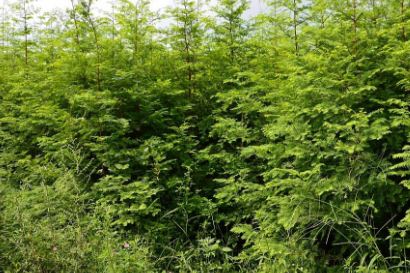
The propagation methods for dawn redwood saplings can be divided into two types: cutting and seed sowing. Let us look at the specific processes below:
1. Cutting propagation
Cutting propagation can be divided into softwood cuttings and hardwood cuttings, and there are still certain differences in timing and specification handling:
The time for softwood cuttings is from May to June, while for hardwood cuttings, branches are collected in January and then cutting propagation is carried out in mid-March.
For softwood cuttings, generally semi-lignified young branches about 14-20 cm long with 5 leaves retained at the top are selected as cuttings. After early cutting, attention should be paid to sun protection, and the soil and water should be kept moist and the environment ventilated. For hardwood cuttings, generally cut branches about 10-15 cm long are selected as cuttings, then tied into bundles and placed in sandy soil for softening. During this period, attention should be paid to keeping the soil and water moist and the air temperature and humidity suitable.
2. Seed propagation
Select mature dawn redwood cones, expose them to the sun, then screen out qualified seeds and store them sealed in a dry environment. After March in spring, when the temperature rises, sowing can be carried out, and after sowing, the soil and water should be kept moist.
[Dawn redwood sapling pictures] Dawn redwood tree price list
Content introduction: The dawn redwood tree, also known as the water cyathea tree, although the plant belongs to tree plants, can survive directly in clear water. The dawn redwood tree is a protected plant in China and a species unique to China, so the price of a single dawn redwood tree goes without saying.
[Dawn redwood tree price list]
Dawn redwood saplings, according to different propagation methods and market demand, can be divided into seedling-grown saplings and grafted saplings. Seedling-grown saplings can be directly used for cultivating young trees, while grafted saplings, as the name suggests, are used for graft propagation. Relatively speaking, the price of seedling-grown saplings is also higher than that of grafted saplings.
Seedling-grown saplings: The dawn redwood tree is a first-class internationally protected plant, and a small sapling 2 cm long costs about 7 yuan; a small sapling 3 cm long costs 13 yuan, while the largest 80 cm seedling-grown saplings sold on the market can reach around 100,000.
Grafted saplings: Grafted saplings can be directly propagated by cuttings, and their price is also lower than that of seedling-grown saplings. The grafted small saplings sold on the market range in height from about 10-40 cm, and their price range is between 160-9000 yuan.
Factors affecting price: The price of dawn redwood saplings is judged according to variety, growth condition, climatic conditions, and seed quality. Second, the most important factors affecting the price of dawn redwood trees are market conditions and consumer demand. In the second half of 2015, the price of dawn redwood seedlings was about 5 yuan, and for those more than 3 years old, the price difference among small saplings gradually becomes larger.
[Complete collection of dawn redwood sapling pictures]
Fast growth is one of the advantages of dawn redwood saplings, but the performance of the saplings in the young stage is extremely obvious. Once the tree age exceeds 15 years, its growth rate doubles, and before the tree age reaches 50, the tree shape increases by about 80 cm on average each year. Later, after the tree age exceeds one hundred years, the growth rate is about 50 cm, and it gradually declines afterward.
Sapling sowing
The sowing time for dawn redwood saplings is in spring, and the suitable planting temperature is about 25 degrees Celsius. During the sowing period, the temperature that the tree species can tolerate should not be lower than 12 degrees Celsius.
Sapling yield
The propagation capacity of dawn redwood saplings is not strong, and the success rate of seed propagation is less than 50%, so dawn redwood trees are decreasing year by year. The domestic planting areas with the highest sapling yields are the two cities of Sichuan and Wuhan.
Sapling density
The propagation of dawn redwood saplings is suitable for large-area planting, and on average, more than ten thousand dawn redwood trees can be planted per mu. The sapling density can be changed according to later transplanting needs. During the transplanting period, dawn redwood saplings can maintain a spacing of about 3 m. After they grow for 15 years, a thinning operation is needed once, mainly to concentrate nutrients, which is beneficial to the propagation of high-quality seedling-grown saplings.
Sapling diseases
Although propagation of dawn redwood saplings is unfavorable, mastering professional knowledge of pest and disease prevention can increase the survival rate of the saplings. The most common disease is mainly yellowing leaves. If the disease is severe, it will directly cause leaf drop, and the tree will also emit a foul odor and feel sticky to the touch. Bordeaux mixture or carbendazim liquid can be sprayed, and both have very strong control effects.
Summary: The above mainly introduces content related to dawn redwood saplings, providing detailed explanations on two major aspects: pictures and prices of dawn redwood trees, and planting methods. We hope it can be helpful to you.
Dawn redwood seedling cultivation techniques
Dawn redwood (Metasequoia glyptostroboides Hu et Cheng) belongs to the genus Metasequoia in the family Taxodiaceae. It is a deciduous tree native to China. Because its crown is conical, its posture is graceful, its leaf color is beautiful, and its autumn leaves turn brown, it is an important tree species in landscaping. Applying the cutting propagation method is the most effective way to solve resource shortages and accelerate the construction of dawn redwood forests, and it is also a feasible and practical seedling cultivation technique for expanding dawn redwood propagation. Starting in 2001, winter cutting seedling cultivation research was carried out in the ecological garden of our institute, with remarkable results.
1 Overview of the experimental site
The experimental site is located in Greenhouse No. 1 in the Ecological Garden (total area 133 hm2) of the North Campus of Eastern Liaoning University, with an area of 400 m2, insulated with straw curtains, and no shading needed in winter. Tap water is controlled through underground pipes. The cutting bed is located in the greenhouse, running north-south, 5 m long and 1.2 m wide, enclosed with bricks. The bricks surrounding the cutting beds serve as walkways. First dig down 20 cm, then spread 7~10 cm of fully decomposed organic fertilizer to provide nutrient supply for seedlings after rooting. Then spread 8~10 cm of newly excavated mountain rock weathering material (iron plate sand) as the cutting substrate. Mountain rock weathering material contains almost no pathogenic bacteria and does not need disinfection. Its water permeability and water retention are both good, and its chemical properties are stable, which is beneficial to seedling rooting.
2 Cutting seedling cultivation methods
Experimental research shows that in one year, the effective seedling growth time for dawn redwood cutting seedling cultivation reaches 280~300 d in a solar greenhouse, while outdoors it is only 200 d, a difference of 80~100 d. The individual cutting, its position, tree age, degree of lignification, and the size of the lower cut all have a close relationship with the seedling survival rate.
21 Cutting time
In mid-to-late December, in combination with winter shaping and pruning of mature dawn redwood trees, cutting propagation can be carried out when the air temperature in the solar greenhouse is above 15°C and the 10 cm soil temperature is above 10°C.
22 Preparation of cuttings
Collect the branches pruned from mature trees during shaping and pruning, cut cuttings (1~2-year-old branches), and process them at any time and insert them at any time. The cuttings are 6~10 cm long, with no strict requirements on thickness. The cut should be smooth and neat, and the cuttings should be kept as straight as possible. The lower cut is best made flat and even, and the slanted surface should not be too large, so as to facilitate the formation of callus tissue and rooting. The buds of dawn redwood are perpendicular to the branches and often grow below the branch scars at the abscission points, making it very difficult to distinguish the inverted or upright direction of the cuttings. Therefore, after cutting the cuttings, they should be arranged neatly and their direction marked to avoid inverted insertion.
To facilitate seedling-stage management after cutting, store and insert separately according to the degree of lignification, thickness, and whether they have a heel. After the cuttings are cut, first seal the upper cut of the cutting with melted wax. The wax sealing must be tight to reduce water loss and avoid infection of the cut, and then cutting can be carried out.
23 Cutting
First use a pointed wooden stick slightly thicker than the cutting to make holes at a spacing of 3 cm × 4 cm and 6~8 cm deep. Then insert the cuttings into the holes and press firmly. After insertion, the depth is 5 cm. After inserting, water promptly with a watering can. The water should soak through, but not too much, so that the cutting substrate in the seedling bed fully contacts the cuttings, and the cuttings should be straight.
24 Management after cutting
After the cuttings are inserted, the air temperature in the greenhouse should be controlled at 15~25°C. If the temperature is too low, they will not root, and if the temperature is too high, rooting will be inhibited. The 10 cm soil temperature should be kept above 10°C, and the relative humidity should be controlled at about 80%. According to weather conditions and indoor temperature and humidity, water thoroughly about once every 10 d. At ordinary times, spray water on the leaf surface to lower the temperature.
Dawn redwood roots relatively slowly. After 30~45 d, the winter buds of the cuttings begin to sprout, leaves emerge, and new shoots extend, but this is still "false life," and care should be taken in maintenance. They truly root only after 2 months. In February, the leaves gradually unfold and the base of the cuttings swells. In early April, rooting gradually begins, and the general rooting rate can reach more than 95%. Cuttings with a high degree of lignification have sufficient soluble sugar in the branches, strong superoxide enzyme activity, early healing of the lower cut, and faster rooting; cuttings with a low degree of lignification are thin, weak, and tender, and after cutting are prone to lodging and rotting, have strict requirements for temperature, humidity, and moisture, are difficult to manage, and root more slowly. Cuttings whose upper cuts are tightly sealed with wax almost do not develop cut infection, the cuttings grow normally, and stress resistance is strong. Cuttings with flat and even lower cuts have small cuts, fast wound healing, early rooting, and a high rooting rate. Although some cuttings have already healed at the cut, they do not grow roots for a long time. They can be transplanted to a seedling bed with good air permeability and with strictly controlled temperature and humidity, and most of them can also root.