Bowl Lotus Seed Planting Method and Tips for Telling Real from Fake
Bowl lotus is also called pot lotus, basin lotus, or table lotus. It is one of the smaller types of lotus, especially suitable for growing in pots at home, and it can also be planted on a large scale in parks and courtyards, with high ornamental value. Bowl lotus flowers are very brightly colored, the flowering period is relatively long, and its ability to adapt to the environment is very good, so it is deeply loved by flower lovers. To grow bowl lotus, besides directly buying seedlings, you can also buy bowl lotus seeds for planting, but it is a bit more complicated. So what is the planting method for bowl lotus seeds? How do you tell real from fake?
1. What is the planting method for bowl lotus seeds?
1. Seed treatment
(1) Breaking the seed coat: Because bowl lotus seeds are very hard, especially after they mature, they enter dormancy. Unlike other seeds, even if buried in the ground they will not rot, and even after a thousand years they will not germinate. So if you want to use seeds to grow bowl lotus, you must break the shell first, and only in a suitable environment will germination occur.
The specific method for breaking the shell is to first rub the concave side of the bowl lotus seed on the ground until the seed coat is worn through. Of course, you can also use clippers to crack it open, so you must be very careful when doing this to avoid damaging the embryo.
(2) Soaking the seeds
After the seeds have had their shells broken, you can put them in a container and soak them in clean water until they sprout. If the temperature is too low, soak them in warm water, and change the water twice every day, generally in the morning and in the evening. After about 3-5 days, they will sprout.
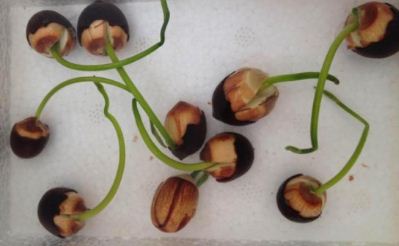
2. Water culture
The common method for growing bowl lotus is water culture, so after the bowl lotus seeds sprout, you can carry out water culture for one week. At this time, no extra fertilizer is needed, because the seed embryo can provide nutrients. At this stage, the bowl lotus seeds should be at a water depth of about 10 cm, and then given sufficient light. When transplanting, the movements should be gentle to avoid breaking the young shoots. At this time, do not water too much; keep the water temperature stable.
3. Flowering
Bowl lotus grows quickly. As long as the planting method is correct and it is kept in sunlight for a long time, it will bloom as expected; it is just that different varieties bloom at different times, some earlier and some later.
Note: If you are growing bowl lotus from seeds, the step of breaking the shell must be done well. Do not damage the embryo, otherwise it will die and will not be able to bloom.
2. How do you tell real bowl lotus seeds from fake ones?
Many friends do not know how to tell real from fake when buying bowl lotus seeds, because its seeds are very similar to vegetable lotus. If you try to distinguish them by the young shoots they send out, it is very difficult. Only after planting and growing into a lotus can you distinguish them well. However, some friends have still summarized the following points:
First, when buying bowl lotus seeds online, look at where they are shipped from. If they are from places such as Suqian or Muyang, most are fake, though the specific situation should be analyzed case by case; this is only a summary of netizens' experience.
Second, if the price is very cheap, they are generally vegetable lotus seeds; bowl lotus seeds are a bit more expensive.
Third, if the pictures show many varieties and very rich colors, they may also be mixed with vegetable lotus.
Summary of the reasons why bowl lotus does not bloom
Bowl lotus is a perennial aquatic herbaceous flower in the lotus family. After bowl lotus blooms, its ornamental value increases greatly, but many flower lovers find that the bowl lotus they grow just will not bloom. In fact, bowl lotus is generally grown from seed lotus roots, and the lotus roots of bowl lotus are usually very small. The editor will now introduce several reasons why bowl lotus does not bloom.
Bowl lotus
Three reasons why planting with seed lotus roots does not bloom:
First, insufficient light. Bowl lotus is a strongly sun-loving plant. When growing bowl lotus, it should be placed in an open area or on a balcony under full light, with no less than 6 hours of light per day. If you do not have light conditions, it is recommended not to grow it.
Second, improper fertilization. In the early stage, bowl lotus should be given nitrogen fertilizer so that the branches and leaves can become thick and strong. In the later stage, phosphorus and potassium fertilizers should be given to promote flower bud differentiation. Some flower lovers apply too much nitrogen fertilizer, and the lotus leaves are indeed very beautiful, but not a single flower can be seen.
Third, the pot soil is too dense, affecting runner growth. Some growing experiences online say to put two lotus roots in one pot. I think the bowl lotus pot is small, and the space for one lotus root to grow is already small enough. Two lotus roots growing will strangle each other, the pot soil will be tightly wrapped and bound by fibrous roots, and the bowl lotus runners will be unable to grow, making it even harder to form flower buds.
Now for the case of being not true to type. Being not true to type means growing from lotus seeds; bowl lotus propagated from lotus seeds will show a certain degree of variation. I once read in a book that the flowering rate of bowl lotus seeds is 70 percent. Generally, bowl lotus sown in April, May, and June that does not bloom that year should, if you want to keep it the next year, definitely be moved to a larger pot for growing. Generally, those that do not bloom are discarded the next year.
What was said above is about real bowl lotus seeds. Now for fake bowl lotus seeds. So-called fake seeds are actually the seeds of pond lotus (detailed introduction). Their appearance is not much different from bowl lotus seeds, and the planting process is the same too. It is just that this kind of seed planted in a bowl lotus pot will 100 percent not bloom, and you can only enjoy the leaves. And if you ask the seller, the seller will still argue righteously: growing from seeds is originally not 100 percent flowering. Since it is impossible to judge whether seeds are real or fake, I can only tell you that expensive ones are not necessarily real, but very cheap seeds are 100 percent fake, because the cost is there.
Reasons why bowl lotus does not bloom (experience)
Flower lovers often ask me why the bowl lotus they grow does not bloom. I will roughly analyze it here. This is purely personal experience and I hope it can give everyone some help. First, the case of being true to type. Being true to type means growing from seed lotus roots, which can preserve the excellent qualities of the variety. The lotus roots of bowl lotus are generally very small, only about the thickness of a finger. I have heard that some sellers on Taobao pass off the runners of pond lotus as seed lotus roots. This kind of fakery is too obvious, and most people can see through it, so I estimate it has no market.As far as I know, there are three reasons why planting with seed lotus roots does not bloom
First, insufficient light. Bowl lotus is a strongly sun-loving plant. When growing bowl lotus, it should be placed in an open area or on a balcony under full light, with no less than 6 hours of light per day. If you do not have light conditions, it is recommended not to grow it.
Second, improper fertilization. In the early stage, bowl lotus should be given nitrogen fertilizer so that the branches and leaves can become thick and strong. In the later stage, phosphorus and potassium fertilizers should be given to promote flower bud differentiation. Some flower lovers apply too much nitrogen fertilizer, and the lotus leaves are indeed very beautiful, but not a single flower can be seen.
Third, the pot soil is too dense, affecting runner growth. Some growing experiences online say to put two lotus roots in one pot. I think the bowl lotus pot is small, and the space for one lotus root to grow is already small enough. Two lotus roots growing will strangle each other, the pot soil will be tightly wrapped and bound by fibrous roots, and the bowl lotus runners will be unable to grow, making it even harder to form flower buds.
Now for the case of being not true to type. Being not true to type means growing from lotus seeds; bowl lotus propagated from lotus seeds will show a certain degree of variation. I once read in a book that the flowering rate of bowl lotus seeds is 70 percent, and in my own experiments it was about the same. Generally, bowl lotus sown in April, May, and June that does not bloom that year should, if you want to keep it the next year, definitely be moved to a larger pot for growing. I discard those that do not bloom the next year.
What was said above is about real bowl lotus seeds. Now for fake bowl lotus seeds. So-called fake seeds are actually the seeds of pond lotus. Their appearance is not much different from bowl lotus seeds, and the planting process is the same too. It is just that this kind of seed planted in a bowl lotus pot will 100 percent not bloom, and you can only enjoy the leaves. And if you ask the seller, the seller will still argue righteously: growing from seeds is originally not 100 percent flowering. Since it is impossible to judge whether seeds are real or fake, I can only tell you that expensive ones are not necessarily real, but very cheap seeds are 100 percent fake, because the cost is there.