How much does a mulberry sapling cost per plant, and when is the best time to plant it?
The mulberry tree is the fruit tree that bears mulberries, and in some regions mulberry leaves are used to feed silkworms; that is because different tree varieties serve different purposes. What the market generally calls a mulberry tree today refers to the fruit tree grown for its mulberries. Mulberries have the effects of nourishing yin and enriching the blood, tonifying the liver and kidneys, and promoting fluid production to quench thirst. The market price is generally around 40 yuan, so growing mulberry trees is still quite promising. So how much does a mulberry sapling generally cost per plant? And when is the best time to plant it?
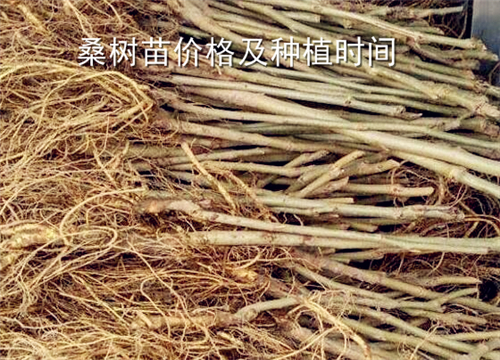
I. Introduction to the Mulberry Tree
1. What are the main varieties of mulberry?
The main variety of mulberry is the Lu mulberry (Morus alba 'Lu'), whose leaves are large and thick. It is cultivated in Jiangsu, Zhejiang, Sichuan and Shaanxi in China, among other places.
2. Where are the main production areas of mulberry distributed?
The main production areas of mulberry are distributed in central and northern China, in all provinces and regions from the northeast to the southwest, and in the northwest as far as **, where it is cultivated.
3. What are the growth habits of the mulberry tree?
(1) Temperature requirements: it prefers a warm and humid climate and is slightly shade-tolerant. It begins to sprout when the temperature is above 12 degrees, and the suitable temperature for growth is 25-30 degrees.
(2) Soil requirements: it has strong adaptability to soil.
(3) Other requirements: it is drought-tolerant, not tolerant of waterlogging, and tolerant of poor and thin soil.
II. How much does a mulberry sapling generally cost per plant?
The price of mulberry saplings is mainly determined by the size of the seedling. If the seedling is relatively tall, the price will naturally be a bit higher; if it is a one-year-old seedling, the price will be a bit lower. The price of mulberry saplings on the market is generally in the range of 3-12 yuan. Another most important factor is the variety; different varieties also make the price of mulberry saplings differ. The latest prices are compiled for you as follows:
1. According to 1688.com, the latest price of chicken mulberry (Morus australis) saplings is around 12-20 yuan per plant; the latest price of fruit mulberry saplings is around 3.2-78.4 yuan per plant; the latest price of courtyard fruit mulberry saplings is around 3 yuan per plant; the latest price of Taiwan long-fruit mulberry saplings is around 6-78 yuan per plant. This mainly depends on the seedling age to determine the price: 1-year seedlings 4-6 yuan, 2-year seedlings 8-10 yuan, 3-year seedlings 12-15 yuan, 4-year seedlings 20-25 yuan, 5-year seedlings 40-45 yuan, 6-year seedlings 80-100 yuan.
2. According to the China National Treasury Network, the latest price of high-quality mulberry saplings is around 30 yuan per plant; the latest price of Taiwan super long-fruit mulberry saplings is around 20 yuan per plant.
3. According to the Northwest Nursery Stock Network, the latest price of 1 cm mulberry saplings is 0.3 yuan per plant, 2 cm mulberry saplings 3 yuan per plant, 8 cm mulberry saplings 70 yuan per plant, 10 cm mulberry saplings 100 yuan per plant, and 12 cm mulberry saplings 180 yuan per plant.
4. According to Baidu Procurement Network, the latest price of Taiwan long-fruit mulberry saplings is 8 yuan per plant; the latest price of high-quality mulberry saplings is 4 yuan per plant.
The above latest prices are for reference only.
III. When is the best time to plant mulberry?
The planting time for mulberry mainly depends on whether you are planting with mulberry saplings or with mulberry seeds; these two differ somewhat in planting time. The specific planting times are as follows:
1. Planting time for mulberry saplings: generally the period from December to March of the following year is the best time to plant mulberry saplings.
2. Planting time for mulberry seeds: the best sowing time is February-May and August-October each year. Mulberry seeds sown during this period have the highest germination rate and grow best. Following the 4 steps below can increase the seed germination rate.
(1) Select top-quality, plump mulberry seeds.
(2) Choose land with plenty of sunlight and a good drainage system for sowing.
(3) Prepare the land, remove weeds, apply fertilizer and water in advance.
(4) Keep the sowing depth at about 2-3 cm.
The above is an introduction to the planting time of mulberry.
Summary: The above content is an introduction to the price of mulberry saplings and the planting time, and we hope it can help grower friends who need it. This article is compiled from the Internet.
How to plant mulberry saplings_Explanation of mulberry seedling-raising techniques
Content summary: The mulberry tree, recorded in the mulberry family (Moraceae), is native to China and mostly distributed in the central and northern regions; it is a deciduous small tree variety. What this article will introduce to you next is: how to plant mulberry saplings? And an explanation of mulberry seedling-raising techniques.
[Mulberry sapling seedling-raising techniques]
The raising of mulberry saplings can be divided, according to their propagation methods, into three methods: seed seedling-raising, grafting seedling-raising and layering seedling-raising. Details are as follows:
▍Seed seedling-raising
Seed collection: when the fruit is ripe, purple mulberry fruits can be harvested; simply strip off the outer flesh, rub repeatedly, then rinse with water to completely separate the small seeds from the flesh, and they can be used directly for sowing.
Seed treatment: the best sowing time for mulberry is spring. Before sowing, soak the mulberry seeds in water, or directly treat the seeds and store them in sand until the outer shell of the mulberry seed falls off and the white inner seed is exposed.
Sowing: open furrows at a row spacing of 20 cm, then broadcast the seeds or sow them in holes, cover with soil about 2 cm, and in about one week the mulberry seeds will sprout.
Thinning: when the mulberry seedlings grow to about 4 cm, the first thinning and filling-in of gaps can begin, removing the weak and keeping the strong, keeping each mulberry sapling at a plant spacing of 15 cm; after about two months, they can be transplanted.
▍Grafting seedling-raising
For the grafting propagation of mulberry saplings, the bag grafting method is mainly chosen. Before grafting, a robust mother plant can be selected, and a cutting of about 20 cm taken; then a pruned mulberry tree of 5 years or more is chosen as the rootstock, its surface bark is stripped off and split into a bag shape, then the scion is inserted directly, and plastic film or a plastic bag is wrapped around it. After about one month, the film on the surface needs to be opened, and after about two months, the seedling can emerge and be planted out.
▍Layering seedling-raising
If layering seedling-raising is chosen, in early spring a mulberry tree of 5 years or more can be selected as the mother plant, then a young branch of within 3 years is used as the layer, buried directly in the soil beside the mother plant with about 5 cm of the tip left out, then soil is mounded and firmed. Only after it has rooted can the branch be separated from the mother plant.
▍Transplanting management
The mulberry tree is a fast-growing variety, and the propagation of seedlings takes only 3 months to complete; after that, what needs to be done is the transplanting of the seedlings.
Planting time: February-April in spring and August-October in autumn.
Land preparation and furrowing: the best transplanting method for mulberry is mainly hole planting. The row spacing of each mulberry tree should be kept at 2-0.4 m. Before planting, decomposed fertilizer can be added at the bottom of the hole, a 1 cm layer of thin soil spread over it, and then planting can be done; after the soil is firmed, water it.
Later management: mulberry has strong dense-planting suitability, but the row spacing of the plants must not be less than 1 m. After transplanting is completed, hoeing, pruning and pest control can be carried out as appropriate, or manual insect removal and fertilizing, etc. Deep hoeing for weed control should be avoided.
Summary: The above mainly introduced the seedling-raising techniques for mulberry saplings, and gave a detailed introduction to the transplanting management methods for mulberry saplings. We hope it is helpful to you.
How to plant mulberry? Introduction to mulberry planting techniques and seedling-raising techniques
The mulberry tree loves light and is slightly shade-tolerant when young. It prefers a warm and humid climate and is cold-tolerant. It is drought-tolerant and extremely tolerant of water and moisture. It has strong adaptability to soil, tolerates poor and thin soil and mild alkalinity, and prefers deep, moist and fertile soil. Its root system is well developed and it is highly wind-resistant. It has strong sprouting ability and tolerates pruning. It has a fairly strong resistance to smoke and dust. Mulberry planting has three approaches: directly buying mulberry saplings to plant, propagating from mulberry branches, and propagation by sowing. The specific planting methods are as follows:
Mulberry sapling planting method
1. On sloping land and semi-dry paddy fields, plant in flat furrows; in paddy fields, plant on raised beds. Before planting, dig the planting furrows: mark out lines according to the predetermined plant and row spacing, then dig the planting furrows deeply, with a furrow width of 30—50 cm and a depth of 50 cm. First dig down 3-5 cm, keeping the topsoil and subsoil piled separately, then dig a further 15 cm deep in the furrow to loosen the subsoil so that mulberry roots can penetrate deeply. The planting furrows should connect with the drainage ditches around the mulberry field so that water can be drained promptly after rain.
2. Apply base fertilizer: apply base fertilizer at planting time, preferably organic fertilizer such as rubbish, barnyard manure and miscellaneous manure, at 1500—2000 kg per mu, and 50 kg of superphosphate can also be mixed in. After the base fertilizer is applied, mix it evenly with the loosened lower layer of soil.
3. Trim the seedling roots: before planting the mulberry saplings, prune off overly long and damaged mulberry roots, leaving roots about 15 cm long. Remove diseased and pest-infested seedlings, and plant large and small seedlings separately. Before planting, first dip the roots in a slurry of phosphate fertilizer plus yellow mud water to improve the survival rate.
4. Planting: fill part of the topsoil into the planting furrow over the base fertilizer, about 7—10 cm thick. When planting, first stretch a planting rope marked with the plant and row spacing, put the mulberry sapling into the planting furrow, spread out the seedling roots so that the seedling is straight and the roots are extended, then fill topsoil over the roots, hold the seedling stem and gently lift it a little so that soil particles fully fill the gaps around the roots, pour on a ladle of clear water and human and livestock manure, break up all the subsoil finely and fill it into the furrow, and firm it. Generally the planting depth should be such that the root crown is buried 5-6 cm. Then, according to the requirements for training the tree shape, prune the seedling stem.
5. Watering and drainage: water promptly in dry periods after planting, and drain promptly when waterlogged; fill in gaps promptly when missing seedlings are found.
6. Fertilizing and weeding: apply the first fertilizer when the new shoots grow to 3—4 cun high, applying manure water + 7-10 jin of urea per mu; apply the second fertilizer when they grow to 5-6 cun high, combined with weeding, applying 500-1000 jin of farmyard manure + 40 jin of compound fertilizer + 20 jin of urea per mu. Keep the fertilizer 3 cun away from the mulberry saplings so as not to burn them to death, and apply it in deep furrows then backfill with soil. After the second fertilizing, a dryland herbicide such as Hemaisi or Duer can be sprayed once; be careful not to spray it on the mulberry saplings. After 20 days, apply the third fertilizer, at 100 jin of bio-organic fertilizer + 40 jin of urea per mu. After this fertilizing, spray once with dimethoate + dichlorvos, at a concentration of 2 capfuls of dimethoate and 2 capfuls of dichlorvos per bucket of water in a knapsack sprayer; no other pesticides may be sprayed, so as to avoid silkworm poisoning.
Mulberry branch propagation method
1. Land selection and preparation: choose dry paddy fields with fertile soil and no waterlogging, plough well and harrow level.
2. Branch selection and planting method
Choose mature branches about 1 m from the root, and the best planting time is in December during winter pruning; plant as you cut to improve the survival rate. The planting methods include the vertical method and the horizontal method.
① Vertical method: cut the mulberry branches into pieces of about 5 cun (3-4 buds), open furrows, place the branches vertically (buds facing up), backfill soil to bury the branches or leave one bud exposed, firm the soil, water thoroughly, keep moist for 20 days, cover with plastic film, and remove the film after sprouting.
② Horizontal layering method: this is a new technique, most suitable for good varieties without seeds. After leveling the land, open furrows about 1.5 cun deep according to the specifications, then lay 2 branches cut to about 2 chi long flat in them (laying 2 is to ensure the number of sprouts), backfill about 0.8 cun of soil, press lightly, water, cover with plastic film, and remove the film after sprouting.
3. Post-planting management
After the buds grow to 5 cun high, combine with weeding and apply a light dressing of 300-400 jin of farmyard manure + 15 jin of urea per mu. Apply again after 20 days, at 60 jin of compound fertilizer + 30 jin of urea per mu, and carry out insect control after fertilizing.
Direct sowing with intercropping to establish the field method
This is a new technique for rapidly establishing a field and improving economic returns. The specific methods are as follows:
1. Pre-sowing preparation: choose good, loose soil that is easy to break up. After ploughing and breaking it up, open drainage ditches, mark lines at a row width of 2.1 chi-2.4 chi, apply decomposed organic fertilizer along the lines, mix it evenly with the soil, and rake the ground level.
2. Sowing method: sowing in February-March is most suitable. First break up the soil thoroughly in a 3 cun wide strip along the mulberry row line and water it thoroughly, then sow mulberry seeds in holes along the mulberry row line, at a sowing rate of 2-3 liang per mu (3-6 seeds every 3 cun), cover the seeds thinly with fine soil, finally cover with grass and water again. Intercrop economic crops such as soybeans, peanuts and vegetables between the rows (not too close to the mulberry saplings). The intercrops can be sown at the same time as the mulberry or somewhat earlier, aiming to finish harvesting by May so as not to affect mulberry growth.
3. Management: after sowing, pay attention to watering at the seedling stage, and weed, fertilize and control insects promptly. After the intercrops are harvested, fertilize promptly, and silkworms can be raised before long. To build up the trees, do not carry out summer pruning that year; in winter, prune about 1.5 chi above the ground. At 6000-7000 plants per mu (row spacing 2.1-2.4 chi, plant spacing 4-5 cun), keep enough strong plants, dig up surplus saplings for sale or for planting yourself, and apply heavy winter fertilizer.