Rutaceae: Prickly Ash (Zanthoxylum) Planting Prospects and Profit Analysis Per Mu
Prickly ash is one of the common seasonings in our daily life. It is a spice and oil tree species with a long cultivation history and wide distribution in China, and it is commonly planted in our country. So what are the planting prospects for prickly ash? How much is the profit per mu?
I. Introduction to Prickly Ash and Its Varieties
1. Prickly ash is also called hui, da jiao, Qin jiao, and Shu jiao. It is a deciduous small tree of the genus Zanthoxylum in the Rutaceae family. It generally matures around the Beginning of Autumn and is a spice unique to China, ranking first among the "thirteen spices."
2. Prickly ash is produced in Sichuan, Shaanxi, Henan, Hebei, Shanxi, Yunnan and other provinces. The quality produced in Sichuan is good, while the output in Hebei and Shanxi is high. It is suitable for warm and humid conditions and deep, fertile loam and sandy loam. It is cold-resistant, drought-resistant, sunlight-loving, and has strong disease resistance.
3. Prickly ash is pungent in flavor and hot in nature, entering the spleen and stomach meridians. It has the effects of aromatically strengthening the stomach, warming the middle and dispelling cold, removing dampness and relieving pain, killing insects and detoxifying, relieving itching and removing fishy odors.
4. There are many varieties of prickly ash. More than 60 varieties and types are known so far. The main cultivated ones are:
(1) Dahongpao (also called Da Hong Jiao, Shizitou, Geda Jiao), which is the excellent type most widely cultivated and distributed. After drying, the peel is deep red, with a strong numbing flavor and top quality. Usually 4-5 kg of fresh fruit can produce 1 kg of dried prickly ash peel.
(2) Da Hong Jiao (also called You Jiao, Er Hongpao, Er Xingzhi, etc.). After drying, the peel is sauce-red, the peel is thicker, and it has a rich numbing aroma and top quality. Usually 3.5-4 kg of fresh fruit can produce 1 kg of dried prickly ash peel. It is suitable for planting in arid mountainous areas, river terrace areas, and around homes at an altitude of 13000-1700 m, and it is cultivated more in the provinces of Northwest and North China.
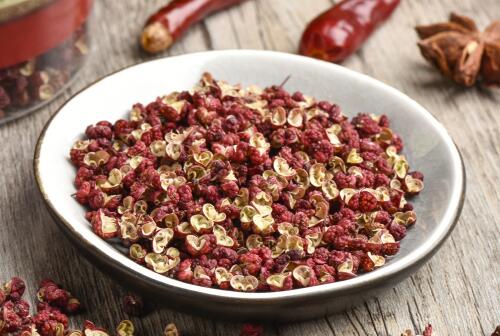
(3) Xiao Hong Jiao (also called Xiao Hongpao, Xiao Jiaozi, Mi Jiao, Mawei Jiao, etc.). After drying, the peel is bright red, with a rich numbing aroma, especially a strong fragrance and top quality. Usually 3-3.5 kg of fresh fruit can produce 1 kg of dried prickly ash peel. It is cultivated in Hebei, Shandong, Henan, Shanxi, Shaanxi and other provinces, with more cultivation in the southeastern Shanxi region and the Taihang Mountain area of Hebei.
(4) Jiuyeqing prickly ash has wide soil adaptability and tolerates poor soil. It is suitable for various soils, especially sloping land. It has the characteristics of high grade, good taste, and strong fragrance, and was designated by Chongqing as the preferred tree species for returning farmland to forest.
(5) Dou Jiao, also called Bai Jiao. After drying it is dark red, and the peel quality is medium. Usually 4-6 kg of fresh fruit can produce 1 kg of dried prickly ash peel. Dou Jiao has strong resistance and high yield, and is cultivated in Gansu, Shanxi, Shaanxi and other provinces in the Yellow River basin.
(6) Qin'an No. 1, also called Da Shizitou, is an individual variant type of Dahongpao discovered in Gansu Province. After drying, the peel is deep red with a brilliant color, rich numbing aroma, and top quality. This variety likes water and fertilizer, tolerates poor soil, resists drought, and tolerates cold, and is suitable for cultivation in arid or semi-arid areas.
II. What Are the Planting Prospects for Prickly Ash?
1. Prickly ash market prices. The price of prickly ash in the current market is relatively stable and has remained at a high level without falling. At present, the price of Sichuan green general goods is 80-85 yuan/kg, Shaanxi Dahongpao is 90-95 yuan/kg, and good goods are 105-110 yuan/kg.
2. Prickly ash market prospects. Prickly ash is one of the essential seasonings for many dishes, and it can also be deeply processed into prickly ash oil, so market demand is relatively large. Prickly ash is also a very good industrial raw material and can be used to make soap. It also has high medicinal value and insecticidal effects.
3. The prickly ash tree is a very good economic tree species and is suitable for planting in most areas of our country. Moreover, the prickly ash tree is especially drought-resistant and can grow as long as rainfall exceeds 400 mm. Second, it does not have high soil requirements, and it can grow in hilly and mountainous areas with relatively poor soil conditions. In addition, the prickly ash tree has relatively few pests and diseases, so it does not require too meticulous management.
4. Prickly ash is an industry for becoming wealthy that combines ecological benefits and economic benefits. It can both optimize the structure of the agricultural industry and increase farmers' income. Taking Dahongpao as an example, it has the characteristics of fast growth, many fruits, high yield, early market arrival, and high economic value.
III. How Much Is the Profit Per Mu from Planting Prickly Ash?
It is hard to say how much profit there is from planting prickly ash. The varieties, area, and prices planted in each region are different, but most planting profits are still good. Below is a case study:
1. Mr. Zeng of Hanyin County, Shaanxi, used the abandoned land resources, geographical location, and climatic conditions of his hometown to plant green prickly ash in his hometown. Green prickly ash planting is a new industry locally. In 2015, he went to the green prickly ash production area in Chongqing to investigate and learn, then returned to Hanyin to carry out land transfer work, preparing the land and planting seedlings. The terraced fields that had originally been overgrown with weeds were planted full of green green prickly ash seedlings. Along the way he also encountered freezing and directly lost more than 200,000. Afterward, he regrouped and went to Chongqing to exchange and learn with local farmers. Under the technical guidance of professional teachers, he carried out fine management. After one year of planting, the largest trunk had already reached 5 cm, and some prickly ash trees had begun trial fruiting. In 2018, the harvested fresh prickly ash reached 40,000 jin.
2. Now Mr. Zeng has established a 500-mu demonstration base and a 10-mu seedling base, and in 2016 established a "Prickly Ash Planting Professional Cooperative." Green prickly ash is different from other varieties of prickly ash. Green prickly ash takes effect quickly, has high yield, and is easy to pick. Each mu of land can plant 130 prickly ash trees, and each tree at full production can produce more than 8 jin of fresh prickly ash. Calculating fresh prickly ash at 6 yuan per jin, the economic value of each tree is 64 yuan, and the income per mu is 6,240 yuan. After farmers deduct about 2,000 yuan for pesticides, fertilizers, and labor, they can net about 4,000 yuan per mu. This is only the income from selling prickly ash. Later, it can also be processed into fresh-keeping prickly ash, pressed prickly ash oil, and refined into cosmetics and anesthetics, etc., making use of the entire prickly ash.
Later, the cooperative vigorously promoted farmers to plant green prickly ash, with a planned area of 5,000 mu, and a preliminary estimate of annual profit of at least 20 million.
Planting prickly ash requires patience, and management requires attentiveness. After prickly ash trees are planted, they generally take 1-2 years to reach full fruit stage, and they are easily affected by weather, so anyone who wants to invest in planting must be psychologically prepared.
Rutaceae: Liangmianzhen (Zanthoxylum nitidum)
Liangmianzhen is a woody vine. Hooked prickles grow on the stems, branches, underside of the leaf rachis, and both sides of the midrib of the leaflets. It has odd-pinnate compound leaves, 7-15 cm long; leaflets 3-11, opposite, leathery, ovate to ovate-oblong, hairless, slightly glossy above; corymbose panicles, axillary; flowers 4-merous; sepals broadly ovate. The follicles are purplish red when mature, with large glandular dots, and the apex is shortly beaked.
Distribution Locations
Distributed in Guangdong, Guangxi, Fujian, Hunan, Yunnan, and Taiwan, China. It grows in mountain wilds. The leaves and peel can be used to extract aromatic oil; the seed oil is used for making soap; the roots, stems, and leaves are used as medicine. It can dissipate blood stasis and activate collaterals, dispel wind, and detoxify.
Liangmianzhen has the functions of dispelling wind and transforming dampness, reducing swelling and relieving pain, and unblocking meridians and activating collaterals. It mainly treats toothache, stomachache, traumatic injuries, rheumatic bone pain, and venomous snake bites. It is mainly produced in Taiwan, China, Guangdong, Guangxi, Fujian and other provinces (regions), and is also distributed in the southern parts of Hunan and Guizhou provinces.
Growth Habits
It grows wild in relatively dry mountain shrub thickets or open forests and along roadsides. It likes a warm and humid environment. The suitable growth temperature is 30°C. It has no strict soil requirements. Except for saline-alkali land, which is not suitable for planting, it can be planted in general soils. It avoids waterlogging.
Propagation method: seed propagation.
1. Site selection and land preparation: It is best to choose sunny loam with good drainage, deep soil layers, and loose fertility. Clear the entire area, plow deeply 30 cm, break up the soil and rake it level, make beds, and open drainage ditches.
2. Sowing and seedling raising: Both autumn sowing and spring sowing are acceptable. For autumn sowing, sow in September when the seeds mature, sowing immediately after collection, which gives a high germination rate. For spring sowing, sow in late March. Broadcast the seeds in the seedbed, cover with 2 cm of fine soil, cover with grass, and water. The sowing rate is 1250-1500 g per mu. After sowing, when the temperature is above 25°C, seedlings can emerge in 20 days. After emergence, remove the covering grass.
3. Field planting: When the seedlings are about 20 cm tall, they can be transplanted. Hole planting: dig holes at a plant spacing of 70 cm and row spacing of 90 cm. The tree hole length x width x depth (cm) is 60 x 60 x 50, and each hole is given sufficient base fertilizer. Plant 1 plant per hole.
Field Management
1. Cultivation and weeding: Within 1-2 years after field planting, cultivate and weed 4-5 times each year. During this period, peanuts, soybeans, and other crops can be interplanted. After two years, cultivate and weed 3-4 times each year.
2. Topdressing: During the seedling stage, apply human manure or urea once each month. After field planting, apply turf mud, compost, and barnyard manure once each in summer and winter every year. After each topdressing, earth up the soil.
3. Pruning: After the main trunk of plants more than two years old has basically formed, prune overly dense weak branches, diseased and insect-damaged branches, dead branches, and sprouting branches growing from the rhizome.
Pest and Disease Control
A common pest is the longhorn beetle, which bores into and feeds on the stems and roots. Adults can be caught manually or the eggs can be removed, and a wire can be inserted into the bore hole to stab the larvae to death. Cotton soaked in 80% dichlorvos original liquid can also be inserted into the bore hole, and the opening sealed with mud to poison the larvae.
Harvesting and Processing
Liangmianzhen is used medicinally as roots. It is generally harvested after 5-6 years of cultivation. Dig it up in winter, wash off the mud and sand, slice it, and dry it in the sun.
Rutaceae Plant: Daidai Flower (Citrus aurantium var. amara)
Chinese scientific name: Daidai Flower. Other names: Huiqingcheng, Daidai.
Kingdom: Plantae. Family: Rutaceae.
Distribution area: Distributed in various parts of southern China, and cultivated in Zhejiang, Jiangsu, Guangdong, Guizhou and other places.
Daidai flower belongs to the genus Citrus in the Rutaceae family. It has lush green leaves and hanging golden fruits, and is a rare fine product among home-grown flowers. The Daidai fruit is initially dark green, turns orange-yellow after maturity, and does not fall off; by the next spring and summer it turns green again, hence the name "Huiqingcheng." If cared for properly, the fruit can persist on the plant until the third year, so it is also called "Daidai."
Daidai flower is native to Zhejiang Province, China. In the north it can only be potted. After flowering, it bears beautiful orange-yellow flattened round fruits that press all over the branches. Although they are inedible, they can remain on the tree among the green leaves for several years, beautiful and unique, and it is a fine flower much loved by people for courtyard planting or indoor potting. Daidai flower is also called Huiqingcheng and Daidai. It has a rich fragrance and beautiful fruit, and is a beautiful potted flower for courtyards and indoor display. Its flowers, like those of white orchid and jasmine, can be used to scent flower tea, and can also be used as medicine and to extract essence.
Daidai flower belongs to the Rutaceae family. It is an evergreen shrub or small tree and is a variety of bitter orange. The leaves are leathery, elliptical, and the petioles have broad wings. The flowers are pure white, solitary or several clustered in the leaf axils, extremely fragrant, with a flowering period from May to June. In winter the fruits are orange-yellow and hang all over the branches, very pleasing to the eye. The next summer the fruit turns green again, hence the beautiful name "Huiqingcheng." The fruit of Daidai flower usually remains on the plant for 2-3 years without falling, with flowers and fruit of different years existing together, like "three generations under one roof," hence the name Daidai. It is an important woody fragrant-flower and ornamental-fruit plant. Potted for viewing, it is very elegant.
Share to: Qzone Sina Weibo Tencent Weibo Douban Renren