How much does a ginkgo tree cost? A profitability analysis of growing this living fossil
The ginkgo tree is also called the white fruit tree. Because it lives extremely long and has high ornamental, medicinal and practical value, it is also known as the “living fossil of the biological world,” which is why many growers want to plant it. So how much does a ginkgo tree cost? What are its growing profits?
I. How much does a ginkgo tree cost?
Ginkgo tree prices vary. Because of differences in variety, region, size and growing method, market prices differ to a certain extent. A seedling-grown ginkgo tree (seedling tree) of 2-3 cm costs about 3-9 yuan each, while one of 4-5 cm costs 25-40 yuan each. As the ginkgo tree slowly grows larger, the price also slowly rises. The most expensive is generally a seedling tree of about 50 cm, which can cost as much as about 65,000 yuan each. Grafted ginkgo saplings start at a size of about 12 cm, with a price generally around 260-350, while 15 cm ones are generally around 450-650. Of course, at present the most expensive grafted ginkgo trees are not much different from seedling trees and are also around 65,000. Therefore the above prices are for reference only; the specific price should be based on the actual price.
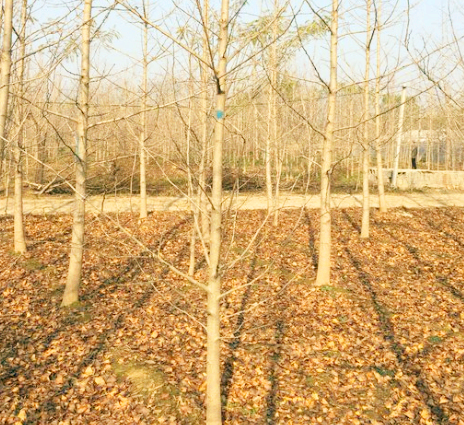
II. What are the growing profits of ginkgo trees?
At present there is relatively strong demand for ginkgo trees for urban greenery and landscaping. Ginkgo trees can not only be used for beautification, but ginkgo nuts and ginkgo leaves also have high medicinal value. Ginkgo leaves can promote blood circulation and remove blood stasis, and play a big role in treating stroke paralysis, reducing fat and relieving cough, so their market value is high.
If you plan to grow ginkgo tree seeds to trade small saplings, about 1000 plants can be planted per mu. The seeds needed for 1000 plants are about 50 jin. Calculated at the market seed price of 6 yuan per jin, planting one mu requires 300 yuan. At market prices, 1000 ginkgo trees of 3 cm can sell for 8000 yuan. If you grow saplings until they are large before selling, about 500 plants can be planted per mu. At market prices, the cost per mu is about 2000-4000 yuan, and when grown to 20 cm they can sell for 75,000 yuan. If you directly plant 15 cm medium-aged trees, the size can be chosen at around 15 cm, with a planting spacing of about 2-4 m. About 100 plants can be planted per mu at a cost of 10,000 yuan, and when they grow to 25-30 cm they can sell for 200,000-700,000 yuan. Looking at it this way, as long as the ginkgo trees can be sold, the profits are still quite good.
As cities expand in the future, the demand for greenery will also grow. People increasingly pursue an enjoyable life, and their understanding of the benefits of ginkgo will become clearer. Moreover, wild naturally growing ones are prohibited from being transplanted, so artificially grown ginkgo trees still have great prospects.
Summary: The above is the relevant introduction to ginkgo tree prices and growing profits. Note that the above ginkgo tree prices and growing profits are for reference only; the specific figures should be based on actual prices and profits. I hope this is helpful to friends who need it!
Is it good to plant a ginkgo tree in front of the door? Points to note when planting a ginkgo tree in front of the door
The ginkgo tree is a tree with extremely high ornamental value, so it is deeply loved by many people. Some people who have courtyards like to plant some ginkgo trees. Some say there is no problem after planting them, while others say they cannot be planted at home. So what is the truth?
Is it good to plant a ginkgo tree in front of the door?
Planting a ginkgo tree in front of the door is fine. The ginkgo tree is the longest-lived tree, so it itself symbolizes longevity, which is why many people like to give ginkgo potted plants as gifts. The ginkgo tree symbolizes love; its leaves are shaped like hearts, implying hearts reflecting each other. Many lovers like to tie red cloth strips on ginkgo trees to symbolize their beautiful love. Planting it in your own courtyard can both beautify the home environment and purify the air at home.
Points to note when planting a ginkgo tree in front of the door
1. The Feng Shui secret manual says: “Flat open ground originally does not fear wind, but there is a difference between yin and yang. What faces east and south receives warm wind and mild wind, called yang wind, so it is harmless.” Planting a ginkgo tree at the main gate or in the southeast corner of the courtyard is best for Feng Shui.
2. The ginkgo tree is a survivor of ancient organisms and is called the living fossil of the plant world. After planting a ginkgo tree, you must also often pay attention to pruning. If you do not pay attention to pruning and it becomes too lush, it easily attracts yin energy.
3. The ginkgo tree is suitable for the Azure Dragon position in the courtyard. Planting it in this position can regulate the home's Feng Shui environment, but be sure not to plant ginkgo in the White Tiger position, otherwise it will become an inauspicious tree.
4. When it is not needed, you also cannot cut down the ginkgo at will. You can adopt the method of transplanting instead, otherwise it will destroy the ginkgo's own Feng Shui role of guarding the house.
What trees are good for Feng Shui when planted in front of the door?
1. Palm, also called palm tree. It has ornamental value, its trunk can also be used as pavilion posts, and palm fiber can be used as medicine, with the function of astringing and stopping bleeding, mainly treating vomiting blood, uterine bleeding and various symptoms. In Feng Shui it has the effect of generating wealth and protecting wealth.
2. Orange tree, namely the mandarin orange tree. Orange is homophonous with auspiciousness and symbolizes good fortune. Its fruit color is red and yellow, full of festivity. Potted mandarin oranges are an important decoration for families during the Spring Festival, and orange leaves have the function of soothing the liver and relieving depression, able to bring joy to the home.
3. Chinese toon tree. "Zhuangzi, Xiaoyaoyou" says: In ancient times there was a great toon tree, with eight thousand years as its autumn. Therefore the toon tree is a sign of longevity, and later generations also used it as a name for one's father. In Feng Shui it has the function of protecting the house and praying for longevity.
4. Osmanthus tree. Legend says there is an osmanthus tree in the moon. Osmanthus is also called muxi. Osmanthus twigs can be used as medicine, with the function of dispelling wind pathogens and harmonizing. Song Zhiwen's verse says: Osmanthus seeds fall in the moon, heavenly fragrance drifts beyond the clouds. Osmanthus symbolizes purity and nobility. In summer the osmanthus fragrance spreads in all directions, making it a natural air freshener.
5. Grape. Grapevines tangle with vines, symbolizing intimacy. Since ancient times there has been the saying of meeting under the grape trellis on Qixi, and cooling off and relieving summer heat in the grape shade in summer is also a great pleasure in life.
Taboos on planting trees at home
1. Do not plant mulberry in front of the courtyard. It is not suitable to plant mulberry in front of the courtyard. Mulberry has the homophone of “mourning” (sang). Planting mulberry will put “mourning” matters in front. In Feng Shui this is very taboo, and it is also very bad for one's personal fortune. In front of the door you should plant osmanthus trees, which carry the meaning of “noble” (gui). Moreover, in the season when osmanthus blooms, it is richly fragrant with a scent that fills the nose, making people relaxed and happy.
2. Do not plant willow behind the courtyard. It is not suitable to plant willow behind the courtyard. Willow has the sound of “slip away” (liu). Planting willow in the courtyard, in Feng Shui terms, means wealth and good luck will secretly slip away, and it may also leak fortune. This is very bad. Moreover, the willow is a soft and yin tree. Planting it behind the courtyard will cause yin energy to gather, which is also not good for the family's fortune.
3. Do not plant thorny trees in the courtyard. It is not suitable to plant thorny trees in the courtyard, such as the pagoda tree (huai). The pagoda tree has been called the ghost tree since ancient times. It is said its roots often penetrate coffins to grow, and its heavy yin energy easily attracts ghosts to possess people, so in Feng Shui it is forbidden to plant in the courtyard. Moreover, thorns also bring sha qi. We often go back and forth in the courtyard when going out. Planting thorny trees in the courtyard is also bad for our health.
As long as the ginkgo tree in front of the door is planted properly, it has no effect on the home's Feng Shui, and even has certain benefits! So after planting it, care for it well and do not cut it down or move its position casually. It is best not to plant mulberry in front of the door, as this tree has a bad meaning, and after planting it may bring some effects to the home's Feng Shui.
Is the ginkgo tree suitable for planting at home? When should ginkgo tree seeds be planted?
Chinese people are very particular about Feng Shui. Different people have different views on Feng Shui, but those who can see through it can understand that Feng Shui is nothing more than a law emphasizing harmony and unity between humans and nature, and between humans and the environment. It is a summary of the wisdom and experience of predecessors. Below, the editor will talk with everyone about the natural laws related to ginkgo trees.
Is the ginkgo tree suitable for planting at home?
Ginkgo leaves symbolize harmony and longevity. Its leaves are fan-shaped and symmetrical, with the peculiar shape of the leaf edge splitting into two while the leaf stalk merges into one. It is regarded as a “symbol of harmony,” implying the harmonious qualities of the unity of opposites of all things, such as “one and two,” “yin and yang,” “life and death,” “spring and autumn,” and so on. Ginkgo leaves can also be seen as heart-shaped, so some people also regard them as a symbol of love, expressing the blessing that two people in love will finally unite as one. Therefore planting ginkgo trees at home is quite good and can bring completeness and harmony to the home!
When should ginkgo tree seeds be planted?
The best time for sowing ginkgo is spring. Because China has a vast territory and large regional differences, adjust appropriately according to different regions. The few days before and after the local ginkgo tree leaves sprout are a better sowing time.
Ginkgo tree Feng Shui taboos
1. The ginkgo tree belongs to the long-lived tree species. It generally does not grow worms and is not easy to die, so it is an auspicious tree. Generally plant it on the left side of the main gate. As the saying goes, Azure Dragon on the left, White Tiger on the right; do not fear the Azure Dragon being ten thousand zhang high, but fear the White Tiger looking back. Also note not to plant the ginkgo tree too close to the door.
2. As the saying goes, planting a tree is easy, but moving or cutting a tree is hard. So once a ginkgo tree is planted at the door, you must take extra care of it. If it rains for a long time and you do not clear the standing water, the ginkgo tree will develop problems such as root rot, illness and yellow leaves, and in severe cases may even die. Furthermore, the ginkgo tree must be planted in a place with sufficient sunlight, and cannot be blocked by other trees or buildings. Once the ginkgo tree dies, it is one hundred percent a major disaster.
3. The Feng Shui secret manual says: “Flat open ground originally does not fear wind, but there is a difference between yin and yang. What faces east and south receives warm wind and mild wind, called yang wind, so it is harmless.” Planting a ginkgo tree at the main gate or in the southeast corner of the courtyard is best for Feng Shui.
4. The ginkgo tree is a survivor of ancient organisms and is called the living fossil of the plant world. After planting a ginkgo tree, you must also often pay attention to pruning. If you do not pay attention to pruning and it becomes too lush, it easily attracts yin energy.
5. The ginkgo tree is suitable for the Azure Dragon position in the courtyard. Planting it in this position can regulate the home's Feng Shui environment, but be sure not to plant ginkgo in the White Tiger position, otherwise it will become an inauspicious tree.
6. When it is not needed, you also cannot cut down the ginkgo at will. You can adopt the method of transplanting instead, otherwise it will destroy the ginkgo's own Feng Shui role of guarding the house.
The planting value of the ginkgo tree
Ginkgo is commonly known as the white fruit tree, gongsun tree or duck-foot tree. After the late Quaternary glaciation it survived only in China, and it is one of China's important specialty fruit trees. The comprehensive utilization value of the ginkgo tree is very great. Its usable part is the seed kernel, which is rich in nutrition and fragrant and glutinous, making it a good ingredient for premium tonics and premium dishes, and it has certain medical value, with effects such as resolving phlegm, relieving cough, tonifying the lungs, treating dysmenorrhea, stopping turbidity, promoting urination and sterilizing.
The ginkgo tree has a tall and majestic posture, and its leaves are clean and beautiful. It has a certain resistance to smoke and dust pollution and can purify the air, and it has very few pests and diseases, so it is also an important landscape tree and an excellent tree species for greening around the four sides. It is also used to make stump bonsai.
Ginkgo wood is fine and soft, rich in elasticity and not easy to deform. It is a material for fine handicrafts and valuable household use, but the time to become usable timber is too long and production is relatively small. The leaves can be extracted to make the new drug kendrone for treating vascular system diseases; even fallen leaves can be used for sewing medicinal pillows. The fleshy seed coat outside the pit can be used to extract tannin extract, and when mashed and mixed with water it can be made into a crude pesticide with an insecticidal effect.
Planting ginkgo trees involves many particularities. Because the ginkgo tree likes sunlight, it should be planted in the sunny southeast, that is, the Azure Dragon position. From this point it can be seen that Feng Shui does not contain any superstition; it is just that Feng Shui must be expressed in a language that makes people believe and respect, adding people's awe of nature.