How to Grow Strawberries for High Yield: A Detailed Guide to Seven Key Cultivation Points
When it comes to strawberries, many people are probably quite familiar with them. They are a common fruit in our daily lives, and because of their bright red, tender appearance and juicy flesh, they are loved by many. They are cultivated throughout China, but some growers do not achieve high strawberry yields. So let me introduce the seven key points for high-yield strawberry cultivation:
1. Key Point One: Site Selection
Strawberries should not be planted in low-lying areas or on uneven, hollow ground. However, soil with good drainage and irrigation capacity, fertile and loose texture, good fertilizer and water retention, and good permeability is most suitable for strawberry cultivation. Strawberries are suited to slightly acidic or neutral soil; too alkaline a soil will hinder strawberry development. For the previous crop in the soil, legumes and cucurbits should be chosen where possible.
2. Key Point Two: Land Preparation
After selecting the site, all weeds in the field should be completely cleared, then the land should be prepared and disinfected. After 3-5 days of sun exposure, apply sufficient farmyard manure. The amount of base fertilizer depends on the land area, generally 5000 kg per mu, then mix in a small amount of superphosphate and potassium chloride. After applying the base fertilizer, plow again to mix the base fertilizer evenly with the soil to improve soil fertility. Finally, make beds to facilitate strawberry growth and later management.
3. Key Point Three: Transplanting
The transplanting method has a great impact on the later growth and management of strawberries. When transplanting, ensure that the inflorescence growth direction of each plant is consistent, and no more than one plant should be planted per hole. In addition, master the planting depth properly -- it should be neither too shallow nor too deep. Reasonably control the planting density; the planting density depends on the planting area and soil fertility level, and it should not be too dense or too sparse.
4. Key Point Four: Watering
Strawberries like water, so after transplanting, water thoroughly to settle the roots. Then water approximately once every 5-7 days to ensure the soil does not become dry. During the growth process, ensure sufficient moisture to promote plant growth. The flowering stage is the period when strawberries have a relatively high water demand. If watering is not done in time, serious flower and fruit drop will occur in later growth, thereby reducing yield.
5. Key Point Five: Topdressing
Strawberries require relatively large amounts of nutrients for growth, especially during and before the flowering and fruiting stage. Therefore, sufficient base fertilizer is needed, and then appropriate topdressing should be applied during growth according to actual conditions. For example, the flowering and fruiting stage, the fruit enlargement stage, and the final ripening stage are all peak periods of fertilizer demand. At this time, fertilizers such as diammonium phosphate and monopotassium phosphate can be appropriately applied to increase yield. When topdressing, ensure comprehensive nutrition and a reasonable mixing ratio to effectively promote growth.
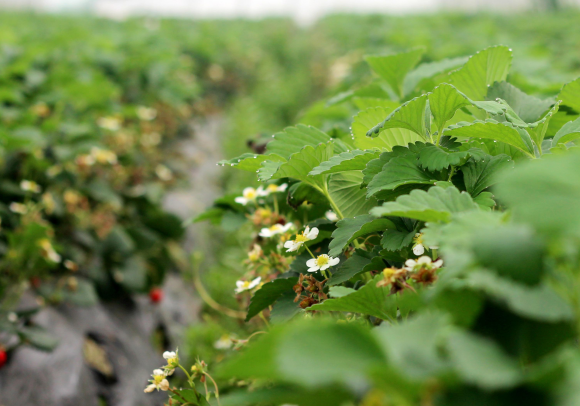
6. Key Point Six: Temperature
Strawberries are a temperature-loving fruit and are also relatively sensitive to temperature changes. During cultivation, reasonably control the growing temperature around the strawberries and strengthen temperature management. The most suitable temperature for strawberry growth is around 22-25°C. If it exceeds the range of 5-30°C, strawberry growth will be greatly hindered. Therefore, the surrounding temperature must be kept balanced so that strawberries can grow better.
7. Key Point Seven: Management
Regularly inspect the orchard and promptly remove old leaves, dead leaves, and diseased leaves. In addition, clear away dropped flowers and fruits as well as some diseased fruits and carry them out of the orchard for disposal. Appropriately control plant growth to prevent excessive vegetative growth. Then do a good job with orchard drainage and irrigation: water promptly during drought and prevent water accumulation in the orchard on rainy days. Minimize orchard humidity as much as possible to prevent root rot and fruit rot that affect yield. In addition, pests and diseases pose the greatest harm to strawberry yield. For example, leaf spot and anthracnose are relatively common diseases. Therefore, pest and disease prevention and control work must also be done well.
Summary: The above is the relevant introduction to the seven key points for high-yield strawberry cultivation. Growers can refer to these seven key points when planting. I hope this is helpful to those who need it!
Strawberry Cultivation Techniques and Key Cultivation Management Points
The strawberry is also called red berry, foreign berry, ground berry, and so on. It is a red flowering and fruiting plant. Strawberry is the general term for plants in the genus Fragaria of the rose family, and it is a perennial herbaceous plant. The strawberry has a heart-shaped appearance, is bright red and tender, has juicy flesh, and contains a special rich fruit aroma. Strawberries have high nutritional value and are rich in vitamin C, with the effect of aiding digestion. At the same time, strawberries can also strengthen the gums, freshen breath, and moisten the throat. In spring, people's liver fire tends to be relatively strong, and eating some strawberries can help suppress it.
In addition, strawberries are best eaten after meals, because they contain a large amount of pectin and cellulose, which can promote gastrointestinal motility, aid digestion, improve constipation, and prevent hemorrhoids and intestinal cancer. The nutritional ratio of strawberries is very reasonable, and their vitamin C content is about 10 times that of an equal amount of watermelon, grapes, or apples. In addition, strawberries are rich in iron, fructose, glucose, citric acid, malic acid, and so on. For lung-heat cough, sore throat, and boils that easily appear in spring, the nutrients contained in strawberries can play a therapeutic role. Also, because they contain iron, friends with anemia can also eat them regularly. However, doctors also note that although strawberries are a very good appetite-stimulating fruit, they are cool in nature, so in early spring do not eat too many at one time. Especially for people with weak spleen and stomach, those prone to diarrhea, and those with excessive stomach acid, strawberry intake should be controlled even more.
Production and Cultivation Overview
At present, most countries in the world cultivate strawberries. The strawberry cultivation area in the United States is 23,000 hectares, with a yield of 567,000 tons, accounting for about 28% of world total production, with an average yield of 24.6 tons per hectare. Japan's cultivation area is 11,000 hm2, with a yield of 218,000 tons, accounting for 11% of world total production, with an average yield of 19.3 tons per hectare. Europe is a major strawberry producing area, accounting for about 50% of world production. Poland, Italy, Spain, the Netherlands, Belgium, Russia, Romania, and the United Kingdom have relatively large cultivation areas, with yields generally 9.5-18.3 tons per hectare. China is the country with the richest wild strawberry resources in the world, and began using wild strawberries very early, continuing this practice to the present day. Large-fruited strawberry cultivation in China began in 1915, but in the past it did not receive attention and developed slowly. Since the 1980s, strawberry production has developed rapidly. China currently has about 70,000 hm2 of strawberry production area, ranking first in the world in area. The main producing areas are distributed in eastern coastal regions such as Anhui, Liaoning, Hebei, Shandong, Jiangsu, Shanghai, and Zhejiang. In recent years, Sichuan, Anhui, **, Beijing and other areas have also developed quickly. Key strawberry producing areas include Sihong in Jiangsu, Hefei in Anhui, Dandong in Liaoning, Baoding in Hebei, Yantai in Shandong, the suburbs of Shanghai, Shuangliu in Sichuan, and Lianyungang in Jiangsu. Among them, Changfeng County in Hefei currently has 145,000 mu of strawberry planting area, with an annual strawberry output of more than 200,000 tons and a total output value of more than 1 billion yuan. By 2012 it expanded to more than 200,000 mu, and the country's only national-level virus-free strawberry science and technology park was built. Every year, promotion meetings are held at the Great Hall of the People in Beijing and the Diaoyutai State Guesthouse in Beijing, and matchmaking meetings between distributors and strawberry growers are held at the Beijing Xinfadi Market, Tianjin Hongqi Market, and Shenyang Fruit Wholesale Market. Its production scale has already risen from once ranking first in Anhui Province to becoming the country's largest strawberry county, and Changfeng strawberry has become a China Well-Known Trademark.
Growing Conditions
Strawberries are suitable for planting in soil with ample sunlight and good drainage. The soil depth should be about 8-10 inches. For large strawberry plants, the row spacing should be 12 inches and the plant spacing about 18 inches. Promptly remove the runners from the plants to help strawberries bear fruit. Strawberry yields are cyclical, so it is best to cultivate some new plants in the first few years of planting. If you do not like managing strawberries, you can plant one strawberry every 18-24 inches, so that strawberries can spread freely. Of course, it will look a bit messy, and the strawberries will not be large. If you want to avoid this situation, you can appropriately remove some runners. In autumn, spread a layer of soil over the plants to prevent frost damage. After the soil freezes, you can spread another 3-4 inches of dry straw over the plants. By the following spring, when new leaves grow, remove the dry straw. Wait until the weather warms and stabilizes, then remove the covering soil on the surface of the plants. But leave some dry straw between the rows to prevent weed growth and maintain soil moisture.
Cultivation Techniques
In world small berry production, strawberries rank first. Strawberries are an economic crop with fast fruiting, early maturity, easy propagation, a short cycle, and high benefits.
1. Preparation of Propagation Nursery Land
1) Choose paddy fields that are convenient for drainage and irrigation and not prone to water accumulation, with relatively high fertility, or vegetable garden soil (previous crop and soil blocks where chlorsulfuron herbicide has been used). Apply sufficient base fertilizer (cake fertilizer, farmyard manure, human waste, phosphate fertilizer) and spread it after decomposition. At the same time, use 1 jin of 50% phoxim or 3 jin of 3% carbofuran per mu, mix with 25 jin of fine soil, spread it, then turn the soil and make beds. The bed width is 1.5-1.8 m, turtle-back shaped to prevent water accumulation, and the soil should be broken up fine.
2) Selection and transplanting of each plant. Choose plants with new leaves developing normally, symmetrical leaflets, dark green leaf color, thick petioles, large leaves, robust growth, and good yield potential, and remove diseased and old leaves. In our city, transplanting into the propagation field is generally done in April of the Gregorian calendar (daily average temperature above 12°C). Plant two rows per bed, transplanting 30 cm from the edge of the bed surface, with a plant spacing of 60-80 cm. After planting, water immediately to settle the roots.
3) Fertilizer and water management. The principle of fertilizing the nursery land is: moderate nitrogen, heavy phosphorus and potassium. Use 200 jin of decomposed rapeseed cake plus 7-8 jin of urea, 50 jin of phosphate fertilizer, and 10 jin of potassium fertilizer per mu. Dissolve in water and irrigate once every 20 days. Human waste can also be used as a substitute.
4) After each plant has survived transplanting (one week later), spray gibberellin (920). That is, each gram of "920" mixed with 40-50 jin of water (first dissolve the "920" in a clean bowl using high-concentration white liquor), then spray. Spray twice in succession, with an interval of one week to 10 days. In August, strictly control nitrogen fertilizer application and allow moderate drought, but not excessively.
2. Timely Transplanting, Preparation of the Transplanting Field, and Specifications
1) Field preparation: Choose fertile fields or soil with convenient drainage and irrigation as the field site. Strawberries have a relatively large fertilizer requirement, and because later stages (fruit harvesting period) generally receive less fertilizer, the base fertilizer must be sufficient and mainly organic fertilizer. Generally, per mu: 1500 kg organic fertilizer, 50 kg cake fertilizer, 25-30 kg compound fertilizer, 7.5 kg urea, 40 kg superphosphate, and 10 kg potassium fertilizer. Except for urea and compound fertilizer, stir the other fertilizers evenly, decompose them, then mix evenly with urea and compound fertilizer and spread on the soil surface, then turn the soil and make ridges. Generally, ridge height is 25-30 cm, ridge bottom width is 90 cm, and ridge surface is 60 cm. The ridge ditch width is 30 cm, and the ridge bottom plus ditch width is about 100-120 cm. The ridge surface to ditch bottom should have a certain slope.
2) Transplanting period and method: Facility cultivation in our city is generally transplanted from late September to early October. Transplanting density should be treated according to seedling condition and whether the land is fertile or poor. Strong seedlings, dry seedlings, and fertile land are suitable for sparse planting. Otherwise, dense planting is suitable. Generally, 7,000-9,000 plants are planted per mu. After the ridges are made, transplant 5 cm inward from the ridge edge, with a plant spacing of 12-15 cm. The ridge length generally should not exceed 30 m.
When transplanting, pay attention to the following: First, directional transplanting: with the arched back facing outward, which helps inflorescences emerge later. Second, plant in a double-row triangle (pin-shaped) arrangement, which facilitates ventilation, light penetration, and root establishment. Third, grasp the depth properly, so that roots are not exposed below and the seedling heart is not buried above, which helps tillering. Fourth, transplant with soil, which helps survival. Fifth, plant in the afternoon on sunny days, and all day on cloudy days. Sixth, strengthen water and fertilizer management, and water thoroughly to settle the roots immediately after planting. When watering, add thiophanate-methyl at 800 times dilution. Seventh, promptly check seedlings and fill gaps.
3. Field Management
1) Pre-winter management: From surviving transplanting to mid-to-late November, pay attention to three points: first, apply thin fertilizer frequently, mainly nitrogen fertilizer, preferably dilute manure water; second, maintain moisture; third, weed, loosen the soil, and remove old and diseased leaves.
2) Management before and after flowering: Before flowering, at the young fruit stage, and at the fruit enlargement stage, promptly spray Caiguo Zhuangdiling to increase the cyclic fruit-setting rate of strawberries and promote fruit development. At the same time, use thiophanate-methyl, procymidone, dimethoate, etc. to control pests and diseases.
3) Wintering management: Before the severe cold arrives, water thoroughly to protect against cold.
4. Timely Film Covering
Covering with film can multiply yield and reduce fruit loss and prevent contamination. Films are divided into greenhouse covering film and plastic mulch. The time for covering film should be when the daily average temperature drops to about 8°C. Cover the greenhouse film first, then the plastic mulch. Before covering film, first weed, cultivate, fertilize, and control pests and diseases. (Greenhouse construction and film purchase models) Due to limited space, they will not be introduced here. Those interested please contact the agricultural science institute. After covering the film, the temperature inside the greenhouse at night should be kept at 8°C, and around 20°C during the day. On sunny days at noon, the film should be lifted, and the film should be replaced at 3 p.m. If the temperature is too high, pollen dies; if the temperature is too low, pollen activity is insufficient, making pollination difficult.
5. Greenhouse Cultivation
Strawberries grown in greenhouses in early spring can flower and bear fruit.
6. Open-Field Cultivation Techniques
Open-field strawberry cultivation can use two methods: one planting per year or one planting for many years. The former rotates with other crops after each year's cultivation and harvest. Under this system, strawberries have strong vitality, good fruit quality, early maturity, and few pests and diseases. But the key technique is to cultivate strong seedlings with more than 3 leaves and a well-developed root system, and appropriate dense planting can be used. Plant once and harvest for many years, transplant in autumn, and harvest in May of the following year. After 3 years, use runner seedlings to renew once.
1) Land preparation and base fertilizer application
Strawberries have shallow roots and are suitable for growing in loam or sandy loam with good permeability and rich organic matter. The previous crop should preferably be wheat, legumes, cucurbits, or vegetables. They can also be intercropped with tall-stem crops. Deep plow the land early, apply 3000 kg per mu of fully decomposed manure as base fertilizer, and sun the soil. When preparing the land, apply 25 kg diammonium phosphate and 10 kg potassium chloride. Irrigate once with a small amount of water before transplanting.
2) Transplanting
Before transplanting, select seedlings with 5-6 compound leaves, robust plants, and complete root systems, and transplant them into the field on cloudy days or in the evening. The planting density is (20-25) cm × (25-30) cm. When planting seedlings, the standard is shallow enough not to expose roots and deep enough not to bury the heart. After transplanting, irrigate once thoroughly. After the water dries, promptly check the seedling condition, loosen soil, earth up, or fill gaps. When transplanting, make the arched back of the seedlings grow toward the inside of the flat bed, which facilitates management and fruit harvesting.
3) Field management
After strawberry transplanting, water to settle the roots, then keep the field moist and lower the soil temperature, irrigating timely and appropriately according to field humidity. When irrigating with winter water, combine with 15-20 kg/mu compound fertilizer to improve wintering ability. The spring flowering and fruiting period is a moisture-sensitive period, and the soil should be kept moist. When irrigating, combine with nitrogen-phosphorus compound fertilizer or foliar spraying. Do not overwater, and promptly drain accumulated water. At the same time, before flowering, at the young fruit stage, and at the fruit enlargement stage, promptly spray Caiguo Zhuangdiling to increase the cyclic fruit-setting rate of strawberries and promote fruit development. After strawberry transplanting and survival, cultivate and weed frequently. After fruit harvest, earth up at the appropriate time. During wintering, appropriately use ground cover to prevent cold, preserve heat, and help strawberries overwinter smoothly. Now, plastic mulch is mostly applied from late January to early February, which can promote earlier strawberry maturity and extend the harvest period.
Strawberry Care
Once strawberries begin to bear fruit and turn red, be careful not to let birds peck at them, because birds easily notice red things. Put a net over the strawberries, or cover the strawberries with a wooden basket. But if there is a greenhouse at home, you can move the strawberries into the greenhouse, which is even better. Strawberries are also more likely to bear fruit. After the strawberry fruiting period is over, you can move them out of the greenhouse and place them outdoors to overwinter.
In a sense, if strawberry plants experience some frost, it is more beneficial for increasing yield the following year. Strawberries are very easy plants to cultivate and can be transplanted. Sometimes you may find yellow leaves on the plants, but do not worry; just remove them. In winter, you can keep the yellow leaves until new leaves grow the following spring, then remove the dead yellow leaves, and pay attention to watering, weeding, and pest control. You can also plant strawberries in plant bags, but be sure to water evenly and prevent birds from pecking the strawberries and insect damage. The soil in plant bags easily dries out, so check frequently to ensure the soil remains moist. If planting only a small amount, try not to use pesticides. You can spray with a large amount of diluted dishwashing detergent; you can also place some melon rinds, beer, etc. nearby to lure away snails and other soft-bodied crawling pests.
Disease Prevention and Control
When growing strawberries, change or control the environmental conditions for their growth and development, overcome unfavorable factors, enable them to flower and bear fruit normally, achieve early harvesting, and supply the market out of season. Greenhouse cultivation has the characteristics of low investment, quick results, high yield, and good benefits. Each mu of land produces 1500 kg, more than double that of open-field cultivation; the output value is more than 10 times higher than open-field cultivation. In order to extend the strawberry supply period and meet the demand for year-round supply, four cultivation forms are commonly used at present:
(1) Forcing cultivation (matures and goes on the market from November to December in late autumn and early winter).
(2) Semi-forcing cultivation (matures and goes on the market from February to March).
(3) Ultra-forcing cultivation.
(4) Inhibiting cultivation.
Although greenhouse production has many advantages, it also has shortcomings. Because the greenhouse has high temperature and high humidity, it easily creates extremely favorable environmental conditions for the occurrence of pests and diseases. Strengthening integrated pest and disease control, "control early, control small, control thoroughly," appears especially important, and has become a key link in achieving high and stable yields of greenhouse strawberries.
1. Leaf Spot Disease
Also called snake-eye disease, it mainly damages leaves, petioles, fruit stalks, tender stems, and seeds. On the leaves, dark purple small spots form, and after expanding they form nearly round or oval lesions, with purple-red-brown edges and gray-white centers, slightly showing fine rings so that the entire lesion appears snake-eye shaped. No small black grains form on the lesions.
Control measures: Promptly remove diseased and old leaves. In the early stage of disease, use 70% chlorothalonil wettable powder at 500-700 times dilution, and spray again after ten days. Or use 70% mancozeb wettable powder, 200 g per mu mixed with 75 kg water for spraying.
2. Powdery Mildew
It mainly damages leaves, and also attacks flowers, fruits, fruit stalks, and petioles. Leaves curl upward in a spoon shape. Damaged flower buds and petals turn purple-red, cannot bloom or bloom as complete flowers, and fruits do not enlarge, becoming slender. Young fruits lose their luster and harden. If strawberries are damaged near ripening, they lose commercial value.
Control measures: At the central diseased plants and around them, focus on spraying 0.3 degree Baume lime-sulfur mixture. After harvest, cut leaves throughout the orchard and spray 70% thiophanate-methyl at 1000 times dilution or 50% thiram at 800 times dilution and 30% triflumizole at 5000 times dilution, etc.
3. Gray Mold
It is a major disease after flowering and can occur on flowers, petals, fruits, and leaves. On fruits during the enlargement period, brown spots form and gradually expand, densely growing gray mold that softens and rots the fruit, seriously affecting yield.
Control measures: From bud emergence to flowering, spray 25% carbendazim wettable powder at 300 times dilution, 50% captan wettable powder at 800 times dilution, 50% iprodione at 500-700 times dilution, etc.
4. Root Rot
Starting from the lower leaves, leaf margins turn red-brown and gradually wilt upward until death. The stele in the middle begins to turn black-brown and rot, and the central stele of the root appears red.
Control measures: Before strawberry transplanting, use 40% asparagus green powder at 600 times dilution and pour it on the bed surface, then cover with soil, level, and transplant, so as to effectively kill pathogens in the soil, reduce the base number of inoculum in the field, and reduce opportunities for infection.
5. Verticillium Wilt
This disease is a soil-borne disease. The main symptoms are deformed young leaves, yellowing leaves, and an extremely rough leaf surface. Subsequently, leaf margins turn brown and wilt inward until death.
Control measures: Strictly introduce disease-free plants for planting; shorten the renewal period; use chloropicrin 13.5 L-20 L or solar film coverage with irrigation for soil disinfection; pull out and burn affected plants.
Key Cultivation Techniques for Excellent Virus-Free Strawberry Varieties
Strawberry (scientific name: Fragaria × ananassa Duch.), perennial herb, 10-40 cm tall. The stem is lower than the leaves or nearly equal, densely covered with spreading yellow soft hairs. Leaves are trifoliate; leaflets have short petiolules, relatively thick texture, obovate or rhombic, dark green above and nearly hairless, light white-green below with sparse hairs, denser along the veins; petioles densely covered with spreading yellow soft hairs. Cymes, with a short-stalked small leaf below the inflorescence; flowers bisexual; sepals ovate, slightly longer than the epicalyx segments; petals white, nearly round or obovate-elliptic. Aggregate fruit large, persistent sepals upright and closely appressed to the fruit; achenes pointed-ovate, smooth. Flowering period April-May, fruiting period June-July. Strawberry is a nutrient-rich health fruit. Excellent virus-free strawberry varieties are new large-fruited, high-yield varieties introduced from abroad and rapidly propagated through plant tissue culture virus-free technology. In order to fully leverage the yield-increasing power of improved varieties, in addition to conventional strawberry cultivation methods, the following technical measures are recommended based on the characteristics of improved varieties:1. Choose land with top-grade fertility, drainage and irrigation conditions, and where strawberries have not been planted before. At the end of August and beginning of September, while plowing the land, apply 8000-**** jin of organic fertilizer, 200 jin of soybean cake, and 200 jin of phosphate fertilizer per mu as base fertilizer. Strawberries are a fertilizer-tolerant, high-yield crop, and the nutrients required for growth, development, flowering, and fruiting should be ensured. Strawberries produced with organic fertilizer taste sweet and delicious. Strawberries produced with chemical fertilizer taste sour.
2. Planting method and density. Double-row high-ridge planting is recommended. Each ridge is 50 cm wide, and two rows are planted per ridge, with a row spacing of 30 cm and a plant spacing of 25-30 cm. The density per mu is 6000-7000 plants. The planting depth for strawberries should be shallow, level with the roots. Soil must not cover the seedling heart.
3. Timely transplanting. Ensure early development before winter. Generally, transplanting in October is more suitable (slightly earlier north of the Yangtze River, slightly later south of the Yangtze River). After transplanting, water or irrigate promptly to promote survival. One week after survival, apply human waste or 50 jin of compound fertilizer per mu as topdressing to promote early root establishment and development (nitrogen-phosphorus-potassium compound fertilizer specially for fruit trees is best). Apply topdressing 1-2 times to promote root establishment. "Strong seedlings before the new year, large fruits after the new year."
4. Timely topdressing to promote flower bud differentiation. In mid-November, apply human waste or 50 jin of compound fertilizer and 40 jin of potassium fertilizer per mu in holes to ensure the nutrients needed for flower bud differentiation.
5. Apply sufficient fruit fertilizer. At the end of March of the second year, the plants grow vigorously, so promptly apply sufficient fruit fertilizer to promote flower and fruit development and promote large fruits. Apply 50 jin of compound fertilizer per hole, and do not apply nitrogen fertilizer alone.
6. Thin fruits in time and remove runners during the fruiting period. In early April, strawberries begin to flower and bear fruit. At this time, a large number of flower buds and fruits can form. Promptly thin out weak and small fruits and fruits on small branches, ensuring 8-10 fruits per plant, with a maximum of no more than 15. At the same time, promptly remove any runners found to reduce nutrient consumption and promote large fruits.
7. After fruit harvest, promptly clear weeds, remove diseased and weak plants, and keep only one quarter of new seedlings for propagation. Extra seedlings can be transplanted with soil to other fields. Propagation seedlings generally can achieve a propagation coefficient of 20-50 times. Virus-free seedlings should be eliminated after 2-3 years of self-propagation, and new virus-free seedlings can be introduced from our office for replacement. Otherwise, they will degenerate due to virus infection year by year, with smaller fruits, deformities, and decreased yield.
8. If you want fruit in winter, you can use greenhouses or vegetable warm sheds for forcing cultivation. Use winter-flowering varieties without a dormancy period, or spring-type varieties such as Baijiao Zaosheng, Fengxiang, Mingbao, 94-3, Nüfeng, and American No. 13. When the temperature drops below 10°C in November-December, cover with a greenhouse to preserve heat, and in December add a small tunnel to preserve heat, keeping the temperature at around 10°C. From January to May, fruit will then be produced successively for five months, maturing in batches for market.
9. If you want strawberries to mature and go on the market one month earlier than the normal season, you can use plastic mulch and small tunnel film covering to preserve heat and strengthen fertilizer and water management. Fruit will be produced and go on the market in March-April.
10. In greenhouses or small tunnels covered for heat preservation and forcing cultivation, bees should be released or artificial assisted pollination should be used, which will help increase the large-fruit rate and increase yield. During the fruiting period, spraying 0.2% monopotassium phosphate or 2% superphosphate solution on the leaves as foliar topdressing can also achieve the effect of increasing yield and income.