What flowers are suitable for growing indoors at home?
Because indoor spaces lack sunlight, it is best to choose shade-tolerant, mainly foliage plants, such as spider plant, asparagus fern, bamboo palm, Swiss cheese plant, rubber plant, and chloranthus. Most foliage plants are mainly tropical plants, so in winter they should be kept indoors, taking care to keep them warm and control watering; in summer they can be placed on a windowsill in a ventilated spot to encourage growth.
Succulent herbaceous flowers have the characteristics of being thick, fleshy, and juicy, with peculiar shapes, and some bloom with bright flowers every year, such as Christmas cactus, epiphyllum, golden ball cactus, prickly pear, and agave. These succulents have the function of storing water in their stems, so they do not need frequent watering or fertilizing during the growing period, and they can serve a decorative role whether placed indoors or outdoors.
For places with good lighting conditions, you can also choose some flowering and fruiting flowers that have certain light requirements, such as geranium, African violet, cineraria, gloxinia, cyclamen, freesia, hibiscus, pomegranate, kumquat, four-season mandarin, and Buddha's hand.
Home flower cultivation Indoor flower picture collection Common indoor flower names and pictures
According to experts, to make indoor flowers grow well, you must master the ecological habits of the flowers and properly regulate the light, water, fertilizer, temperature, humidity, and pest and disease control needed for home flower growth. Below are some suggestions from experts:
(Click the picture to see more peony pictures and growing methods)
Most homes cannot achieve greenhouse humidity, while most native tropical plants prefer a humid environment. In a greenhouse, flowers can receive sunlight through shade netting all day, so they are not exposed to direct sunlight, whereas at home there is often insufficient light or direct sun exposure. Many flowers like semi-shaded environments, but winter sunlight is too weak, so flowers can be allowed to receive full sunlight. The suitable growing temperature for most flowers is between 15°C and 20°C; if the temperature is too high, flowers bloom quickly and problems are also more likely.
In a greenhouse, regular fertilizing and moderate watering are carried out, and compound fertilizers suitable for each growth stage need to be used, whereas at home, due to insufficient gardening knowledge, flowers often suffer from malnutrition because no fertilizer is applied, or from being burned by a single excessive fertilizing. In particular, note that during the flowering period you may skip fertilizing or apply a small amount of compound fertilizer; "too much fertilizer" is bad for flowering.
(Click the picture to see more wild chrysanthemum pictures and growing methods)
Flowers mostly prefer neutral or slightly acidic soil. If tap water is alkaline, long-term watering will make the soil alkaline and also affect flower quality. If the soil is heavy and not breathable, it also affects root respiration and can even cause root rot. Watering should basically follow the principle of alternating wet and dry; in winter evaporation is low, so do not water too frequently, as too much water easily causes root rot. Before watering, be sure to touch the potting soil with your hand so you can judge the degree of dryness and wetness and avoid watering blindly.
Most flowers like an environment with high air humidity, so spray more water around the flowers to increase air humidity. Try to keep the flowers in a sunny and well-ventilated place, which can help avoid pests and diseases. The room temperature should preferably not be lower than 5°C, and not exceed 25°C. Too much water, low air humidity, and excessively high temperature are often the main factors causing problems for flowers.
In addition, when cultivating flowers you should also pay attention to the following aspects:
(Click the picture to see more cattleya pictures and growing methods)
1. Dry air. When indoor air is excessively dry, flowers often show phenomena such as dry leaf tips or scorched leaf edges. You should take measures such as spraying water and covering with plastic film to increase air humidity.
2. Excessive fertilizing. If too much fertilizer is applied, new leaves will become thick and fleshy, and mostly uneven, while old leaves will dry at the tips, turn scorched yellow, and fall off. Fertilizing should be stopped immediately, and the amount of water changed should be increased so the fertilizer is leached away, or the plant should immediately be repotted, with the bulbs rinsed with water and then replanted in the pot.
3. Hot and high temperature. If flowers are placed in a high-temperature spot and exposed to strong direct sunlight, it is very easy to cause the tips and edges of young leaves to scorch, or for leaves to turn yellow and fall off. They need to be moved promptly to a well-ventilated, cool place.
4. Excessive shading. If flowers are kept in a shaded place or a place with insufficient light for a long time, the branches and leaves will turn yellow.
5. Too dense and not ventilated. If too much nitrogen fertilizer is applied, the branches and leaves grow too luxuriantly, and if they are not pruned for a long time, the inner branches and leaves receive insufficient light, which easily causes leaves to turn yellow and fall off. Fertilizing should be reasonable and pruning should be strengthened so as to provide ventilation and light.
II. Indoor flower picture collection
(Click the picture to see more morning glory pictures and growing methods)
Bulbous flowers: such as narcissus, paperwhite narcissus, tulip, and hyacinth, all belong to seasonal flowers, with a very short flowering period, generally only 1 week to 2 weeks. Indoors they can be placed in a sunny, relatively cool place; if the temperature is too high, they bloom quickly and the flowering period is shortened.
Orchid family flowers: such as clivia, cymbidium, phalaenopsis, cattleya, and dendrobium grow under trees in tropical regions in nature, liking humidity and shade, and avoiding direct sunlight, growing well in bright semi-shade. Therefore, at home you should spray more water to increase air humidity. In winter they can be allowed to receive soft sunlight so they can carry out photosynthesis and gain more nutrition. Orchid family flowers are easily affected by snails and scale insects; scale insects can be brushed off with a toothbrush. Taking the common clivia as an example, it is native to the forests of subtropical South Africa, where it is warm as spring all year round, with an average minimum temperature not lower than 10°C and a maximum temperature not exceeding 22°C. Clivia likes to grow in a warm, moist natural environment with moderate dryness and wetness, and homes should also create a similar environment. Clivia likes soft light and avoids scorching sun exposure. Clivia has fleshy roots and a certain drought resistance; too much watering will cause root rot. The water content of clivia potting soil should be at a state where it can be pinched into a ball by hand and loosens easily with a gentle press.
(Click the picture to see more canna lily pictures and growing methods)
Maranta family and fern plants: maranta family plants such as peacock plant and purple-backed maranta, and fern plants such as Boston fern, like semi-shade, warmth, high humidity, and well-drained environments, and like bright light but cannot tolerate strong direct sunlight.
Calla lily: likes light, water, and fertilizer, and prefers moist soil and high air humidity.
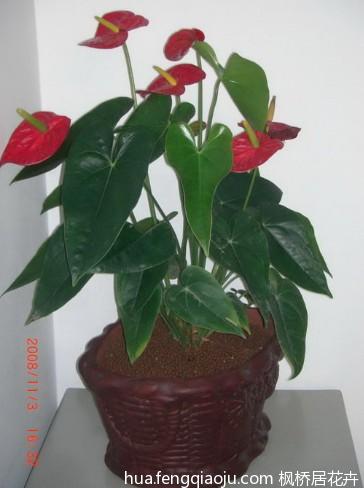
Anthurium: also called flamingo flower, likes a shaded, humid, warm, and well-drained environment. Scale insects are its common pests, so attention should be paid to prevention and control; brushing with a brush is enough.
Cineraria: likes sun, humidity, and fertilizer, but fertilizing should be reduced during the flowering period, and watering should balance dry and wet to prevent excessive dryness or wetness. At low temperatures, watering should be controlled, just slightly moist is enough, and attention should be paid to ventilation; otherwise, cineraria is prone to powdery mildew or damage by aphids and red spiders.
(Click the picture to see more cineraria pictures and growing methods)
Gloxinia: likes warmth and humidity, likes fertilizer, and avoids direct sunlight. Cyclamen likes a sunny, cool, and humid climate, with 10°C to 20°C being the suitable growing temperature, and is afraid of high temperatures.
Belgian azalea: likes cool, humid, acidic humus soil.
Christmas cactus: likes a warm, humid, semi-shaded environment. The suitable growing temperature is 15°C to 20°C, and when the temperature is below 5°C it enters a dormant state.
Calceolaria: likes a warm, cool, humid, and well-ventilated environment, is not cold-resistant, and avoids wetness.
Rieger begonia: likes a warm, humid environment and a semi-shaded environment.
(Click the picture to see more lotus pictures and growing methods)
Poinsettia: likes sufficient light, requires loose, fertile soil with good drainage and good aeration, and has strict water requirements. If soil moisture is too high, it often causes root disease and then leaf drop; if soil moisture is insufficient, the plant grows poorly and also drops leaves.
Kumquat: likes warmth, humidity, and sufficient light, and is suitable for fertile, well-drained, well-aerated sandy soil; it is not cold-resistant and avoids drought.
Ornamental bromeliad: likes a high-temperature, humid, semi-shaded environment. The potting soil should preferably be sandy soil containing humus, and the overwintering temperature should be above 10°C.
Summary: A large collection of indoor flower pictures makes people feel they must take action after looking at them. Rather than just being tempted, it is better to act, and follow the home flower cultivation methods introduced by the editor to decorate your beloved home together.
Which flower varieties should be chosen for home flower growing
For home flower growing, potted plants are generally the main choice. Due to limited conditions, do not plant too many; 10 to 15 pots is suitable. The flowers chosen should preferably include foliage flowers, flowering flowers, fruiting flowers, fragrant plants, and ornamental-form flowers, so that the varieties are rich and diverse.
For home flower growing, if the main purpose is decorating the living space, you can grow more indoor-suitable foliage plants, such as Brazilian wood, dwarf umbrella tree, Swiss cheese plant, giant taro, areca palm, broadleaf lady palm, parlor palm, cast-iron plant, spider plant, pothos, asparagus fern, and clivia. These plants are relatively shade-tolerant and can grow normally with only weak light or scattered light.
For home flower growing, if the purpose is ornamental appreciation, you can grow more flowering, fruiting, and stem-appreciation flowers and bonsai, such as Chinese rose, camellia, azalea, milan, jasmine, hibiscus, pomegranate, kumquat, Buddha belly bamboo, lucky bamboo, sago palm, five-needle pine, elm stump, and banyan stump.