What are the basic principles for controlling pests and diseases in household potted flowers?
Pest and disease control should be based on prevention. Whether for indoor home cultivation and appreciation or large-scale commercial cultivation, strict quarantine must be carried out to eliminate sources of pests and diseases. If pests or diseases are found, the principle of "treat early, treat few, treat thoroughly" should be followed. Do not wait until the damage is severe before treating, so as to avoid wasting manpower and resources and making control difficult. Even if the problem can be cured at that point, the flowers have already been damaged.
1. Strict quarantine
When introducing new varieties, pests and diseases are often brought in along with them. Therefore, all purchased flowers and seedlings should be strictly inspected, and it is best not to buy flower plants carrying pests or diseases. If purchased plants are found to carry pests or diseases, immediately remove the insects, eggs, and diseased leaves and branches, and plant them separately for observation for a period of time. Once it is confirmed that there are no pests or diseases, they can be kept together with the majority of the flowers.
2. Improving cultivation environmental conditions
The occurrence and spread of pests and diseases require certain external environmental conditions. Therefore, in pest and disease control, comprehensive conditions should be considered, especially the improvement of cultivation techniques and environmental conditions. When flowers are well cultivated and grow robustly, their ability to resist pests and diseases is stronger. Improving the cultivation environment can make it unfavorable for the survival and occurrence of pests and diseases while being suitable for the growth of cultivated flowers. For example, enhancing ventilation and light penetration, and promptly removing residual branches, fallen leaves, and pest- or disease-infested plants.
3. Rational use of pesticides
When pests and diseases appear in large numbers, the most commonly used method is chemical control. Its advantage is that it can kill or inhibit a large number of pests and pathogens in a short time, rapidly eliminating the threat of pests and diseases, and it is relatively simple and easy to apply. However, improper use of pesticides can lead to phytotoxicity, pest resistance, and residual contamination. Especially for indoor home flower growing, the purpose of which is to enhance people's physical and mental health, pesticides should be used with particular caution. If possible, avoid pesticides entirely; when they must be used, only non-toxic or low-toxicity pesticides should be chosen. Spraying toxic pesticides indoors is absolutely prohibited. When spraying, flower pots can be moved outdoors, and moved back indoors several hours after spraying. Unrestrained repeated use of a single insecticide will cause pests to develop resistance. Therefore, insecticides should be used in rotation.
Pest and disease control for potted flowers
The principles of flower pest and disease control are: prevention first, comprehensive management. The following should be achieved:1. Strengthen quarantine: When introducing flowers, be careful not to bring back harmful organisms and pathogens. This is a major problem in current flower production and must be given sufficient attention by relevant departments, flower growers, and flower enthusiasts.
2. Protect natural enemies: Such as ladybugs, Aphidius wasps, aphid flies, big-eyed bugs, as well as various spiders on the ground and on plants, toads, frogs, beneficial birds, etc., all of which should be protected.
3. Light and color trapping: 24 pairs of black light lamps can be used to trap and kill some phototactic pests.
4. Heat treatment: If there are root mites harming the corms of narcissus, tulips, gladiolus, etc., the corms can be treated with hot water, soaking in 44°C water for 4 hours or in 45°C hot water for 3 hours, which can kill all root mites.
5. Manual capture: This method can be used for household flowers.
6. Chemical control: Common underground pests mainly include: white grubs (white soil worms); control methods:
① Pour 50% phoxim emulsifiable concentrate at 100-1500 times dilution around the root zone; the mortality rate can reach 100%; at 2000 times dilution it can also reach 98.3%.
② Pour 50% phosphamidon emulsifiable concentrate at 1500-2000 times dilution around the root zone; the mortality rate can reach 100%; at 2500 times dilution it can also reach 92.5%.
Ant control methods: Use 70% mirex powder, directly sprinkle on the soil surface around the root zone where ant colonies are present, or around ant nests and ant trails, or mix into bait and spread. In addition, dusting with lindane, chlordane, heptachlor and other powders on the soil surface where ants are active also has good results.
Snail and slug control methods:
① Pour tea seed cake water (soaked in water at 1:15) around the root zone of affected flowers, or spread soaked tea seed cake crumbs;
② Spread 8% metaldehyde granules on the soil surface around the root zone. The effective earthworm control method for metaldehyde: use chlordane, or heptachlor, carbaryl powder (1-1.5 grams per square meter) or pour tea seed cake water (soaked at 1:15).
Millipede (Julus) control method: Use 25% carbaryl or 25% diazinon, diluted 500 times with water, and apply to the soil surface inside and outside the pot.
Main types of leaf-eating pests and their control: Slug moth control methods:
① Use parasitic wasp protectors to protect natural enemies. During the emergence period of slug moths (late May to mid-June), use black light lamps to trap and kill adults;
② Spray 50% fenitrothion or 50% phoxim at 800-**** times dilution during the young instar or before the larvae disperse from clusters; or 10-20% pyrethroid at 1000-2000 times dilution;
③ Spraying Br emulsion containing 10 billion spores per ton diluted 500 times with water also has good results. The ingredient metaldehyde has good results.
Bagworm (also known as bag moth) control methods:
① Protect and utilize the dominant natural enemy, the tachinid fly,
② Use black light lamps to trap and kill male adults. Use Br emulsion or Br emulsion or Br-NPV microbial mixture, so that Bt spores at 5-10.7 per ml and NPV particles at 1×10.6 per unit have good results.
③ Spraying 50% phoxim at 1000 times dilution is highly effective.
Tussock moth control methods:
① Use black light lamps to trap and kill during the adult emergence period. Before overwintering, tie grass bundles on the trunks of woody flowers to attract mature larvae, then kill them;
② Spray 50% fenitrothion or 50% phoxim at 1000 times dilution, or synthetic pyrethroids at 1000-2000 times dilution.
Main types of piercing-sucking mouthpart pests and their control:
Green peach aphid and cotton aphid control methods:
① Use yellow plastic boards coated with heavy oil in the field to attract and trap winged aphids.
② Protect natural enemies, including parasitic Aphidius wasps, predatory aphid flies, ladybugs, as well as pathogenic microorganisms such as Entomophthora.
③ Chemical control:
a. Botanical pesticides: 3% natural pyrethrin, 25% derris extract, 40% nicotine sulfate, all can be diluted to 800-**** times; effective and safe;
b. Synthetic pyrethroids such as: deltamethrin, cypermethrin, permethrin, fenvalerate, etc., most with an effective content of 20%, can be diluted 2000-3000 times with water, have a rapid knockdown effect, but easily induce resistance;
c. 40% acephate emulsifiable concentrate (Orthene) at 1000 times dilution, 40% omethoate, with good systemic and translaminar properties, spray at 2000 times dilution, or apply to stems at 50-100 times dilution.
Red wax scale control methods:
① During the hatching period, spray 40% omethoate or 50% fenitrothion, 50% monocrotophos at 1000 times dilution, or 20% fenvalerate at 1500-2000 times dilution. Starting from early June, spray once every 10 days on sunny days, 3 times consecutively, to achieve ideal results.
② Protect natural enemies, the red-spotted ladybird and the Mongolian ladybird (for mealybugs, refer to the same chemical control methods). Main types of boring pests and their control: Longhorn beetle control methods:
① Adults often crawl from the canopy to the trunk base to mate and lay eggs on sunny noons, and are easy to capture.
② Since their tunnels are not deep and are generally in the bark and tender branches, when frass is seen being expelled, they can be picked out and killed with a small knife.
③ Release the dominant natural enemy, the parasitic wasp.
④ Apply whitewash to the trunk base (ratio: lime-sulfur 10:1 salt, appropriate amount of water).
Cossid moth control methods:
① Use black light lamps to trap and kill adults.
② Prune and collect wind-broken branches and burn them promptly.
③ Use a mixture of fenitrothion and omethoate to drip into the bore holes.
The main types of infectious diseases of plants are:
1. Damping-off: also called seedling blight, mainly harms seedlings of various plants. Control methods:
① Seed disinfection by mixing with 0.3% thiram.
② At the early stage of disease, spray 50% captan at 500 times dilution, or 75% chlorothalonil at 800 times dilution, spray 1-2 times, or 60% carbendazim at 500 times dilution twice a week, with 3-4 day intervals, to inhibit its spread.
2. Southern blight (sclerotial basal rot of seedlings): Control methods:
① Mix soil with 70% quintozene.
② Replace the soil.
③ Crop rotation for more than 4 years.
④ Add 0.7 kg of Trichoderma harzianum to 50 kg of potting soil for pot cultivation.
⑤ Provide appropriate ventilation and avoid overcrowded cultivation.
3. Powdery mildew control methods:
① Apply more phosphorus and potassium fertilizers and use disease-resistant varieties.
② At the early stage of disease, spray 25% triadimefon wettable powder at 2000 times dilution, or 20% triadimefon emulsifiable concentrate at 4000 times dilution, or 70% thiophanate-methyl at 1000 times dilution, or dexon at 1000 times dilution.
4. Downy mildew: Control methods: at the early stage of disease, spray 50% zineb at 600 times dilution, 20% metalaxyl (Ridomil) at 400 times dilution, or 50% dimethomorph at 4000 times dilution; all are effective.
5. Rust disease control methods:
① Selection of mother plants;
② Spray 40% triadimefon at 4000 times dilution, or 20% triadimefon emulsifiable concentrate at 2000 times dilution; or spray 20% triadimefon emulsifiable concentrate at 2000 times dilution; or use 20% triforme emulsifiable concentrate at 1000 times dilution for control.
6. Gray mold control methods: From March to April, use 80% zineb at 500 times dilution, 1% Bordeaux mixture, 50% dicloran at 1000 times dilution, or 75% chlorothalonil at 500 times dilution. Choose any one and spray once every 10 days, 2-3 times.
7. Anthracnose control methods:
① Strengthen environmental sanitation and maintenance management;
② When disease occurs, prune diseased branches and burn them, then spray 1:1:100 Bordeaux mixture for protection and to prevent spread, or spray 50% carbendazim wettable powder at 500 times dilution, or 50% thiophanate wettable powder at 500 times dilution 3-4 times, once every 10-14 days.
8. Leaf spot disease control methods:
① Select disease-resistant varieties;
② Use 75% chlorothalonil, 50% zineb, or 50% dexon; choose any one at a concentration of 500 times dilution, spray once every 10 days or so.
9. Fusarium wilt control methods:
① Crop rotation;
② Dig on sunny days and select loose sandy soil;
③ Before planting, soak corms in 50% carbendazim at 500 times dilution for half an hour, then coat with 50% thiram powder before planting.
Propagation methods and pest and disease control of potted giant orchids
Today's potted plant knowledge begins. The editor of Huinong Network will bring you household potted giant orchid propagation and pest and disease control cultivation techniques. Flower grower friends in need can refer to this!
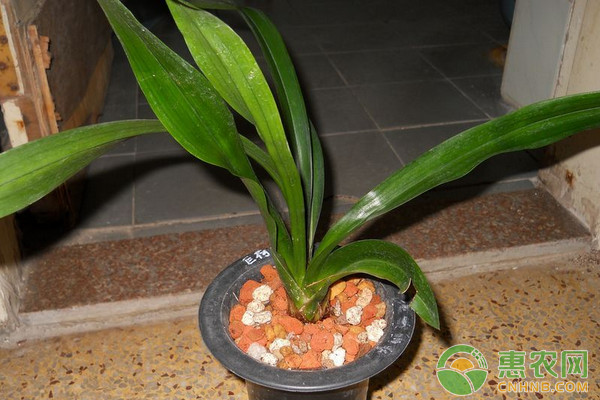
1 Propagation
Conventional propagation of giant orchids is mainly by division, while large-scale propagation can be carried out through aseptic sowing.
1.1 Division propagation
This method is easy to propagate, and plants planted in the same year can produce many pseudobulbs that same year. Division propagation is mostly carried out after flowering or before spring sprouting. When dividing, first take the plant out of the pot, remove the substrate attached to the roots, expose the root system, and then separate the pseudobulbs with more shoots from the base. Each clump should have 3 pseudobulbs, and use a brush dipped in sulfur powder or carbendazim powder to apply to the wounds to prevent infection by pathogens. The new plant should be planted in a pot filled with bark chunks or expanded clay pellets and placed in a semi-shaded, humid place, with daily misting of the leaves to keep the leaves and pseudobulbs from shrinking. At the time of division, the roots must not be watered or fertilized, otherwise root rot will occur. Root watering can only be carried out when new roots have grown to 2-3 cm long.
1.2 Aseptic sowing
Through aseptic sowing propagation, a large number of tissue-cultured seedlings can be obtained in a short time. For aseptic sowing, use mature but unopened fruits, disinfect them, and scatter the seeds in modified KC medium without growth regulators for culture. Seeds can germinate in 30 days, and tiny protocorms can be seen with the naked eye in 40 days, with a germination rate of over 70%. Then transfer them to modified KC+NAA 0.2 mg/L medium, where the protocorms begin to grow and differentiate into small seedlings. Transfer the small seedlings to modified KC+NAA 0.5 mg/L+banana puree 20 g/L medium for rooted seedling culture. When the root system of the test-tube seedlings grows to 5-6 cm, they can be transplanted into the greenhouse. Before transplanting the test-tube seedlings, to improve the survival rate of transplanting, first culture the bottle seedlings under natural conditions for about 7 days to improve their adaptability to the environment. After hardening, gently take out the seedlings with tweezers or chopsticks, rinse the roots clean with tap water, soak the washed test-tube seedlings in 0.01% potassium permanganate or 0.1% carbendazim or chlorothalonil and other fungicides for 3-5 minutes, dry slightly, and then plant them in the prepared substrate. The substrate is best made of bark chunks, crushed stone, expanded clay, volcanic rock, etc. with good aeration. After transplanting, provide appropriate shading and strengthen water management, but note that the substrate should not be too wet or waterlogged to prevent seedling rot. The most suitable transplanting temperature is between 23°C and 28°C. After 4-6 weeks of transplanting, the new buds of the test-tube seedlings begin to grow. 0.1% urea and monopotassium phosphate can be used as foliar topdressing, and at this point the small seedlings can be transferred to normal management.
2 Cultivation management
2.1 Temperature and environment
Giant orchids prefer a warm, humid, semi-shaded and ventilated environment, and are not cold-tolerant. The suitable temperature for year-round growth should be 15°C-30°C, and the winter overwintering temperature should be above 10°C. Because the plants have strong spreading characteristics, they are not often introduced for cultivation, but in large high-temperature greenhouses they can achieve good ornamental effects. Tall species can be planted in gardens in tropical regions. Small species can be planted in pots, but in northern regions in winter it is best to place them indoors with heating facilities and maintain relatively high air humidity.
Giant orchid plants are not tolerant of strong light and require good ventilation and air permeability to prevent excessive heat from adversely affecting plant growth. The more sufficient the light, the more the plants bloom. If the temperature exceeds 30°C, photosynthetic capacity decreases; above 35°C the plants stop growing and may even enter a semi-dormant state. For large-scale planting, 50%-60% shading should be provided in summer, the shading rate can be reduced to 30%-40% in spring and autumn, and no shading or little shading can be used in winter.
2.2 Cultivation substrate
The root system of giant orchids consists of relatively thick upright roots and clinging roots. During cultivation, the roots require good aeration, and the cultivation substrate must be loose, water-permeable and air-permeable. Usually expanded clay, fern roots, bark chunks, coconut shells, peat soil, crushed bricks, charcoal, volcanic rock or vermiculite and other materials are used as substrate for planting, and they can also be grown attached to trees. For those with bamboo-like stems, coarse bark and dried cow dung or a similar mixture can be used as substrate and planted in greenhouse beds. If moss and bark chunks are used for potted flower production, the planting material should be replaced once every year, preferably in spring before new shoots have grown. When transplanting, be careful not to damage the upright roots and clinging roots. After repotting, provide appropriate shading, and do not water for 3-5 days. Only spray a small amount of water on the pot surface and leaves each day to keep the plant from shrinking. Only after new roots and new shoots enter normal growth can normal management begin.
2.3 Watering and fertilizing
During the vigorous spring growth period, giant orchids require sufficient water and relatively high air humidity, otherwise their growth will be affected. The relative air humidity should be maintained at 70%-80%, but at the same time air circulation should be strengthened. During the flowering period, the leaves and flowers should be kept dry at night. In summer, watering can be scheduled in the morning or evening, and attention should be paid to misting the leaves and the environment. During winter dormancy, in addition to keeping warm, watering should be reduced, otherwise the pseudobulbs are prone to rot.
During the cultivation of giant orchids, light fertilizer should be applied frequently, with the principle of small amounts and frequent applications, and complete nutrition. Fertilization should be carried out in the three growing seasons of spring, summer and autumn. Every 7-15 days, apply once with decomposed cake fertilizer liquid diluted 2000-3000 times, or apply once as foliar feeding with a nitrogen, phosphorus and potassium compound fertilizer diluted 1000-2000 times. Multi-element slow-release compound fertilizer granules can also be buried and applied monthly. Fertilization should be stopped when the room temperature is above 30°C or below 15°C.
3 Pest and disease control
3.1 Diseases
Mainly include leaf blight, phytophthora disease, anthracnose, round spot disease, stem rot, and sooty mold.
① Leaf blight. It harms plant leaves. In the early stage, small reddish-brown spots appear on the leaves, then expand into semicircular, circular or irregular water-soaked dark brown spots. When it occurs at the leaf margin, the lesion is semicircular, relatively large, with a dark brown broad band at the edge. When humidity is high, the leaf tissue between the lesions loses green and turns yellow, causing the entire leaf to die. When the lesion is at the leaf base, it accelerates leaf death. Control methods: Strengthen maintenance management, do not wet the leaves when watering, and potted flowers should not be placed too densely. Promptly prune diseased leaves when found and keep them away from other plants to reduce infection. For chemical control, choose orchid disease. Bizhi wettable powder at 500-800 times dilution, or 47% Kasumin at 800-1000 times dilution, or 75% chlorothalonil wettable powder at 1000 times dilution, once every 7-10 days, 3-4 times consecutively.
② Phytophthora disease. It can occur throughout the year, but is most severe during the plum rain season, when watering is too wet or ventilation is poor, and seedlings that have just come out of bottles are especially vulnerable. Brown lesions form at the infected site, rapidly expanding under high temperature and high humidity, eventually becoming dark brown spots, with leaf drop and stem rot leading to plant death. Control methods: Avoid excessive moisture, improve ventilation and air circulation, and provide sufficient light. Avoid excessive use of nitrogen fertilizer to reduce weak and spindly plant growth. Once diseased leaves are found, prune them promptly, treat the cut with 75% alcohol, and then place in a dry place. During the epidemic period of phytophthora disease, control watering to curb the spread of the disease. In the early stage of disease, spray 72% Curzate wettable powder at 800-1000 times dilution, or Amistar wettable powder at 2000 times dilution, or 72.2% Previcur wettable powder at 600-800 times dilution for control, once every 7-10 days, 3 times consecutively.
③ Round spot disease. It harms leaves and manifests as two symptoms: one is circular lesions, with semicircular lesions produced on the leaf margin, the diseased part is black, the junction between diseased and healthy tissue does not change color, and both sides of the leaf are sunken. The second is the appearance of a disease center on the leaf surface, with lesions radiating and spreading outward from the center, producing many small dark brown spots, and the leaf tissue around the lesions gradually turning yellow. Control methods: Strengthen maintenance management, pay attention to sanitation, promptly prune diseased leaves, and reduce sources of disease. At the early stage of disease, spray 12.5% Guoguang Heisha wettable powder at 3000-4000 times dilution, 75% chlorothalonil wettable powder at 800 times dilution, or 70% mancozeb wettable powder at 800-1000 times dilution, once every 7-10 days, 2-3 times consecutively.
④ Anthracnose. At the early stage of disease, brown sunken small spots form on the leaves, gradually expanding into circular or irregular lesions, and in severe cases there is necrosis in the center of the lesions. Plants planted too densely, with poor ventilation, water imbalance, or wounds are more susceptible to infection. Control methods: Do not plant too densely. Increase light, and ensure good drainage and ventilation. Spray promptly at the early stage of disease or after pruning diseased leaves. Use anthracnose-specific fungicide, chlorothalonil, thiophanate-methyl, mancozeb and other wettable powders at 800-1000 times dilution, once every 10 days, 3-4 times consecutively.
⑤ Stem rot. It mostly occurs on the stem nodes of sugarcane giant orchids. It is more likely to occur under high temperature and high humidity in spring and summer, poor ventilation, and excessive application of nitrogen fertilizer. Control methods: Improve growing conditions, increase ventilation, and lower temperature and humidity. Once it occurs, immediately cut off the infected part, apply antibiotic powder, and do not water for 1 week, which can stop the spread of the disease. For chemical control, spray 72% agricultural streptomycin at 1000 times dilution, 47% Kasumin at 800 times dilution, lime-sulfur mixture or Bordeaux mixture at 500 times dilution at the early stage, once a week, 2-3 times consecutively.
⑥ Sooty mold. It occurs in places with extensive management, poor ventilation, and insufficient light. Affected by pests such as aphids and whiteflies, scale insects on the leaf surface or underside secrete honeydew, affecting plant photosynthesis and appearance. Control methods: Strengthen maintenance management and pay attention to ventilation. Promptly control pests such as scale insects, aphids and whiteflies. For sooty mold, use a wet cloth to wipe the affected areas to remove the fungi attached to the surface. For chemical control, spray 50% procymidone wettable powder at 1000 times dilution, 75% chlorothalonil wettable powder at 800-1000 times dilution, 50% carbendazim wettable powder at 500-800 times dilution, or 18% copper carbendazim wettable powder at 2000 times dilution, once a week, 3-4 times consecutively.
3.2 Pests
Mainly include aphids, scale insects, boring insects, snails, slugs, etc.
① Aphids. They harm newly unfolded leaves and inflorescences, affecting plant growth, inducing sooty mold, and at the same time spreading various viral diseases. Once aphid damage is found, immediately spray imidacloprid at 1000 times dilution, or 2.5% deltamethrin at 2000-3000 times dilution for control. Insect-proof nets can also be installed at greenhouse vents or yellow sticky boards hung indoors to trap and kill winged aphids.
② Scale insects. They mostly occur in cultivation sites with high humidity, poor ventilation and insufficient sunlight. Scale insects are widely damaging. In warm regions they occur outdoors, and in cold regions indoors, mostly damaging the leaf underside and leaf axils, hindering plant growth and inducing sooty mold, affecting ornamental value. In severe cases, leaves yellow, weaken, and eventually wither and fall. Control methods: Improve the environment, strengthen ventilation and air permeability, and prevent dry heat and stuffy humidity. When scale insects occur in large numbers, choose highly penetrative scale-specific pesticides, such as 2.5% Jiebizhi at 800 times dilution, Pumiejie at 2000 times dilution, Jiesijing at 800-1000 times dilution, Jieshate at 1000 times dilution, Supusha at 2000-3000 times dilution, etc., and spray comprehensively, covering both the front and back of leaves. Spray once a week, for more than two consecutive times.
③ Boring insects. Also called the sugarcane stem borer, it harms pseudobulbs or rhizome parts, and in severe cases causes plant death. Control methods: Check frequently and promptly eliminate pests when found. Hang black light lamps in the greenhouse to trap and kill adults. For chemical control, choose 2.5% deltamethrin emulsifiable concentrate at 2000 times dilution, or 80% dichlorvos or omethoate at 800-1000 times dilution for spraying or drenching.
④ Snails and slugs. They mostly occur in humid environments, harming new buds, new leaves, roots and flowers, causing notches or holes. They also come out to cause damage during rainy days, early morning, or at dusk when the temperature is low. Control methods: Do not allow long-term water accumulation in the greenhouse, and pay attention to environmental cleanliness. In the early morning and evening, check the plants and pot bottoms in the garden, capture crawling snails and slugs, and destroy them in a centralized manner. Vegetable leaves can also be used to lure and gather them, or metaldehyde granules or snail-killing star granules can be spread around flower pots to trap and kill them. In the evening, spray 3% quicklime water or ammonia water at 100 times dilution to kill adults and juveniles.
The above is all the content on potted giant orchid cultivation and management techniques. Everyone is welcome to learn at Huinong Network!