Management Methods and Care Points After Flower Cutting Propagation
The environmental factors affecting the survival of cuttings are mainly temperature, humidity, light, aeration conditions and the cutting medium, etc. Whether the management after cutting is appropriate directly affects the survival rate of the cuttings.
① Temperature. Temperature has a great influence on the rooting of cuttings, and different types of flowers require different cutting temperatures. Generally, the temperature required for cuttings to root is 2-3°C higher than that required for cultivation. Cuttings root more easily at 15-20°C, and all heat-loving greenhouse flowers root at 25°C-30°C. If the soil temperature can be 3-6°C higher than the air temperature, it can promote the rapid rooting of cuttings.
② Humidity. After cutting, care should be taken to keep the cutting bed in a moist state, creating a soil moisture that is both moist and able to breathe. When doing softwood cuttings, a relatively high air humidity should be maintained, preferably 80%-90%, to prevent the cuttings and the retained leaves from wilting, and to rely on some green branches and leaves to produce nutrients for rooting. Therefore, the cutting bed should be sprayed frequently, and plastic film should be used for covering to retain moisture, so as to reduce the water evaporation of the cuttings. Before callus tissue forms, water a little more appropriately, and then gradually water less.
③ Sunlight. The duration and intensity of light have a great influence on the rooting ability of cuttings; longer daylight gives stronger rooting ability than shorter daylight. Cuttings do better when receiving scattered light; strong sunlight is unfavorable to the survival of cuttings. If the temperature is too high and evaporation is great, the cuttings will wither, so in the early stage of cutting, moderate shade should be given, maintaining about 50% light transmittance; on cloudy days, shading may be omitted. After the root system grows out, gradually provide sufficient sunlight.
④ Aeration. When cuttings root, cell division is vigorous and respiration is enhanced, requiring sufficient oxygen. Choose soil with good aeration, and spray water appropriately. When the temperature is high at noon, part of the film can be opened for ventilation, which is beneficial to rapid rooting and growth.
⑤ Cutting medium. For hardwood cuttings in the open field, they can be done in fertile sandy loam with relatively high water content. Softwood cuttings can be done in water, plain sand, vermiculite and perlite, cinder, or peat. The cutting medium should be loose and have good aeration conditions, contain no organic fertilizer or other impurities that easily mold, and be able to maintain a certain humidity. After the cuttings' root system grows out, they should be transplanted as early as possible; otherwise, due to insufficient nutrient supply from the medium, the leaves of the cuttings will turn yellow and age, affecting later growth and development.
Management Methods After Flower Cutting Propagation
1. Temperature. Softwood cuttings are generally more suitable at 20°C-25°C, and heat-loving plants root faster at 25°C or above. For flowers and trees that are difficult to root, such as creating a condition where the ground temperature is 20°C-40°C higher than the air temperature, rooting can be promoted.
2. Humidity and moisture. Softwood cuttings have higher requirements for environmental humidity and need to be kept above 80%, so the cutting bed should be sprayed frequently, and plastic film is commonly used to build an arched shed for moisture retention. For ordinary watering, before callus tissue forms, it can be appropriately more, and afterward it should be reduced somewhat.
3. Light. A certain amount of light promotes the rooting of leafy softwood cuttings. But the sunlight is stronger in the growing season, so shading is needed, maintaining about 50% light transmittance. On cloudy days, shading may be omitted, and after rooting, the shading material should be gradually removed.
4. Air. Cuttings will suffocate and rot because the medium is too wet and there is insufficient air in the medium. Therefore, the selected medium should be loose and well drained, and water should be sprayed appropriately. When the temperature is high at noon, part of the film should be opened for ventilation.
After the cuttings root, they should be transplanted as early as possible; otherwise, due to the lack of nutrients in the medium, the leaves of the cuttings will turn yellow and age, affecting later growth and development.
Techniques and Methods for Propagating Flowers in Water
For water propagation containers, an ordinary canning jar can generally be used. Use a piece of perforated foam plug at the mouth of the bottle to fix the cuttings.
In the growing season, take robust current-year or two-year-old branches, about 3 nodes long, keep 2-4 leaves on the upper part of the branch, cut the lower end diagonally into a horseshoe shape, and then insert it into a container filled with water, with a depth of 1/2-2/3 of the branch length. It is better to keep the water temperature at 20°C-25°C, and change the water 2 times a week. Usually place the container in a place with bright scattered light; it can receive light in the morning and evening, but avoid too strong light.
When the new roots grow to about 3 cm, they can be transplanted into pots. For a period at the beginning, relatively high humidity should be maintained to let them have an adaptation process, which helps improve the transplant survival rate. Suitable for water propagation are, for example, gardenia, oleander, rubber tree, Aucuba japonica, Rohdea japonica, Monstera deliciosa, spider plant, Tradescantia, ivy, Begonia semperflorens, winter jasmine, fig, Codiaeum variegatum, Chinese rose, Daphne, Michelia figo, Dracaena species, hibiscus, pomegranate, dahlia, Cyperus alternifolius, chrysanthemum, Pachystachys lutea, Coleus, marigold, etc.
How to Manage After Cutting Propagation
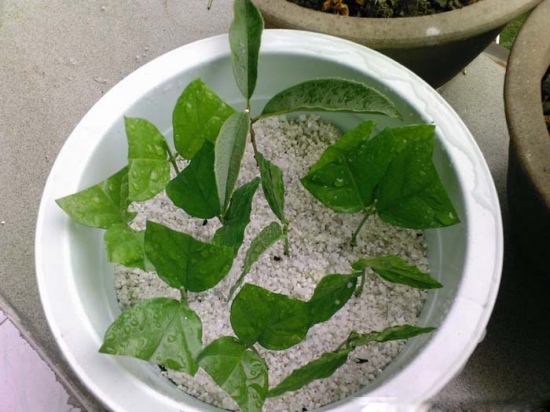 Plants After Cutting Propagation
(1) Temperature management. Temperature plays a very important role in the rooting of cuttings. The suitable rooting temperature for softwood cuttings of most flowers is 20°C~25°C; for semi-hardwood and hardwood cuttings it is 22°C~28°C; for leaf cuttings and bud cuttings it varies by species, with the suitable temperature within the range of 20~28. If the temperature of the cutting bed is lower than 20°C, the cuttings are not easy to root; if higher than 28, the leaves of the cuttings are likely to wilt and affect rooting. In spring, the outside air temperature is too low; if the cutting bed has a device to increase bottom temperature, it is beneficial to the survival of early spring hardwood cuttings. For summer cuttings, attention should be paid to preventing high-temperature damage; open the covering and spray the leaf surface to lower the temperature.
(2) Moisture management. After cutting, the medium is required to continuously provide sufficient moisture to maintain the normal freshness of branches and leaves. Generally, a soil moisture content of 50~60 is suitable; too much moisture often causes the cuttings to rot. At the same time, relatively high air humidity is required, usually 80%~90% relative humidity is good. For this reason, timely use leaf surface spraying and adjustment of the covering should be used to control it. To avoid direct sunlight causing large amounts of water transpiration and leading to leaf shrinkage, attention should be paid to shading.
(3) Light management. The terminal buds and leaves carried by the cuttings can carry out photosynthesis only in sunlight and produce auxin to promote rooting. However, because they have been separated from the mother plant, appropriate shading should be given, generally with a shading degree of 70% as suitable. About half a month after the cuttings root, they can be moved out and planted into pots, first placed in a concealed place to recover, and after the root system develops well and the plants are robust, gradually move them to a place with sufficient sunlight and manage them conventionally.