How is layering done for flowering plants? A detailed guide to the method
Layering is a propagation method in which part of a flowering plant used as the mother plant is ring-barked, then soil is mounded or pressed around its stem, and once roots have formed it is cut from the parent plant and planted separately to become an independent plant. On the mother plant, choose a mature, robust current-year branch with plump buds to serve as the layer. Its advantage is that it preserves the fine characteristics of the mother plant; its drawback is that it cannot be used for mass propagation. The timing of layering varies with the flower species; generally, deciduous trees are layered in spring and autumn, with early spring in April being suitable. It is mostly used for flowers that are difficult to root from cuttings, such as wintersweet, osmanthus and Aglaia odorata.
Single-branch layering: take a branch close to the ground as the layering material, bury the branch 15 cm deep in the soil, cut or ring-bark the buried portion of the branch, leave the tip of the branch exposed above the ground, and cover with soil and press firm. Forsythia, Buddhist pine (Podocarpus macrophyllus) and winter jasmine are commonly propagated by this method.
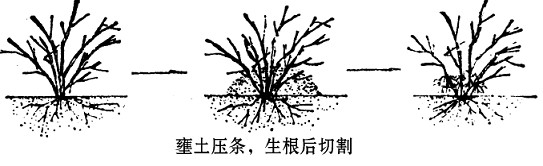
Mound layering: this method is mostly used for clump-forming woody flowers. In the first year, cut the above-ground part short to encourage side shoots to sprout; in the second year, cut the base of each side shoot and mound soil over it, and after rooting, transplant them separately. Winter jasmine, Forsythia viridissima and the like can all be propagated by this method.
Wave layering: cut the branch in several places, bury the cut portions in soil, and after rooting, cut and transplant them to make new plants. Air layering: choose a mature, robust current-year branch, perform ring-barking or notching, wrap the ring-barked area with plastic film, fill it with moss and soil of suitable moisture, and after new roots grow, cut it off, remove the film, and plant it as a new individual. The layer does not detach from the mother plant and relies on the mother plant for nutrition, but be careful to press the covering soil firm. The time to sever it varies with the variety. Rose can be severed the same year, while osmanthus is severed the following year. When planting, keep as much soil around it as possible to protect the new roots and improve the survival rate.
How is layering carried out? Which flowers are suitable for propagation by layering?
Flower Bonsai Network, Flower Growing Basics section: How is layering carried out? Which flowers are suitable for propagation by layering?
Layering is a propagation method that makes use of the habit of branches rooting when they come into contact with soil: part of a branch or its stem or vine is buried and pressed into the soil to let it root, and then it is divided off as an independent plant. Two forms are often used for flowers: mound layering and air layering.
Mound layering makes use of plants with relatively short branches or vine-like plants by burying the lower branches in soil and watering regularly; after one season or half a year, once the buried branches have produced roots, pull the soil aside and cut them, then pot and plant the plants with their root masses separately. Generally, they are layered in spring and divided and planted in autumn. Flowers commonly propagated by this method include rose, azalea, osmanthus, wintersweet, gardenia, night-blooming jasmine (Cestrum nocturnum) and honeysuckle.
 Air layering is suitable for taller plants and for flowers whose branches are not easily bent, such as camellia, Aglaia odorata, white magnolia (Michelia alba), peach, plum, crape myrtle, crabapple and osmanthus. For a branch used for air layering, first ring-bark it 4 to 6 cm above the branching point, with a length of about 3 cm, cutting down to the xylem but without damaging the xylem. Then use plastic film filled with moss or peat soil to wrap the cut portion. Tie the upper and lower openings tightly with fine hemp rope, and tie the middle well too, leaving the upper part funnel-shaped so that rainwater can run down along the branch. Moss or peat soil is used mainly because it is lightweight, moisture-retaining and breathable. Generally, the air layer is wrapped in April to May, and in September to October of the same year the plastic film can be unwrapped and the rooted branch cut off for planting.
How to propagate flowering plants by layering at home
Layering is a propagation method in which a branch is not detached from the mother plant but is made to root at a fixed point, forming a new plant. Layering is mostly used for flowers that are difficult to root from cuttings. The plants grown from layers are relatively large and the young plants are quickly established. Depending on the layering site, it can also be divided into mound layering and air layering.(1) Mound layering. Mound layering means mounding soil around the mother tree in spring, burying most of the branches in the soil, and keeping the mound constantly moist; after the branches have rooted, cut them off with roots from the base of the layer, separate them from the mother plant to form new plants, and pot or transplant them.
(2) Air layering. Air layering is used for flowers with tall plants and branches that are not easily bent. First notch or ring-bark the branch, then surround the wound with a flower pot, plastic film, paper tube or the like, fill the inside with potting soil, moss and other moisture-retaining materials, tie it firmly in place, and water regularly to keep it moist. After rooting, cut it off from the lower end to form a new plant.