How to grow rosemary? Master the correct care methods
How to grow rosemary? Rosemary is an evergreen shrub native to Europe. It has a rich, fresh fragrance and can be used as a seasoning for Western dishes. When grown naturally, the shrub can reach more than 2 m tall; if grown in a pot on a balcony, because the roots are restricted, the plant height can be kept within the range of 30-40 cm, forming a small shrub. It has a well-developed root system, with the main root reaching 20-30 cm into the soil layer. The plant is 30-40 cm tall, with stems 0.5-0.8 cm thick; tender branches grow opposite each other at the base of the stem and are 10-12 cm long. The leaves are opposite, with relatively dense nodes, forming clusters of young leaves; the leaves are 2.5-3 cm long and 0.2 cm wide, linear in shape. Next, let us learn how to grow rosemary!
For growing rosemary at home, tender branches can be used for softwood cuttings during the plum rain season. If planting for the first time, propagation by sowing can be used.
Home courtyard cultivation requires only a small number of seedlings, so small seedling trays can be used to grow the seedlings. Place about 4 cm of soaked rice husk in the seedling tray, press it firm, then add 1 cm of potting soil, spread it flat, scatter the seeds, cover with another 0.5 cm of potting soil, moisten the potting soil with a sprayer, cover with plastic film, and keep it indoors at about 25°C to retain warmth. Seedlings emerge in about 12-15 days.
After the seedlings emerge, remove the film promptly and place them on a windowsill, keeping them exposed to light, with the seedbed soil moist and suitable temperature conditions, so the seedlings grow normally. When the seedlings are 2-3 cm tall, transplant them into small plastic pots 9 cm in diameter. By the end of autumn of that year the seedlings have grown larger and need repotting, moved into slightly larger plastic pots 18 cm in diameter, so the roots can develop in fresh potting soil.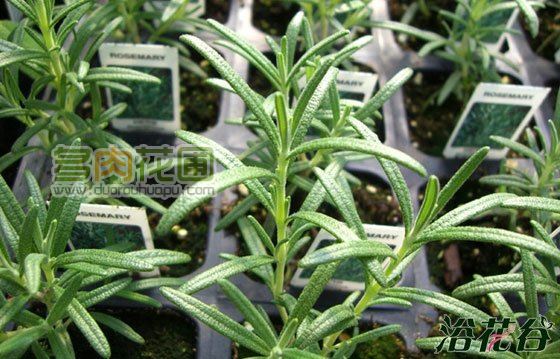
About fertilizing rosemary,Do not worry about fertilizing. Herb plants do not need fertilizer. However, please make sure the soil contains some lime.
How to grow rosemary?
1. Light and temperature.
Rosemary likes a warm and suitable environment. In the south it can be grown year-round, while in the north it is mostly grown in pots, which makes it easier to move indoors in winter to keep it warm. Rosemary likes sunlight and needs no less than 8 hours of sunlight per day; in summer, when temperatures are high, it can be shaded appropriately.
2. Soil.
Rosemary is suitable for growing in slightly alkaline soil. When cultivating it, you can add some quicklime to acidic soil to make the soil suitable for rosemary growth, and the stronger the soil alkalinity, the stronger the fragrance of rosemary.
3. Watering.
Rosemary is relatively drought-tolerant. When watering, take care to water when the soil is dry, generally once every two days, watering thoroughly each time. In winter, watering should be reduced to enhance cold resistance and prevent freezing damage.
4. Fertilizing.
Rosemary does not have high fertilizer requirements and is relatively tolerant of poor soil; generally, herb plants do not need fertilizer. During the growing season, nitrogen and phosphorus fertilizer can be applied in appropriate amounts as needed to promote growth.
5. Pruning.
To maintain the shape of a potted plant, rosemary can be pruned three months after it has established. Generally, prune overly dense and overly long branches, and prune dead branches and diseased branches promptly. This ensures ventilation and air movement, allowing the plant to grow healthily.
The above is an introduction to rosemary cultivation methods. Below, the editor will also tell everyone about pest and disease control for rosemary care at home.