Detailed Guide to the Care Methods and Techniques of Plum Blossom Bonsai
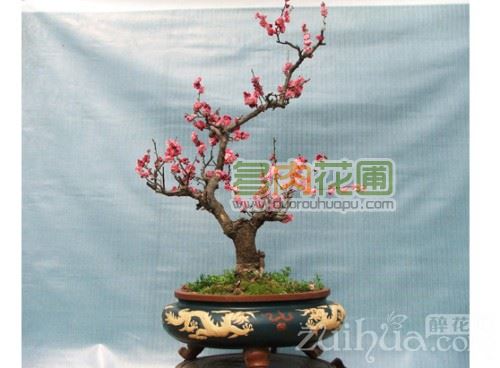
Care of plum blossom bonsai. People love plum blossoms; some paint them, some grow them, and more simply admire them. The plum blossom, one of the Ten Great Famous Flowers, has a long history of being made into bonsai. It is a representative tree species of Hui-style bonsai, mostly shaped by binding and bending, and holds high ornamental value.
The shaping is mainly done by natural-style pruning and cutting, supplemented by binding and bending. The trunk is hung and bound into a curved-trunk style, slanted-trunk style, or lying-trunk style; some are trained from a young age, with the trunk bound into a cliff-hanging style lower than the rim of the pot; some have the trunk bent into a wandering-dragon style. The roots are mostly exposed roots or suspended roots, and the branches should be both sparse and dense, with the main branches not too numerous.
The care of plum blossom bonsai is very important; with proper care it can bloom and be enjoyed year after year.
When potting, generally use 70% pond mud, 20% leaf mold, and 10% decomposed compost soil, mixed evenly for planting; such potting soil has good drainage and does not easily become waterlogged. The size and style of the pot are determined by the size of the tree stump and the form of the shaping, mostly using a long pot of medium depth. The potting soil should not be too shallow or too little, otherwise it will affect the growth and development of the tree stump. After the tree stump is potted, it should be placed in a spot with ample light and good ventilation.
Fertilizing: Attention should be paid to the fertilizing season. Generally, when repotting, bone meal, soybean cake, etc. can be placed at the bottom of the pot as base fertilizer; in mid to late May, before the flower buds form, apply 1-2 times of cake fertilizer water as a top dressing; in early August apply another 1-2 times; and apply one more top dressing in early autumn.
Pruning: To make plum blossom bonsai both quaint and vigorous while growing robustly and blooming abundantly, pruning is extremely important. Because the flower buds of the plum form on new branches of the current year, after flowering each year the old flowering branches should be immediately cut short, leaving only 2-3 buds, and care should be taken to make the buds grow outward, so that the following year the flowers will be abundant and brightly colored. Pruning of plum blossoms can be divided into the following types:
1. Thinning branches: That is, thinning out and cutting away various crossing branches, parallel branches, overlapping branches, opposite branches, water sprouts, and excessively dense or weak branches that affect the beauty of the tree shape. Follow the thinning principle of "do not touch old branches, keep the strong and remove the weak."
2. Cutting back: That is, on the basis of thinning branches, cut off the upper part of the one-year-old branches after flowering. The degree of cutting back is determined by the needs of the shaping and the growth vigor; those with good growth can be cut back less, while those with poor growth can be cut back more. According to the needs of the shaping, a small number of long branches may sometimes be appropriately retained. When cutting back, also choose the direction of the buds according to the direction and angle of the branch, so as to achieve an appropriate balance of sparse and dense.
3. Bud removal: That is, around April, when the leaf buds of the current year have grown to about 3 cm, remove a portion of the unnecessary buds according to the position of the buds, the density, and the needs of the tree's shaping. As for buds on the old trunk, remove them as soon as they appear.
4. Pinching: That is, in late June, when the new shoots have grown to a certain length, pinch off the terminal buds to control the growth of the branches; generally the length should be 15-30 cm. For plum blossoms with weaker sprouting ability, pinching can be done earlier to encourage them to sprout again. When a plum blossom tree is too old, its vigor often weakens. To make a declining plum tree "rejuvenate," the following measures can be taken:
① Gradually cut away the side branches on the main trunk in batches year by year, or cut the side branches back year by year until they are removed from the base, so as to achieve renewal.
② To renew thick branches, attention must be paid to protecting the wounds to prevent the invasion of pests and diseases.
③ Place the plum pot in the ground for cultivation, preferably choosing a spot with good ventilation and light and fertile, loose soil, and at the same time thin out the branches. Repotting: Plum blossom bonsai should be repotted once every 1-2 years, preferably after flowering in March, though November-December in winter is also acceptable. When repotting, remove 1B3-1B2 of the old soil, cut off dead roots, shorten overly long old roots, and replace with leaf mold rich in humus or frozen-loosened pond mud, mixed with rice husk ash and sandy soil.
Pest and disease control: The main diseases of plum blossoms include anthracnose, powdery mildew, leaf curl disease, and sooty mold. The main pests include plum caterpillars, aphids, longhorn beetles, lace bugs, and slug moths. For diseases, spray 0.5% Bordeaux mixture for control; for pests, spray 80% dichlorvos at 1500 times dilution for control. If longhorn beetle larvae are found boring into the trunk of the plum tree, use 1 part dichlorvos plus 0.5 part light diesel oil, dip a cotton ball in it and plug the insect hole, then seal the opening with wet mud. When using chemicals to control pests, avoid using dimethoate, otherwise it will cause leaf drop and may even lead to death.
Ornamental appreciation
The plum blossom tree has an elegant posture, with gnarled trunks and reclining canopies, sparse branches stretching slantwise, quaint and vigorous, and is the most beautiful of all. The best time for appreciation is during the flowering period, generally in February-March. If flowering is desired at Spring Festival, the plum blossom bonsai can be placed in a greenhouse at about 10°C around 40 days before Spring Festival, with sufficient sunlight, and it needs frequent spraying with water. Plum stump bonsai has beauty of color, beauty of form, and beauty of charm, and is excellent in color, fragrance, and flavor.
The Southern Song dynasty poet Yang Wanli wrote in a poem praising plum blossoms: "At first coming, one feels the fragrance pierce the nose; when it is poured out, there is no fragrance and no flavor either; vainly gazing at dusk, the flowers seem about to sleep; one does not know one has been intoxicated by the flowers' fume." This is a description of the subtle fragrance of plum blossoms.