How to plant plum blossoms? Detailed guide to planting methods and care essentials
How to plant plum blossoms:
1. Choosing a planting site for plum blossoms
The planting site for plum blossoms must meet the requirements of their ecological habits; it is best to choose a place with higher terrain, good drainage and convenient irrigation. Slightly acidic sandy loam or loam with deep soil; neutral or slightly alkaline light loam can also be used for planting. However, it is not suitable in areas with thin and compacted soil, poor drainage, or a high groundwater table. At the same time, the planting site must have sufficient sunlight and good air circulation. It is not suitable to plant plum blossoms in wind gaps or in shaded areas on the north side of buildings. The plum has a very long lifespan and can live for several hundred to a thousand years. For large-scale planting, it is best to choose sunny gentle slopes in hilly areas; slopes of 5°-15° should have trenches dug; slopes of 15°-35° should be made into terraces; slopes above 35° should have fish-scale pits built to prevent soil erosion. In addition, they cannot be planted in basins or canyon areas where cold air accumulates.
2. Selecting plum blossom seedlings
Plum blossoms planted in specialized gardens are generally large seedlings that have already been cultivated in a nursery for 4-5 years, with a trunk diameter generally above 5 cm, having 3-5 natural branches, and already flowering. This kind of plum seedling has strong vitality and a certain resistance to mechanical damage and unsuitable environments.
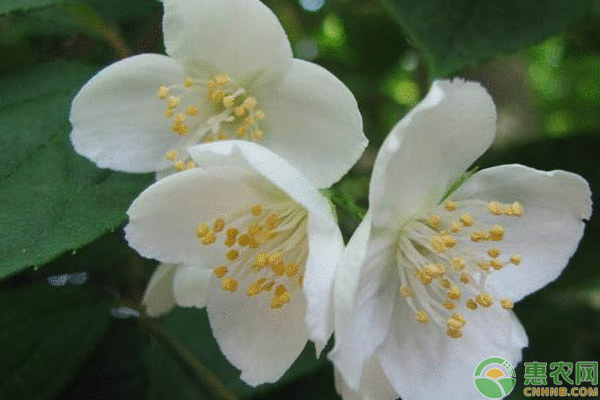
1 Characteristics of mock orange
Mock orange is a shrub, its flower color is white, its flower form is beautiful, its flowering period is May-June, and its fruiting period is July-August. It has strong adaptability and fast growth, making it a very good flower and nursery stock.
2 Economic value
2.1 Ornamental value
Mock orange is fragrant and beautiful, with many flowers clustered together and a relatively long flowering period. It is an excellent ornamental flowering plant, suitable for planting in courtyards and scenic areas. It can also be used as cut flower material. Mock orange has strong cold resistance and is suitable as a landscaping tree species for high-altitude areas such as Hezuo, Luqu, and Xiahe in Gannan Prefecture. Seedlings bloom early, flowering in 2-3 years, with good ornamental effects.
2.2 Medicinal value
Mock orange uses stems and leaves as medicine. Collected in summer and autumn, dried in the sun or used fresh. Its taste is sweet and bland, and its nature is neutral. It has the effect of clearing heat and draining dampness, and is used to treat cystitis and icteric hepatitis.
3 Growth habits
Mock orange has strong adaptability, likes light, likes warmth, and is also cold-tolerant and heat-tolerant, but fears waterlogging. Annual branches bloom, so pruning should be done after flowering. Shade should be provided during the seedling stage. Transplanting should be carried out in early spring.
4 Cultivation techniques
4.1 Environment selection
A nursery site should be chosen close to a water source, sheltered from wind and facing the sun, free from pests and diseases, with a high groundwater table, and with fertile neutral or slightly acidic soil.
4.2 Land preparation and fertilization
The nursery land should be cultivated thoroughly. The first priority is careful land preparation, then removing weeds, applying base fertilizer, comprehensively disinfecting the soil, and finally irrigating fully to keep the soil moist.
4.3 Propagation
It is mainly propagated by seeds, and can also be propagated by division, layering, and cuttings.
4.3.1 Seed propagation
4.3.1.1 Seed collection Capsules mature from late October to November, and the seeds are tiny. After cleaning the seeds, store them dry in cloth bags or sealed in plastic film bags, and place them in cold storage (5°C) or a refrigerator for storage, to be sown the following spring.
4.3.1.2 Sowing Mock orange is generally sown in spring, with sowing carried out in the Hezuo area from early to mid-May. Because mock orange seeds are tiny, broadcasting or drilling is generally used on the bed surface, with a row spacing of 12-15 cm. Sowing should be done on a windless and rainless day. Mix the seeds with fine soil and broadcast them on the seedbed, then cover with 0.3 cm thick rice straw, to the extent that the soil is no longer visible.
4.3.1.3 Post-sowing management After sowing, keep the bed surface moist frequently to ensure uniform emergence. Seedlings emerge 20-30 days after sowing. Remove the straw on cloudy days or in the evening, and set up a shade shed. When the seedlings are 3-5 cm tall, remove the shade shed and carry out full-light cultivation. When the seedlings are 10 cm tall, loosen the soil, remove weeds, or irrigate, and thin the seedlings in stages, with a plant spacing of 6-8 cm. Loosen the soil, remove weeds, and irrigate 2-4 times throughout the year.
4.3.2 Division propagation Division is carried out before spring sprouting. Select robust plants with dense branches for division. 4.3.3 Layering propagation On the mother tree, select robust 1-year-old branches. Layering is generally carried out in June. After digging a trench, press the branches into the trench, then mound soil 5-6 cm at intervals of 1-2 nodes, and finally cover with thick film to retain moisture.
4.3.4 Cutting propagation
4.3.4.1 Hardwood cuttings In the Hezuo area, hardwood cuttings are carried out from late April to early May. Select robust 1-year-old or 2-year-old branches and cut them into 10-15 cm cuttings (with at least 3 nodes). The plant and row spacing for cuttings is 5 cm x 20 cm, inserted into the soil 2/3-1/2 deep. After insertion, cover with soil and press firm, water thoroughly, and build a shade shed in late May. Generally, roots can form about 1 month after cutting.
4.3.4.2 Softwood cuttings Select semi-lignified branches of the current year and carry out cuttings in July-August each year. Cut into 10-15 cm cuttings, retain 1/4 of the leaves, with a plant and row spacing of 5 cm x 5 cm, inserted into the soil 3/4 deep. Use river sand or vermiculite as the cutting substrate. After cutting, spray water promptly and cover with a shade net for shading. Roots can form in about 20 days.
4.4 Water and fertilizer management
2-3 years after planting, loosen the soil and weed 2-3 times each year, and do a good job of replanting missing seedlings. Each year before sprouting, before flowering, before fruiting, and after leaf fall, carry out soil loosening, fertilization, and irrigation. Fertilize regularly 3-4 times a year and water 5-6 times, which is beneficial to the growth of mock orange, prolongs the flowering period, and makes the flowers large and beautiful.
4.5 Cultivation techniques
1-year-old seedlings are 20-30 cm tall, and after two years they can be planted out from the nursery. Spring planting is generally chosen, and in the Hezuo area planting is carried out before spring buds sprout (April-May). Autumn planting is not suitable. When planting seedlings, be sure to keep the soil ball, ensuring the root system spreads naturally. After 2 years of cultivation, the tree height is 100-120 cm, the ground diameter is 1-1.5 cm, and it can bloom in 2-3 years, with good ornamental effects.
4.6 Shaping and pruning
Shaping and pruning are carried out in winter after leaf fall each year or before spring sprouting the following year. The principles of shaping and pruning are even branch distribution, forming a perfect crown, and robust growth. First, shorten the branches, which can form a beautiful crown. Also remove dead branches, inner branches, slender branches, crossing branches, diseased and pest-infested branches, poorly growing branches, and dense branches, which helps concentrate nutrients for the flowering branches and also forms a neat and good crown.
5 Pest and disease control
Mock orange has few pests and diseases. After 3 years of cultivation, only slight aphid damage was found on mock orange. Aphids mainly harm young leaves, stem tips, flowers, and young buds, and can be controlled by spraying with 1000-1300 times diluted wettable mieyaling powder, 50% wettable pirimicarb powder, or 50% pirimicarb aqueous solution at 500-1,000 times dilution.
The above is a detailed introduction to the propagation and pest and disease control of mock orange on the Gannan Plateau. In the editor's view, mock orange has high ornamental value and is easy to grow, making it a good potted flower variety.
How to plant plum blossoms? Planting methods for plum blossoms
To plant plum blossoms well, the planting method is key. Next, the editor will introduce the planting methods of plum blossoms in detail to help everyone grow plum blossoms better.
Planting methods for plum blossoms:
1. Soil
Sandy loam with excellent drainage and aeration should be chosen. This kind of growing soil can be prepared from peat, fine sand, and garden soil in a 1:1 ratio. If possible, adding a small amount of leaf mold is even better. The purpose of adding leaf mold is to improve the fertilizer storage capacity of the growing medium and make the growing soil slightly acidic.
2. Pot selection
A handsome plum and an elegant pot can complement each other and add ornamental value. However, it is best to plant plum blossoms in ordinary clay pots, and when the plant blooms, put it inside an elegantly shaped pot. This is because clay pots are beneficial to the growth of the plum blossom root system, while antique porcelain pots or purple clay pots are slightly inferior.
3. Watering
In winter and spring, plum blossoms do not need much water. Apart from keeping the pot soil slightly moist during the flowering period, at other stages the pot soil should be kept slightly moist and on the dry side. Summer and autumn are the stages when plum blossoms need the most water, and they should be watered when the soil dries. However, from June to July, flower buds begin to differentiate. During this period, "water control" should be carried out several times for plum blossoms, that is, reducing watering until the plum blossom leaves slightly curl and then watering again, so that the plum blossoms can bloom better.
4. Fertilizing
Plum blossoms like fertilizer, but fertilizer should be supplied timely and in appropriate amounts. From late spring to early summer, apply dilute liquid fertilizer once about every 10 days. From late winter to early spring, when the plum blossom buds begin to grow noticeably until just before they color, apply dilute liquid fertilizer once every 5 days, so that the plum blossom flowers bloom with vivid color and fragrance.
5. Light
When placed in a location with abundant sunlight, plum blossoms grow robustly and produce more flowers; otherwise, the plant grows slowly and flower bud differentiation is reduced. Therefore, it is very necessary to ensure that potted plum blossoms receive 4 to 6 hours of sunlight each day. During the flowering period of plum blossoms, especially after the flower buds begin to swell, receiving several hours of direct sunlight each day is beneficial to flowering. After the plum blossom flowers open, they should be placed in a bright place without direct sunlight, otherwise the flowers will quickly fade.
6. Pruning
To give plum blossoms a beautiful tree shape and strong growth vigor, annual pruning is essential. In the vigorous growth season, plum blossoms should have their branches pinched, allowing them to grow only to a height of 20-30 cm. At the same time, sprouts growing from the rootstock should be cut off at any time, and diseased and weak branches and inner branches should be cut off in time. In addition, suckers growing from the rootstock should also be removed at any time. After plum blossoms bloom, they should also be pruned, leaving only 3 to 5 buds at the base of each branch. When the branches sprout in spring, bud thinning should also be carried out so that nutrients are distributed reasonably, so that plum blossoms can grow more beautifully and robustly.