How to Propagate Violets? A Detailed Guide to Common Propagation Methods
Violets can generally be propagated by leaf cuttings, division, and sowing.
1. Leaf Cutting Propagation of Violets
Violets can be propagated asexually by leaf cuttings. The best time is during the most vigorous growth period in March to April. Select healthy plants of superior varieties - the leaf form should be mature. When cutting, cut from the base of the petiole, remove the upper half of the leaf blade, and use the rest as the cutting: for the seedbed, choose a porous clay pot, soak and wash it in clean water, preferably sterilize it strictly by soaking in 0.1% potassium permanganate solution for 15-20 minutes. A plastic pot can also be used instead of a seedbed! For the substrate, vermiculite or perlite can be used. When cutting, use a bamboo stick to make a hole, insert the entire petiole into the substrate, then lay the leaf blade flat on the surface of the substrate. Water thoroughly using the bottom-soaking method and place in a moist, shaded area with careful management.
After leaf cutting of violets, keep the substrate moist. During the day, control the temperature at 18-22°C, at night 16-20°C, with relative air humidity of 70%-80% and shade level of 30%-40%. In such an excellent environment, after about 20-30 days, root primordia will appear from the callus tissue of the leaf, and in 40-50 days new roots will grow and small buds will sprout from the above-ground part. When the seedlings grow to 4-5 cm, they can be potted separately and grown individually.
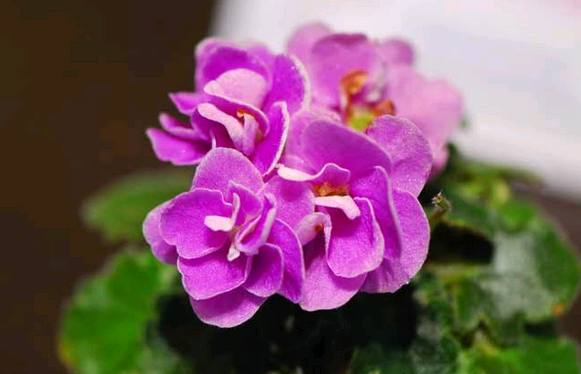
Violets are famous European flowers that have been loved by people for a long time. Their flowers are noble purple as their name suggests. Violets are plants of the Brassicaceae family, and their petals also feature the characteristic four-petal cross arrangement of Brassicaceae plants. Many people love violets simply for their beautiful legends and fragrant, delicate flowers. Their beauty has always overshadowed their own powerful properties. In fact, violets are a rare beautiful plant in nature with certain beneficial properties.
Propagation Methods of VioletsViolets are all propagated by sowing. Violets have single-petaled varieties and double-petaled varieties.
Single-petaled varieties only produce single-petaled flowers and usually have lower ornamental value.
Among the offspring of double-petaled varieties propagated from violet seeds, there are both double-petaled plants and single-petaled plants. Because the stamens and pistils of double-petaled plants are degenerated and cannot set seed, seed collection for double-petaled varieties must be done from single-petaled plants. After sowing the seeds produced, the plants bearing single-petaled flowers and double-petaled flowers generally each account for about half. After sowing superior double-petaled varieties, about 80% of the plants can bear double-petaled flowers. This ratio also increases or decreases depending on the quality of cultivation. The seeds and seedlings of double-petaled plants and single-petaled plants have certain differences: the seeds of double-petaled varieties are smaller in size, with cotyledons in a long oval shape, and when there are 7-8 true leaves, the leaf margins have many serrations; while the seeds of single-petaled varieties are larger and plump, with cotyledons in a short oval shape, and the true leaf margins have fewer serrations.
The varieties usually cultivated are mostly biennial, with sowing time generally from mid-to-late August to early October. In northern regions, if sown too late, the plants will be short, have poor cold resistance, and often bloom poorly the following spring.
Annual varieties can be sown in all four seasons in cool summer regions, using cold frames, hotbeds, and greenhouse cultivation to have flowers year-round. However, in most regions of our country, due to hot summers, they are suitable for biennial cultivation. Tall varieties can have their flower branches cut after blooming, apply additional fertilizer, and they can send out new branches and bloom a second time from June to July.
Sowing can be done in pots or in seed beds. The potting soil and bed soil should be well-drained sandy loam. Before sowing, prepare the land (bed), irrigate to soak the bed (pot) soil thoroughly, then scatter the seeds in the bed. Sowing should not be too dense, otherwise the seedlings are prone to damping-off disease. After sowing, immediately cover with fine soil, with a covering thickness of 1.5 to 2 times the seed diameter. After sowing, keep the soil moist. The seed bed (seed pot) needs shading, maintaining the temperature between 20-25°C. Seedlings emerge about 10 days after sowing. After emergence, immediately remove the shading material. For early sowing, gradually remove the shading material within 10-15 days after emergence.
Violets are taproot plants with underdeveloped fibrous roots and poor root regeneration ability. They do not tolerate transplanting well, so it is best to divide seedlings appropriately early, and when dividing seedlings, more soil must be kept with the roots; the root ball must not be broken apart, and roots must absolutely not be damaged. Once roots are damaged, they are difficult to recover. When seedlings have 2-3 true leaves, divide them into 10×8cm nutrition pots. When plants grow to 7-10 cm tall (around mid-November), pot them and cultivate in a greenhouse.
If used for flower bed planting in the ground, sow appropriately later. Seedlings overwinter in a greenhouse or a small open-ground arch shelter. In early spring of the following year, move them to the open ground for final planting, with a plant spacing of 15-20 cm, blooming from Qingming to the "May Day" holiday. After spring planting in flower beds, attention should be paid to intertillage and moisture conservation, controlling irrigation, and promoting low, compact plant clumps.
African Violet Cultivation Methods and Propagation Methods
Morphological Characteristics of African Violets
The entire plant is hairy; leaves are clustered at the base, slightly succulent, leaf blades round or ovate, with purple on the underside, and long petioles. Flowers are 1 to 6 in clusters on long-stalked dichasial cymes; flowers have a short tube, corolla is 2-lipped, lobes unequal, flower colors are diverse, including white, purple, light purple, or pink. Capsule, seeds extremely tiny
Growth Habits of African Violets
Prefers warm, humid, and semi-shaded environments. Afraid of strong light and high temperatures in summer. The optimal growth temperature is 16-24°C, 18-24°C from April to October, and 12-16°C from October to April of the following year. Daytime temperature should not exceed 30°C; high temperatures are unfavorable for African violet growth. Winter nighttime temperature should not be lower than 10°C, otherwise it is prone to cold damage. Relative humidity of 40%-70% is more suitable; if the pot is too wet, roots are prone to rot. If the air is dry, leaves lack luster. African violets need shading in summer for lush green leaf color; in winter, sufficient sunlight is needed for continuous blooming; adding supplementary light on rainy and snowy days is very beneficial for the growth and blooming of African violets
Common Varieties of African Violets
Common varieties include large-flowered, single-petaled, semi-double-petaled, double-petaled, and variegated-leaf types, with flower colors including purple-red, white, blue, pink, and bicolor. A common cultivated variety is the single-petaled Snow Prince
Propagation Methods of African Violets:
Seed Propagation
The sowing period also varies depending on the variety. Biennial and annual varieties are usually sown in the open ground, generally sown in August to September; annual varieties should be sown in spring and avoid hot climates. For autumn-sown varieties, seedlings should be placed in a cold greenhouse to overwinter. Spring-sown varieties require low-temperature vernalization treatment and generally do not bloom easily in the same year.Leaf Cutting Propagation
African violets commonly use cutting propagation, mainly leaf cuttings. After blooming, select healthy, plump leaves, cut with 2 cm of petiole retained, let dry slightly, insert into a sand bed, maintain high air humidity, room temperature of 18-24°C. Roots form 3 weeks after cutting, seedlings will be produced in 2-3 months, and they can be moved into 6 cm pots.During the cutting process, treating with vitamins is beneficial for root formation and subsequent seedling growth of African violets. Treating petioles with 25 mg/L kinetin for 24 hours is beneficial for the formation of adventitious buds. From cutting to blooming takes 4-6 months.
Stem Cutting Propagation
Stem cutting propagation is also a propagation method chosen for African violets. It is mainly done in spring after flowers fade, combined with repotting and soil replacement, dividing the underground tubers for planting. Seedlings form quickly, but the plant shape is not attractive enough, and because the plant is not renewed, growth is not vigorous enough
African Violet Cultivation Methods
Choose Good Potting Soil
Violets require loose, fertile, slightly acidic soil. For pot cultivation, use a potting mix of 6 parts leaf mold and 4 parts sandy soil mixed evenly, or a potting mix of leaf mold, peat soil, and sandy soil at 1/3 each.
Light Should Be Appropriate
Violets prefer semi-shade. If the care location is too shady, there will be few flowers with pale colors or only leaves without flowers; if the light is too strong, it will cause leaves to turn yellow and appear scorched.
Temperature Should Be Suitable
The optimal growth temperature for violets is 18°C-24°C. When the temperature exceeds 27°C, growth becomes poor, so cooling measures must be taken in hot summer. In winter, room temperature should not be lower than 12°C.
Watering Should Be Moderate
After planting, water thoroughly and place in a shaded area. After 3-4 days, place in a well-ventilated sunny area. However, do not water too much, otherwise roots are prone to rot. Also be careful not to splash water on the leaves, otherwise it can easily cause leaf rot.
Fertilization Should Be Light
During the growth and development period, apply diluted decomposed liquid fertilizer or compound chemical fertilizer once every 7-10 days. Do not apply too much nitrogen fertilizer, otherwise the leaves will grow very luxuriantly but bloom very little. Therefore, the ratio of nitrogen, phosphorus, and potassium is best at 1:1:1. After flower buds appear, appropriately apply more phosphorus and potassium fertilizer for larger and more colorful flowers.
Pinching and Seed Collection
When about 9 leaves have grown, pinching is needed to promote branching. When the plant grows to 40 cm, a thin bamboo stake is needed for support. For seed collection, harvest seeds promptly when the siliques turn yellow but before they split open.