How do you plant an osmanthus tree? A detailed explanation of the planting method
Osmanthus tree planting method. The osmanthus tree is also known as muxi, yangui, jinsu, and so on. When it is in full bloom, dot after dot of yellow flowers scatter their fragrance on the wind, rich and aromatic, refreshing to the heart, and it has the praised line "Alone it dominates the three autumns and outshines all other flowers; why boast of green oranges and yellow tangerines?" In addition, its economic value is also relatively high; the flowers can be used as a raw material for food processing, such as steeping in wine, scenting tea, and making all kinds of cakes and pastries. Its fruit, roots, flowers and so on can also be used as medicine, so for thousands of years it has always been loved by people.
Osmanthus is an evergreen tree species, native to the northwest of our country. It is now cultivated in Henan, Gansu, Shandong, Sichuan, Yunnan, Guizhou, as well as Jiangsu, Zhejiang and other provinces, and its cultivation history is long. It is said that in Shaanxi, Guizhou and other places today there are still osmanthus trees over a thousand years old. In Shanghai, in recent years, both professional landscaping and public planting of osmanthus have also been increasing day by day. Apart from varieties such as silver osmanthus, golden osmanthus, and red osmanthus, most are four-season osmanthus, among which a type suitable for pot culture, the willow-leaf osmanthus, has also appeared on the Shanghai market.
The habits of the osmanthus tree: it likes light and tolerates cold, and has relatively high requirements for the environment. For ground planting, one should choose a place with high, dry terrain, fresh air, and no coal smoke or other pollution; otherwise, it will be difficult for it to grow and bloom. It requires loose, humus-rich, slightly acidic sandy soil, and dislikes clay or alkaline soil. When planting, a certain amount of space (distance) should be kept around the tree body, and branches and leaves should not overlap or press against one another, so as to facilitate ventilation and light; otherwise, growth and flowering will also be affected.
To make the osmanthus tree grow well and bloom, reasonably adding nutrients is very important. In winter, sufficient base fertilizer should be applied (December to January of the following year). The method: dig trenches around the base of the roots and fill them with sufficient organic fertilizer, such as thoroughly decomposed cake fertilizer plus animal matter (or plus bone meal and superphosphate). In rural areas, pig, sheep and other manures can be used, so that new side branches grow strong and sturdy, which helps produce more flower buds in the future. In July, apply topdressing once more, using organic fertilizer mainly of phosphorus and potassium, or 0.5% urea plus 2% superphosphate, to promote abundant autumn flowers. If fertilizer is insufficient, it will bloom less, or not bloom at all.
Besides the above two points, attention should also be paid to routine care, such as promptly pruning away dead branches, diseased branches, weak branches, overly dense branches, and cutting back excessive vegetative branches, so as to concentrate nutrients and produce more flower buds and more flowers; prevent the soil from becoming too dry or too wet, and especially avoid water accumulation after rain, to prevent root rot and leaf drop, which affect flowering; also loosen the soil and remove insects, keep the ground clean, and prevent and control pests and diseases. Among them, in particular the "leaf-cutting worm" that eats osmanthus leaves, also known as the "night thief worm"; once discovered, it can be sprayed with one-thousandth trichlorfon.
In addition, the time for transplanting the osmanthus tree is generally best in March to April or in autumn after the flowers fade. The methods for pot culture or vat culture are basically the same as above. The above is the osmanthus tree planting method.
Characteristics of the osmanthus tree. Osmanthus tree cultivation techniques
The osmanthus tree is a kind of evergreen broadleaf tree, and I believe everyone is familiar with it, because the osmanthus tea we usually drink and the osmanthus cake we eat are all made from osmanthus. The osmanthus tree has an elegant posture, with jade-green branches and emerald-green leaves. It is a plant that stays green through all four seasons and can give off a pleasant floral fragrance; this is where "the fragrance of golden osmanthus drifts" comes from. Below is an introduction to the characteristics of the osmanthus tree.
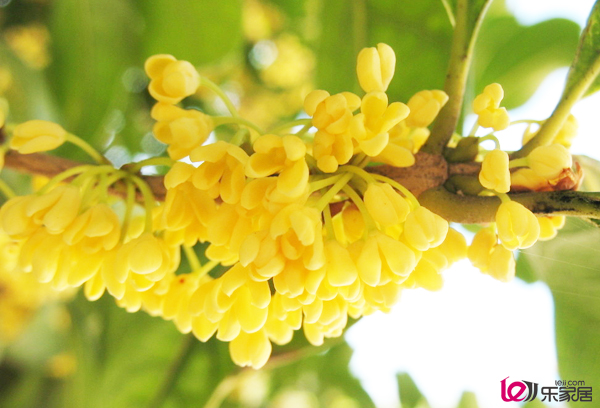
The characteristics of the osmanthus tree of course first come from its form. The osmanthus tree is very tall, reaching up to 15 m at its tallest; its crown is very large, able to cover an area of four hundred sq m. The osmanthus tree has luxuriant branches and leaves, generally blooming in autumn, and when it blooms the fragrance spreads in all directions, so that even from far away one can faintly smell the scent. The root system of the osmanthus tree is quite well developed and can extend and grow deep underground.
The characteristics of the osmanthus tree should also be seen from its living habits. The osmanthus tree originated in the Himalayas in the southwest region of our country, and wild osmanthus also grows in Sichuan, Yunnan, Hunan and other places. The osmanthus tree can withstand high temperatures and likes to grow in warm and humid areas. The osmanthus tree is not picky about soil; apart from some alkaline soils and soils with poor drainage, it can grow healthily.
Osmanthus trees are divided into August osmanthus, four-season osmanthus, and red osmanthus, among which August osmanthus is further divided into golden osmanthus and silver osmanthus. The flowers of golden osmanthus fall off easily and it is the most commonly planted type; the flowers of silver osmanthus are more firmly attached and its fragrance is also lighter; red osmanthus has the strongest fragrance but is also the most expensive type; four-season osmanthus is named for blooming in all four seasons and is quite popular with everyone.
The planting methods for osmanthus trees are divided into balcony planting and courtyard planting. For balcony planting, one should choose young seedlings and place them in a flowerpot with small holes in the bottom, and afterward fertilize with multiple applications of small amounts. For courtyard planting, one needs to dig a pit in the courtyard, and after burying it, pat the soil firm, and also fertilize with small amounts multiple times. You can also "shape" the osmanthus tree, trimming it into a spherical or umbrella shape, both of which are extremely attractive.
Summary:As the saying goes, when osmanthus blooms, its fragrance travels ten li. Isn't this exactly the characteristic of the osmanthus tree? People often call magnolia, crabapple, peony and osmanthus the four great traditional famous flowers, and plant them together in front of the courtyard, taking the homophonic meanings of yu, tang, fu, and gui, which carries an auspicious meaning. With such a beautiful implication, who could dislike osmanthus?
▏ Dendranthema ▏◇Potted osmanthus tree cultivation techniques. Potted osmanthus tree cultivation techniques and precautions
In August, the fragrance of osmanthus fills everywhere. Its breath and its beauty make it impossible for many people to forget even now, and because of this many people have gradually fallen in love with the enchanting fragrance of osmanthus. Nowadays, many people also plant osmanthus trees at home. Do you know the cultivation techniques and precautions for osmanthus trees? Let's follow our editor and take a look at how to grow osmanthus trees!
The osmanthus tree is evergreen all year round and has luxuriant branches and leaves. Its flowering season is in autumn, and it can be called "alone dominating the three autumns and outshining all other flowers." It is used in many gardens, often as a landscape tree, with some planted singly and some planted in pairs. Through continuous artificial cultivation, osmanthus trees now roughly include red osmanthus, golden osmanthus, silver osmanthus and four-season osmanthus. Red osmanthus, golden osmanthus and silver osmanthus all bloom in autumn and can also be collectively called August osmanthus.
The care technique for osmanthus trees is in summer: newly planted osmanthus trees should be watered thoroughly; during the flowering period in mid-September, they should be watered appropriately to keep the soil moist; the principle should be light fertilizer applied frequently, mainly with quick-acting nitrogen fertilizer, with reasonable pruning, strengthened photosynthesis, and reduced pests and diseases.
When watering potted osmanthus, follow the principle of not watering if not dry, and watering thoroughly when watering. In summer, when temperatures are high, the amount of watering should be greater. When the temperature is above 25°C, water once every afternoon. When osmanthus is blooming, maintain moist conditions for the soil and air, and at the same time spray the leaves more to increase the relative air humidity.
The precautions for potted osmanthus are first of all to choose slightly acidic soil; at the same time, water at the right time and grasp the principle of "two less and one more"; skillfully apply topdressing, applying once every 10 days in spring a fully decomposed, dilute cake fertilizer solution, after July applying dilute decomposed chicken and duck manure water or fish waste water, and in early September applying once a liquid fertilizer mainly of phosphate fertilizer; and prune appropriately.
More information:
|What are the uses of mulberry leaves?|How do you plant Iris tectorum? Iris tectorum picture display|Introduction to the cultivation method of Dendranthema|
|What are the cultivation methods of Gomphrena globosa?|A brief discussion of the air-layering propagation method of rhododendron|Bellflower picture display|
|Radiation-proof flowers, what flowers can resist radiation|How do you grow sago palm? The cultivation method of sago palm|Do cactus balls resist radiation|