The correct methods and step-by-step details of osmanthus grafting
Osmanthus grafting methods. For osmanthus grafting, branch grafting is the main method. In Wuhan and Nanjing, the best grafting period is from late March to the beginning of April. At this time the rootstock begins to put out new buds, the sap is flowing, and healing after grafting is fast. The scion should be cut from 1-2 year old branches taken from a young to middle-aged mother tree of an excellent variety, growing vigorously, already flowering and free of pests and diseases. Because osmanthus enters its flowering period late, in order to make it flower early and go into production, be sure to choose branches of a relatively old developmental age that already have flower buds as the scion; upright water sprouts and interior branches cannot be used as the scion.
The best time to cut the scion is in the early morning. Once the scion has left the mother plant, the leaves must be cut off immediately, leaving the petioles, and it must be kept moist, so that the scion does not lose water through leaf transpiration and the grafting survival rate is not affected. If the scion is cut from a distant place, it should be protected with damp green moss to keep the scion fresh. For those grafting with locally available material, it is best to graft as soon as the scion is cut.
Osmanthus grafting methods include cut grafting, cleft grafting, bark grafting, side grafting and many others. Because after osmanthus grafting it is better to promote the formation of its own roots, the grafting site should not be too high. However, grafting of non-deciduous plants requires retaining leaves, which is good for survival, so by comparison side grafting is the best.
The grafting site is 3-5 cm above the ground on the rootstock. After inserting the scion, use ultra-thin plastic film cut into a plastic strip 10 cm wide, take a 30-40 cm length, first wrap the scion and the graft union so that the scion presses against the film. After wrapping, move the film downward and merge the film into a string, use it to wind several turns around the split below the union, and tie the union tightly. Finally, thread the end of the plastic string through the upper loop, then pull it tight. This wrapping method can also be used for grafting of all kinds of headed-back stock, such as cut grafting and cleft grafting. But side grafting makes it very hard to put on a plastic bag, and evergreen trees are not suitable for sealing the scion with wax, so the plastic film wrapping method is an efficient and labor-saving method; after grafting it can maintain the humidity of the union, play a role in keeping warm and moist, and also prevent rainwater from seeping in, so the scion does not dry out.
After side grafting, all the leaves of the rootstock should be retained; just pinch out the growing tip to control the growth of the rootstock. 10 days after grafting, the wound has healed; at the union leave 3-5 leaves on the rootstock, then cut off the upper part of the rootstock. After another week the scion has begun to sprout, so cut off the rootstock 1 cm above the scion and cut open the wrapping plastic film so that the scion bud can grow out. In this way, by gradually cutting back the rootstock, on the one hand the nutrients produced by the rootstock leaves can promote the healing and growth of the scion and the normal activity of the root system can be used, and on the other hand it can stimulate the sprouting and growth of the scion bud. These are the osmanthus grafting methods.
Osmanthus grafting methods: when is the best time to graft
Osmanthus, this is something super many people like; when this osmanthus blooms, it really smells so good. What are the osmanthus grafting methods? When is the best time to graft osmanthus:
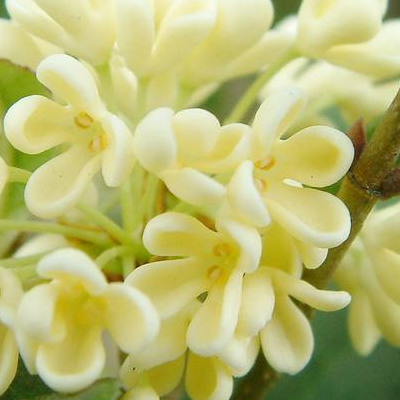
Osmanthus grafting methods:
Grafting methods: side grafting and approach grafting are generally used.
1. Side grafting: For side grafting, first trim the rootstock, cut everything off 6—7 cm above the soil surface, and make a slanted cut near the root crown. Be sure not to injure the pith. Use a 2—3 year old branch (without leaves) as the scion, about 10 cm long. One with 2—3 nodes is more suitable. Then cut the scion end into an unequal-sided wedge shape, insert it into the cut in the rootstock so that they fit closely together. After tying with plastic or hemp fiber, mound soil up to the top of the scion, and that is done.
2. Approach grafting: For approach grafting, first grow the rootstock in a pot. Generally, in the plum rain period of June—July, choose a two-year-old osmanthus seedling branch similar in thickness to the rootstock and approach-graft it while still in the pot; after it survives, cut it off before “Bailu” (White Dew). That is, the new plant can bloom in the same year.
3. After the graft survives, when the new shoot of the grafted plant reaches 10-15 cm, at this time all the remaining rootstock branches and suckers can be cut off. Because the rootstock easily sprouts adventitious buds, they should be peeled off at any time. From June—August carry out drought resistance measures, apply topdressing, and weed. For potted seedlings, when the new shoots reach about 15 cm, pinch out the growing tips, which can promote the growth of side branches and form a shrub shape.
When is the best time to graft osmanthus:
Grafting osmanthus in early spring is better; in the same year you can already determine whether it has survived, which is good for management. Osmanthus can also be grafted in autumn; for skilled growers the survival rate of grafting is relatively high.
That is all for the introduction to osmanthus grafting methods; pay attention to the grafting method.
Osmanthus grafting methods | How to graft osmanthus?
What osmanthus grafting methods are there? This article mainly introduces how to graft osmanthus.There are many methods for grafting osmanthus, among which approach grafting is a commonly used one; in China potted osmanthus mostly uses approach grafting. Its advantages are: a long suitable grafting time, easy survival, fast shaping, and early flowering. The key points of osmanthus approach grafting techniques are introduced below:
I. Grafting methods
(1) Bring the scion close to the rootstock. Methods such as propping, padding, framing, hanging and tying can be used to bring the selected osmanthus branch for the scion close to the rootstock branch in the same direction. Then specifically determine the suitable grafting sites on the rootstock and scion, and fix their positions well.
(2) Cut the slanted surfaces of the union. Cut the slanted surfaces of the union separately at the determined grafting sites on the rootstock and scion. The slanted surface is oval, 3-5 cm long, and the depth of the slant generally does not exceed half the thickness of the branch.
(3) Cut the rootstock. After the grafting and tying are completed, cut off the rootstock branch 1 cm above the union.
(4) Remove sprouts. After grafting, if branches sprout from the part of the rootstock below the union, they should be wiped off in time. 31-35 days after grafting, cut off the scion below the union and let it separate from the mother plant.
(5) Check survival. 3-5 days after cutting off the scion, if the branches and leaves of the scion grow normally, it has survived; if the leaves appear wiltedII. Cultivating the rootstock
The rootstock tree species used for grafting osmanthus include privet, fringetree and so on. The rootstock used for grafting needs to grow vigorously and be free of pests and diseases, with a thickness of more than 1 cm, either a 2-3 year old sapling or a 2-3 year old branch on a perennial tree.III. Selecting the scion
Osmanthus has varieties such as golden osmanthus, silver osmanthus, red osmanthus and four-season osmanthus. First, choose the osmanthus variety according to your preferences, needs and resource conditions, then from the selected osmanthus tree choose a vigorously growing, well-developed, pest- and disease-free branch of moderate size, 2-3 years old, as the scion.