Detailed Explanation of Osmanthus Tree Cutting Techniques and Methods
Osmanthus tree cutting techniques. Osmanthus cuttings are often taken in spring, the plum rain season, or after early autumn, but in the south, plum rain season cuttings are mostly used, as they root quickly and have a high survival rate. The specific cutting time varies with local climate and fertilizer and water management, and the best cutting time is standardized by when the current year's spring shoots and summer shoots stop growing and become semi-lignified, because at this time the branches have the most abundant nutrient reserves and their meristematic tissue has strong division capacity.
(1) Osmanthus tree cutting bed preparation
It is advisable to choose light loamy cultivated land for deep plowing and bed making. The bed width is required to be 120 cm, the bed height 25 cm, and the ditch width 40 cm, with the soil finely crushed, the bed surface flat, and the ditches unobstructed. If there is deep yellow subsoil free of weed seeds, it is best to cover the original soil with a 5 cm thick layer of yellow subsoil, which can reduce weed and disease occurrence. Above the cutting bed, build two covers, one above the other, namely a plastic film shade arch cover 50 cm above the bed surface and a shade frame 1.8 to 2 m above the bed surface, with the light transmittance of the shade netting for both being 50%.
(2) Osmanthus tree cutting time
It is advisable to carry out from mid-May to mid-June. The specific time is best when the new shoots stop growing.
(3) Osmanthus tree cutting collection
Select vigorous, pest- and disease-free superior plants within 6 years old as mother trees for cutting collection. In the morning, cut the current year's semi-lignified young branches from the upper outer periphery as cuttings.
(4) Osmanthus tree cutting treatment
Cut the cuttings to about 5 cm long, keep 2 opposite leaves at the upper part, and cut off the remaining leaves. If rooting agent is available, it is best to treat them before cutting, as this can shorten the rooting time of the cuttings.
(5) Osmanthus tree cutting operation
Cuttings should be inserted in separate beds (sections) according to diameter class. With a plant and row spacing of 5 cm x 10 cm, insert the cuttings into the soil to a depth of about 2 cm, water the seedbed thoroughly with clean water, then spray the seedbed with a 1000-1500 times carbendazim solution. After disinfecting the soil and cuttings, immediately cover fully with a small arch shed.
(6) Osmanthus tree post-cutting management
When there are no water droplets inside the shed film and the bed is dry, spray water in time to maintain moisture. Generally, uncover the film after about half a month for inspection. If humidity is found to be insufficient (relative humidity should be maintained at 85%), sprinkle water, and after the leaves dry slightly, spray with a 1000 times solution of carbendazim to prevent diseases. At the same time, combined with spraying, 0.2% urea or monopotassium phosphate solution can be added to promote root and new shoot growth of the cuttings. If there is continuous rainy weather for more than a week, the lower shade netting should be removed to increase light transmittance.
After osmanthus cutting, roots generally form in 1 to 3 months (Sijigui roots in 1 to 1.5 months, Jinyindangui roots in 2 to 3 months). When 80% of the cuttings have rooted, choose a rainy day to remove the lower shade netting and plastic film for hardening off; if hardening off on a sunny day, uncover both ends of the plastic film in the morning and evening for ventilation, and after half a month, remove the lower shade netting and plastic film. By the end of October, new shoots of the seedlings have already grown. According to weather conditions, promptly remove the upper shade frame on a cloudy day or in the evening (generally at Cold Dew), and by the following spring the young seedlings can be transplanted to field nurseries. The above are the osmanthus tree cutting techniques.
Osmanthus Tree Cutting Techniques
Osmanthus tree cutting techniques. Cutting has the advantages of easy material collection, simple operation, saving propagation materials, and a high propagation coefficient, with a survival rate of over 80%.
1. Osmanthus tree cutting bed preparation
The cutting bed should be chosen in a place with higher terrain, good drainage, and close to a water source. The seedbed is 1 m wide, and the length is unlimited, but generally not more than 20 m. The cutting bed is built around with bricks, 10 to 25 cm above the ground. Inside the bed, spread a 10 to 20 cm thick substrate. The substrate can be selected from slightly acidic sandy loam, river sand, peat, etc.
2. Selection of osmanthus tree cuttings
Cuttings should be selected from 10 to 15 year old trees, from the middle and upper outer periphery of the crown, vigorous in growth, and free from pest and disease damage, from the current year's branches, generally about 10 cm long. The upper end of the cutting bears 1 pair of leaves, and the lower end is cut at 0.5 cm below the node, with the cut slightly slanted. Cuttings should be inserted immediately after cutting to prevent water loss and wilting.
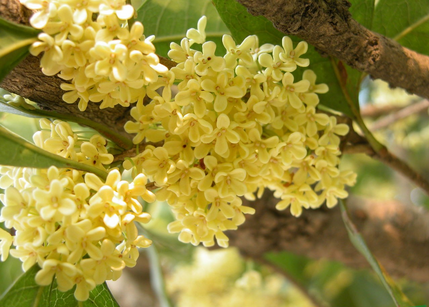
I. Cutting time. For summer cutting of osmanthus, May to July is more suitable, carried out at 6 to 9 in the morning and 4 to 7 in the afternoon when the temperature is lower and evaporation is less.
II. Seedbed preparation. Osmanthus likes warm, moist, fertile, well-aerated acidic soil. The bed soil should be deeply plowed and finely harrowed, and made into high ridges. Make the seedbed in a place with good drainage and convenient irrigation.
III. Cutting collection. For osmanthus cuttings, select superior varieties of vigorous mother trees, cut strong current year's semi-lignified branches from the upper outer periphery of the crown, remove the tender top part, and cut into cuttings about 10 cm long. Each cutting retains 2 to 3 pairs of leaves at the top, and all basal leaves are cut off.
IV. Root promotion treatment. Soak the base of the cuttings in 500 ppm naphthalene acetic acid solution for 5 seconds, or soak in 40% ABT rooting powder solution for 2 hours, or soak in 0.01% aspirin for 4 to 5 hours, which can promote rooting and increase the survival rate.
V. Cutting method. Water the seedbed thoroughly before cutting, and insert after the water drains. Plant and row spacing 3 cm x 5 cm, insertion depth about 6 cm, water after insertion to promote close contact between the soil and the cuttings.
VI. Seedbed management. After cutting, promptly set up a shade frame to maintain moisture and prevent high temperature and strong light. Maintain the seedbed at 20°C to 28°C and relative humidity 80% to 90%. If the temperature is high, ventilate and spray water to increase humidity, lower temperature, and prevent drought. Under suitable temperature and humidity, roots can form in about 1 month. Gradually remove the shade frame, increase light, and water or spray in time to keep the soil moist and promote growth.