What to Do When Flowers Won't Bloom? Cause Analysis and Prevention Methods
How to prevent flowers from failing to bloom? Whether a flower blooms is influenced on the one hand by the plant's internal mechanisms, and on the other hand by external environmental conditions; neither can be missing.
Flowers, like other plants, must go through a certain vegetative growth stage before they can shift into the reproductive growth stage. At this point, some of the plant's terminal buds or axillary buds differentiate into flower or inflorescence primordia, and then flower bud differentiation proceeds step by step. For a flower to bloom, it must first accumulate a certain amount of nutrients in its body to meet the materials needed for blooming. Without a certain accumulation of nutrients, the nutrients needed for flower bud growth will be insufficient, so the plant cannot bloom. This is usually the reason why thin, weak flowers do not bloom or bloom sparsely.
Flowering also requires certain environmental conditions; flower bud differentiation can proceed normally only under suitable environmental conditions. In other words, flower bud differentiation requires both sufficient nutrients and water, and also has strict requirements for environmental conditions such as sunlight and temperature. Only when these requirements of the plant are met can flower bud differentiation proceed; otherwise flower bud differentiation cannot proceed, and the plant shows the phenomenon of growing only leaves without blooming.
Therefore, the development, formation and opening of plant flowers require both sufficient material accumulation and a matching set of environmental conditions.
Why won't your flowers bloom? Causes of flowers not blooming
Flower and Bonsai Network introduction: Today, the Flower and Bonsai Network editor shares with you an article about why your flowers won't bloom, the causes of flowers not blooming. Let's take a look.
Few people regularly repot their potted plants, I believe. When it comes to potting up or repotting flowers, many people find it troublesome, and many also think it is unnecessary, but in fact repotting is a very important step for plants to bloom.
1. After a plant has grown in a pot for a certain period of time, it must be repotted, because at this point the potting soil's fertility has declined and the soil has become compacted; at the same time, the roots have filled the pot and the drainage gaps are clogged, which is very unfavorable for the plant's healthy growth.
So it is generally recommended to repot once every 1-2 years. The best time to repot is when the flower or tree has ended dormancy and its new buds are stirring, just after it has been moved from indoors to the balcony and before it has put out new shoots.
2. When repotting, choose the pot size according to the size of the plant, though many friends think that a large pot for a small plant is better, which is actually not the case.
If you use too large a pot, since a large pot holds more growing medium, if you water too little the roots will not easily absorb water, leading to "wet outside but not inside, dry outside but not inside," and the growing medium will easily rot, and the roots will then rot along with it.
3. Remember that the plant must stop being watered a few days before repotting; repot only after the potting soil is half dry. Also, before putting the plant into the new pot, cut off any coiled roots and old roots.
4. Whether using a new pot or an old pot, the pot needs to be thoroughly sterilized to prevent lurking insect eggs or bacteria from affecting the plant's health.
Soak a new flower pot in clean water for a day and a night, then scrub it, let it dry, and use it. If it is an old pot, put the old flower pot in the sun to sterilize it, and before reusing it scrub the inside and outside clean to remove any possible insect eggs; if necessary, also spray it with a chemical agent to disinfect it.
5. When potting up, be careful to place the flower in the center of the pot; after straightening it, start adding soil from all around, and when it reaches a certain depth press it down firmly so that the plant and the pot are fully combined, until it is 2-3 cm from the rim of the pot, then stop adding soil.
6. After planting the flower well, water it thoroughly once so that all the soil in the pot absorbs enough water, then place it outdoors in a ventilated, shaded spot. After it passes the seedling-establishment period, sun-loving flowers can be moved into the sunlight for care.
7. Do not fertilize flowers that have just been repotted. Wait until the plant in the new pot has grown new leaves or sprouted new roots, then fertilize according to the principle of light fertilizer applied frequently.
What are the reasons flowers won't bloom? How do you make flowers bloom year after year?
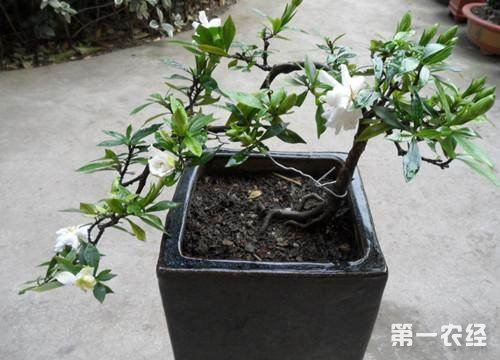
Potted jasmine
I often hear friends say, "I bought flowers at the same time as someone else; hers bloom every year, while mine has never bloomed once. Why exactly is that? Could it be that I bought a male one?" Hearing this, I laughed. Although flowers do come in male and female, they all bloom. The reason they don't bloom may be that the following 6 points were not done well:
1. Not fertilizing the flowers
Potted flowers that are only watered but not fertilized, and not repotted either, thus lack sufficient nutrients, have no strength to form flower buds, and cannot bloom.
2. Too much fertilizer and water during the growth period
Too much fertilizer and water during the growth period, especially too much nitrogen fertilizer, will cause the flower's branches and leaves to grow excessively, consuming a large amount of nutrients, and with a lack of phosphorus and potassium fertilizer, flower buds cannot form, resulting in no flowers to bloom.
3. Unsuitable environment
If the flower's growing environment has insufficient light, poor ventilation, and improper temperature, it will grow thin and weak, and it will also be difficult for it to bloom.
4. Room temperature too high in winter
If the room temperature is too high, it affects the flower or tree's dormancy or causes it to sprout and put out leaves too early, consuming nutrients; the next year it will grow weakly and not bloom, or the flowers will be small or drop.
5. High alkali content in the potting soil
When the alkali content of the potting soil exceeds 0.1% and the pH is above 7.5, most flowers will find it very difficult to bloom.
6. No shaping or pruning during the growth period
If a flower or tree is not pruned or shaped during the growth period, it not only affects its appearance but also consumes a large amount of nutrients, thereby affecting flower bud formation and causing it not to bloom or to bloom little.
If your flowers have been grown for many years and still won't bloom, quickly check yourself! Find the cause and then handle it accordingly, and next year they will surely be full of flowers and lush leaves.