How to prune a pomegranate bonsai? Detailed pruning methods and techniques
Pomegranate bonsai pruning methods. The pomegranate is a clump-forming shrub with abundant branches and leaves and poor ventilation and light penetration. To keep it growing robustly, pruning and shaping are very important, and pruning can be carried out according to its branching and flowering habits.
Over the course of a year, the pomegranate can produce 2-3 flushes of new shoots; the spring shoots bear many flowers, while the summer and autumn shoots bear few flowers and mostly fail to set fruit. The flowering branches sprout from the fruiting mother branches formed the previous year. The terminal buds of these fruiting mother branches are relatively plump, and the several lateral buds below the terminal bud are also quite full; the buds contain both the primordia of leaves and branches and the primordia of floral organs, so after the buds germinate and shoots emerge, they can flower along with growth. Therefore, these buds are called mixed buds. In late autumn and early spring each year, these branches must absolutely not be headed back, otherwise the mixed buds will be cut off and flowering will not occur.
Among the new shoots that do not flower in the current year, some stop elongating after growing for a period, and their terminal buds and the few lateral buds at the tip begin to differentiate into mixed buds, thus forming fruiting mother branches and preparing to produce fruiting branches the following year. Such fruiting mother branches should be retained as much as possible and not cut off. When nutrition is insufficient, some new lateral branches stop elongating after reaching a certain size and do not form terminal buds; instead, a cluster of leaves grows at the tip of the branch. These branches often interfere with the tree's shape and affect ventilation and light penetration, so they should be cut off from the base.
There are also some branches that grow especially vigorously. They keep growing continuously through spring, summer and autumn, and can even produce secondary and tertiary branches, but they cannot form mixed buds, and the following year they cannot produce fruiting shoots. Therefore, they are called water sprouts. In summer they should be pinched back to stop them from growing endlessly and consuming nutrients, and to encourage full, plump lateral buds to form in the leaf axils, preparing for the production of new fruiting mother branches the following year.
Besides the above three types of branches, on the crown of the pomegranate there are also some branches whose tips grow into needle-like spines, with neither terminal buds nor very obvious lateral buds. Such branches are all quite short; if they are not too many or too dense, they should be retained as auxiliary nourishing branches, using their dense leaves for photosynthesis to produce more nutrients. If such branches are too many and too dense, some can be thinned out to improve ventilation and light penetration.
For the shaping of the entire pomegranate plant, the natural open-center form is suitable, because the center is open and ventilation and light penetration are good. Therefore, prune according to the above methods and gradually form a natural open-center plant shape. For pruning after fruit set, focus on dead branches, water sprouts, densely growing branches and basal suckers. Because the terminal flower buds on spring shoots of the pomegranate set fruit reliably, apart from shaping needs, spring shoots are generally not headed back.
To prevent excessive vegetative growth in potted pomegranates, they can be headed back. The method is: starting in February, before branches and leaves grow, the overly tall parts can be cut back with scissors. If there are too many inner branches, some can also be pruned away; this will not affect continued growth, flowering or fruiting. If overly tall water sprouts grow again during the growing season, the water sprouts can still be cut back, thus maintaining a low profile. The above is an introduction to pomegranate bonsai pruning methods.
Pomegranate bonsai pruning techniques
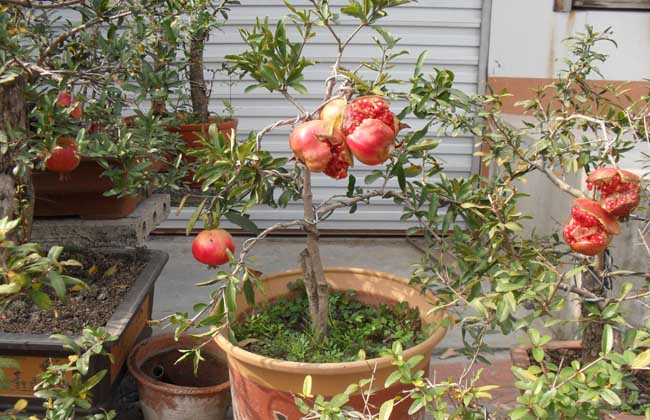
The pomegranate has strong sprouting ability and grows new branches several times within a year, so pruning is very important. If not pruned in time, it will affect flowering and fruiting. Usually, after new branches grow, overly dense, weak and basally clustered branches should be cut away in time to ensure that the main branches have sufficient nutrition, which is conducive to flowering and fruiting. Let us take a look at pomegranate bonsai pruning techniques below!
How to prune a pomegranate bonsai?
Potted pomegranates should have excess branches and untidy branches cut away before spring germination according to the shape envisioned in your mind. Pruning of young seedlings is mainly tip pinching, usually carried out when they are above 10 cm in height. For dense parts of new lateral branches, they can be cut off from the base; for water sprouts, repeated pinching can be used for shaping, and at the same time it encourages full, plump lateral buds to form early in the leaf axils, making good nutritional reserves for the production of new fruiting mother branches the following year; dense needle-like short branches can be cut away.
How to thin fruit on a pomegranate bonsai?
After the pomegranate fruits on a bonsai have set firmly, excess fruits not needed for the design should be cut away; a medium-sized pomegranate bonsai only needs to keep 3-5 fruits. The fruits should be distributed with variation in height, some sparse and some dense, and not at equal distances. If there are too many fruits, besides looking messy and disorderly, it will also affect fruiting the next year.
Precautions for pruning pomegranate trees
1. In spring, pomegranate trees should have dead branches, diseased branches, weak branches, water sprouts, etc. from the overwintering period cut away, retaining robust branches and crown shape, which helps promote more new branches, more flowers and more fruit. Seedlings begin repeated pinching when 10 cm tall to encourage branching and achieve a full crown width.
2. When pruning pomegranate trees, note to keep outer branches and not inner ones, keep straight branches and not horizontal ones, and the cut should face outward.
3. The focus of pomegranate pruning should be water sprouts and root-zone suckers, because water sprouts sprout from latent buds in the cortex of the trunk or large lateral main branches, have strong vigor, grow upright or diagonally upward, but do not readily differentiate flower buds and interfere with the tree's shape. Root-zone suckers sprout from the underground root zone and grow faster than crown branches, but mostly only consume nutrients.
How to prune a pomegranate bonsai? Pruning techniques and precautions for pomegranate bonsai
The pomegranate has large, brightly colored flowers and fruits as lustrous as polished jade; it can be enjoyed both for its flowers and its fruit and has high ornamental value, so it is often made into a pomegranate bonsai and is much favored by bonsai enthusiasts. In the process of caring for a pomegranate bonsai, if it is not pruned in time, it will affect flowering and fruiting. So, how do you prune a pomegranate bonsai? The pruning techniques and precautions for pomegranate bonsai are introduced below.
Image: Pomegranate bonsai
I. Pruning methods for pomegranate bonsai
Potted pomegranates should have excess branches and untidy branches cut away before spring germination according to the shape envisioned in your mind. Pruning of young seedlings is mainly tip pinching, usually carried out when they are above 10 cm in height. For dense parts of new lateral branches, they can be cut off from the base; for water sprouts, repeated pinching can be used for shaping, and at the same time it encourages full, plump lateral buds to form early in the leaf axils, making good nutritional reserves for the production of new fruiting mother branches the following year; dense needle-like short branches can be cut away.
II. Fruit thinning methods for pomegranate bonsai
After the pomegranate fruits on a bonsai have set firmly, excess fruits not needed for the design should be cut away; a medium-sized pomegranate bonsai only needs to keep 3-5 fruits. The fruits should be distributed with variation in height, some sparse and some dense, and not at equal distances. If there are too many fruits, besides looking messy and disorderly, it will also affect fruiting the next year.
Image: Pomegranate bonsai
III. Precautions for pruning pomegranate trees
1. In spring, pomegranate trees should have dead branches, diseased branches, weak branches, water sprouts, etc. from the overwintering period cut away, retaining robust branches and crown shape, which helps promote more new branches, more flowers and more fruit. Seedlings begin repeated pinching when 10 cm tall to encourage branching and achieve a full crown width.
2. When pruning pomegranate trees, note to keep outer branches and not inner ones, keep straight branches and not horizontal ones, and the cut should face outward.
3. The focus of pomegranate pruning should be water sprouts and root-zone suckers, because water sprouts sprout from latent buds in the cortex of the trunk or large lateral main branches, have strong vigor, grow upright or diagonally upward, but do not readily differentiate flower buds and interfere with the tree's shape. Root-zone suckers sprout from the underground root zone and grow faster than crown branches, but mostly only consume nutrients.
[Editor's concluding remarks]The pomegranate has strong sprouting ability and will grow new branches several times within a year. If not pruned in time, it will affect its ornamental value, so attention should be paid to it. The above has introduced the pruning techniques and precautions for pomegranate bonsai for everyone, and we hope it can help you!