How to Grow Hyacinths in Water? Here's the Correct Hydroponic Method
How to grow hyacinths in water. Hyacinth, also known as Dutch hyacinth and five-colored hyacinth, has colorful, dazzling blooms and a pleasant fragrance. It is suitable for both pot culture and water culture, and has become very popular in recent years.
Hyacinths that have not undergone artificial low-temperature treatment can be water-cultured in early November. A specially made glass bottle should be used, filled with water. Then choose a large, plump bulb and stand it upright at the mouth of the bottle so that there is no gap, with only a small part of the base or none of it immersed in water.
First place the hyacinth in a cool, dark place (it is best to cover the bottle with black cloth) to encourage rooting. After roots have developed, move it to a semi-shaded place for care. At a room temperature of 18-20°C, it will bloom in early March. If water culture is started too late, leaves will be shortened and the inflorescence will develop poorly. For bulbs that have undergone artificial low-temperature treatment, the water culture period can be advanced or delayed; if the temperature is suitable, flowers can be seen 6-8 weeks after water culture.
During the water culture period, the water should be changed every 2-3 days (tap water at about 20°C), always maintaining a shallow water layer. To prevent the water from spoiling, 1-2 small pieces of charcoal can be added for preservation. When changing the water, pour it slowly in from the edge of the container; do not pull up the roots, to prevent the bulb from shifting and breaking the roots, which would affect growth.
During the water culture period, growth mainly relies on the nutrients stored in the bulb, so fertilizer is generally not necessary. If you want to improve nutritional conditions and promote later bulb development, a compound fertilizer can be appropriately added, with the concentration strictly controlled at about 1%-2%. After the flowers fade, plant the bulb in soil. Once the leaves wither, take it out and store it in a cool place. The above is an introduction to how to grow hyacinths in water.
How to Grow Hyacinths in Water: Detailed Steps for Water Culture of Hyacinths
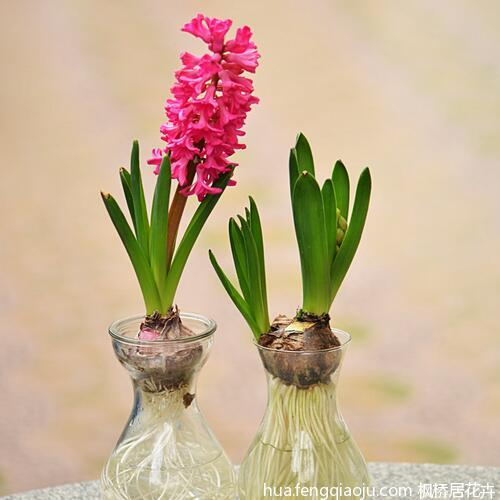
Hyacinth is a common flower in offices. It blooms beautifully and is easy to grow, so many people like to cultivate hyacinths, and water-cultured hyacinths, being clean and attractive, have also won the affection of many flower lovers.
Growth Habits of Hyacinths
Hyacinth is a perennial herbaceous bulbous plant. The bulb is spherical or flattened spherical, with a membranous outer skin. The outer skin is purple-blue or white, etc., and the color of the skin is positively correlated with the flower color. Hyacinth prefers a growing environment with ample sunlight and relatively high humidity, and can be soil-cultured, pot-cultured, or water-cultured.
Hyacinth roots in autumn, new shoots emerge in early spring, blooms in March, fruit ripens in late May, and the aboveground part withers in early June and enters dormancy. Flower bud differentiation occurs during the dormant period, with an optimum temperature of about 25°C, and the differentiation process takes about 1 month. After flower bud differentiation and before elongation growth, there must be a low-temperature stage of about two months, and the temperature must not exceed 13°C.
How to Grow Hyacinths in Water
Water culture of hyacinths requires a 1-2 cm space between the water level and the base plate of the bulb, so that the roots can breathe. It is strictly forbidden to fill the water so full that it covers the bottom of the bulb. In December, place the bulb in a wide-mouthed glass bottle with a grid, and add a little charcoal to help prevent rot and disinfect. The bulb only needs to be immersed up to its base, then place it in a dark place and cover the bottle with black cloth. After about 20 days of sprouting in a completely dark environment, put it outside to receive sunlight. At first, expose it to 1-2 hours of sunlight per day, then gradually increase to 7-8 hours. In most cases, under good weather conditions, it will bloom by the Spring Festival.
Steps for Water Culture of Hyacinths
1. First remove the dry, old roots of the hyacinth, otherwise the base plate will absorb water and the bulb will rot.
2. Soak in water for 40 minutes.
3. Fill the vase with clean water, with the water surface 2-5 mm from the bulb's base plate (do not immerse the entire bulb in water, to ensure the roots can breathe freely). As the root system grows, gradually lower the water level to encourage the roots to grow downward evenly.
4. Change the water about once a week. When changing the water, just pull the hyacinth bulb partway out of the hydroponic bottle, to avoid breaking the roots.
Water-Cultured Hyacinths Need Attention to Light
If light is too weak, hyacinth plants will become spindly, stems will be too long, flower buds will be small, flowers will fade early, and leaves will turn yellow. An incandescent lamp can be used about 1 m away for supplemental light; but too strong light can also cause scorching of hyacinth leaves and petals or shorten the flowering period.
In hyacinth cultivation, besides paying attention to light, temperature must also be considered: if the temperature is too high, even above 35°C, flower bud differentiation will be inhibited, growth will be deformed, and the rate of blind flowers will increase; if the temperature is too low, the flower buds will suffer frost damage.
Seeing once is better than hearing a hundred times. Hurry and plant a pot of hyacinths yourself. Exchange hyacinth cultivation experience with flower lovers at Fengqiao Ju.
How to Grow Hyacinths in Water: Hydroponic Method for Hyacinths
Hyacinths can be forced in water just like narcissus, so how do you grow hyacinths in water? Below is an explanation of the hydroponic method for hyacinths.
I. Steps Before Hydroponic Culture of Hyacinths:
1. Add clean water to the glass bottle, but be careful that the water surface should just not reach the bottom of the bulb.
2. Use an ordinary glass cup or a specially made flower glass bottle to grow it. The bottle is divided into upper and lower parts, small at the top and large at the bottom;
3. For the glass cup, lead wire can be used as a tray, hung down from the mouth of the cup.
4. Put water in the lower part, and place a piece of charcoal in the water to prevent the water from smelling bad.
5. Choose an extra-large bulb, place it 5 cm from the mouth of the cup or bottle, immerse it in water, and place it in sunlight.
6. When the sprout grows to 5 cm, place it in a dark place. After the roots have fully emerged, place it in a warm place without direct sunlight, and add water frequently so that the water reaches the bulb. When leaves and flower buds emerge, expose it to sunlight for 1-2 hours daily to make the leaves and flower stalks sturdy; turn it in one direction every day so that it does not grow leaning to one side.
7. No fertilizer is needed, and it will bloom into a bright, fragrant hyacinth in March or April of the following year. After the flowers fade, take it out with the roots, plant it in potting soil, and when the leaves wither, dig it up and store it well; it can be planted again next year.
II. Place the hyacinth in a cool, dark, well-ventilated location, keep the temperature at 9°C to 13°C, and check once a week to see whether water needs to be added.
III. When the flower bud grows 8 cm from the bulb (after about 10 to 12 weeks) and the glass bottle is full of roots, the hyacinth can be moved into a warm room.
IV. At a temperature kept between 17°C and 20°C in your home, you will enjoy the process of bud growth and color development. But do not place them directly near a heat source; this way the beautiful hyacinth flowers will stay open longer.
V. After flowering, the bulb can be planted in your courtyard. In summer you can use a glass bottle for flower arrangements, and in winter you can buy a treated hyacinth and reuse it.
Precautions for Hydroponic Hyacinths:
1. There should be a 1-2 cm space between the water level and the base plate of the bulb, so that the roots can breathe. It is strictly forbidden to fill the water so full that it covers the bottom of the bulb. In December, place the bulb in a wide-mouthed glass bottle with a grid, and add a little charcoal to help disinfect and prevent rot. The hyacinth bulb only needs to be immersed up to its base. Then place it in a dark place and cover the bottle with black cloth.
2. If growing in clean water, change the water once every 7 days; if using a hydroponic nutrient solution, replace the nutrient solution every 10-15 days depending on how cloudy it becomes. In any case, keep the water quality in the bottle clean. You can grow the hyacinth in a specially made gourd-shaped glass bottle, and in the upper section you can admire its flower cluster. After more than 20 days like this, the roots will sprout in a completely dark environment, and then it can be taken outside to receive sunlight.
3. Before the bulb sprouts, do not place it under direct sunlight. After sprouting, place it in a bright, well-ventilated location with sunlight to benefit its growth. At first, expose it to sunlight for one or two hours a day, then gradually increase to seven or eight hours. If the weather does not change much, it may bloom by the Spring Festival, and in the lower section you can see a cluster of thick white roots. This scene of flowers and roots flourishing together is rarely seen in other flowers and plants except orchids.
4. Hydroponic hyacinth is one of the easiest flowering ornamental varieties to grow among hydroponic flowers. The flower colors of hyacinth are varied: red like fire, purple intoxicating, yellow dazzling, pink charming, white pure, and blue profound. They represent positivity and a love of life. When they bloom, they symbolize the arrival of spring and inspire people. Start hydroponic culture in November, and they will bloom after about 70-80 days, with fragrance.