How to Grow Crinum asiaticum in the North? A Detailed Guide to Its Cultivation Methods
Crinum asiaticum originates from the tropical regions of Asia. Because it is not cold-tolerant, it is grown as a potted ornamental plant in the north. Although it can bloom in the north, producing seeds is difficult, so it is generally propagated by separating and replanting the offshoots that grow from the base of the stem. It prefers a warm, humid climate and tolerates saline-alkaline soil, and it should be kept from harsh sun exposure in summer. Crinum asiaticum is easy to manage; when potted, the young seedlings grow very quickly at first and should be moved into a pot one size larger about every four months to meet their growth needs. Large plants are grown one per pot and can go for many years without repotting.
In the north, May to October is its peak growing period, when it should be watered once a day and fertilized once a week. The height of summer is when flowers are scarce, and June to September is its blooming period, which is one of the reasons people love Crinum asiaticum. After autumn begins, reduce watering; when the bulb enters dormancy, stop fertilizing and watering. In winter it should be kept indoors in a sunny spot to prevent cold damage. Water sparingly in winter to prevent root rot. Crinum asiaticum is not as delicate as the foliage plants of the south; with good care it can bloom three times a year. How to grow Crinum asiaticum in the north, and the care of Crinum asiaticum, require attention to the following aspects:
(1) Light: Crinum asiaticum likes warm, ample sunlight, and grows luxuriantly and blooms well under sufficient light. Insufficient or excessive light will both affect its growth and flowering. It should be kept from harsh sun exposure in summer; after summer begins, the potted plant should be moved under a shade frame for care, and water should also be sprinkled on the ground frequently to lower the temperature.
(2) Water and fertilizer management: Crinum asiaticum has a strong root system and a strong ability to absorb water and nutrients. After planting, it needs thorough watering; during the growing period, keep the soil moist and apply dilute fertilizer frequently. In spring, mainly nitrogen fertilizer; before flowering, apply a liquid fertilizer rich in phosphorus and potassium; in autumn, apply rotted cake fertilizer. This will make it grow vigorously and bloom abundantly. Be careful not to pour the fertilizer solution into the leaf cluster when fertilizing. After the flowers fade, cut off the flower stalk to promote bulb development. In summer, water can be sprayed around the plant regularly to maintain relatively high air humidity, but after rain, guard against waterlogging, because standing water will cause the bulb to rot. During the winter dormant period, water about once every half month, keeping the potting soil on the dry side.
(3) Keeping warm: Crinum asiaticum is not cold-tolerant; its optimum growing temperature is 13-21°C. In northern regions, it needs to be moved indoors to a sunny spot in early to mid-October, and a room temperature of 8-10°C is enough for it to pass through dormancy safely. If the winter room temperature is above 15°C, it can continue to bloom. It is commonly propagated by seed and by division. Sowing is best done in spring; the seeds are large, so sow them individually in a shallow pot. They germinate about 2 weeks after sowing, and plants grown from seed need 3-4 years of care before they bloom. Division is done in March to April together with repotting; peel off the daughter bulbs around the mother plant and plant them, with the planting depth such that the bulb is not visible. The above is an introduction to how to grow Crinum asiaticum in the north.
Crinum asiaticum Crinum asiaticum Crinum asiaticum Illustrated Guide: How to Grow Crinum asiaticum / How to Propagate Crinum asiaticum
Crinum asiaticum ProfileCrinum asiaticum Crinum asiaticum
Crinum asiaticum Cultivation Methods and Precautions An Introduction to Crinum asiaticum
Crinum asiaticum is a perennial robust herb with a spherical bulb. It has 20-30 leaves, strap-shaped, 0.9-1.2 m long. The margins are wavy, light green. The flower scape is erect, and 10-20 flowers form an umbel, giving off fragrance in the evening. The tepals are white, linear; the stamens are pale red, the anthers linear with acuminate tips, and the ovary spindle-shaped. The fruit is nearly spherical, 3-5 cm in diameter, usually containing 1 seed. It is mostly distributed in southern China, often growing in coastal areas or sandy riversides. The leaves and roots are used medicinally, with the effects of promoting blood circulation and dispersing blood stasis, reducing swelling and relieving pain; they can treat bruises, feverish headache, heat-toxin sores and swellings, and other conditions.
Morphological Characteristics of Crinum asiaticum
A perennial bulbous herbaceous flower. The leaves are broad and thick, deep green year-round, and can reach more than 1 m long, with sharp tips, like a giant's green sword; the flower scape grows upright in all four seasons and is about as tall as the leaves, but it mostly blooms only in summer and autumn, generally with 10-24 flowers arranged in an umbel at the top of the scape; each flower has 6 slender petals, purple-red in the middle and pink on the sides, spreading outward when fully open and even curving backward, as if doing its utmost to show people its beauty and charm, and the fragrance is rich and carries far, which is why it has always been deeply loved by people. The perianth is linear, white, and delicately fragrant, with peak bloom in July. The capsule and seeds are large and green.
A perennial robust herb. The bulb is long-cylindrical. Leaves 20-30, many-ranked, strap-shaped lanceolate, up to 1 m long, 7-12 cm wide or wider, apex acuminate with 1 acute tip, margins wavy, dark green. The flower stem is erect, almost as long as the leaves; the umbel has 10-24 flowers; the spathe-like involucral bracts are lanceolate, 6-10 cm long, membranous; the bracteoles are narrowly linear, 3-7 cm long; the pedicels are 0.5-2.5 cm long; the flowers are salverform, fragrant; the perianth tube is slender, straight, 10 cm long, 1.5-2 mm in diameter, greenish white; the tepals are linear, 4.5-9 cm long, 6-9 mm wide, narrowing toward the apex, white; the stamens are pale red, the filaments 4-5 cm long, the anthers linear with acuminate tips, 1.5 cm long or longer; the ovary is spindle-shaped, less than 2 cm long. The capsule is nearly spherical, 3-5 cm in diameter; usually 1 seed. The flowering period is summer.
It likes warmth and humidity and tolerates slight shade. It tolerates saline-alkaline soil. It is not cold-tolerant, and in winter it needs to overwinter indoors at no less than 5°C.
The optimum growing temperature for Crinum asiaticum is 15-20°C. It does not tolerate harsh sun exposure and is somewhat shade-tolerant. In summer it needs to be placed under a shade frame; during the growing period it needs heavy fertilizer and water, especially before, after, and during flowering, when ample fertilizer and water are even more necessary.
Ecological Habits of Crinum asiaticum
Crinum asiaticum likes warmth, humidity, ample light, and a fertile sandy loam environment. It is not cold-tolerant and tolerates saline-alkaline soil, but during the seedling stage it should be kept from strong direct light. Its optimum growing temperature is 15-20°C. During the winter bulb dormancy period, the suitable storage temperature is about 8°C.
Variety Classification of Crinum asiaticum
Crinum asiaticum flowers originate from Indonesia, Sumatra, and elsewhere. They are cultivated in the tropical and subtropical provinces and regions of southern China, but are especially widely grown in Xishuangbanna, Yunnan Province, because the Dai people of that area all follow Theravada Buddhism, and nearly every village has a Buddhist temple. Crinum asiaticum has been designated by Buddhist temples as one of the "Five Trees and Six Flowers" (that is, the five kinds of trees and six kinds of flowers that Buddhist scriptures stipulate must be planted in temples), so it is widely planted. It grows wild in riversides, village edges, and grass in low-lying areas, or is planted in gardens. It is distributed in Fujian, Taiwan, China, Guangdong, Guangxi, Hunan, Sichuan, and other places.
It is distributed in Fujian, Taiwan, China, Guangdong, Guangxi, and other provinces and regions. It often grows in coastal areas or sandy riversides; it is now cultivated for ornamental purposes. The type specimen may have been collected from Hong Kong, China.
The Uses and Purposes of Crinum asiaticum
Crinum asiaticum is beautiful in both flower and leaf and has high ornamental value. It can serve as a decorative accent for the green spaces of scenic areas, school campuses, and government offices, and for the lawns of residential communities, as well as a courtyard ornamental flower, and it can also be used as a hedge around buildings; if grown in pots, it can be placed in stately conference halls, luxurious hotels, banquet hall entrances, and the like, being elegant and graceful, filling the room with fragrance and delighting the eye. It can be used as medicine.
The leaves and bulbs are used medicinally, with the effects of invigorating blood and dispersing stasis, reducing swelling and relieving pain, and treating bruises, wind-heat headache, heat-toxin sores and swellings, and other conditions.
Accidentally eating Crinum asiaticum may cause abdominal pain, diarrhea, and fever.
Cultivation Techniques for Crinum asiaticum
In summer, supply ample water and keep the potting soil moist; apply a dilute liquid fertilizer once a week, and apply superphosphate once before the flower scape emerges. After flowering, promptly cut off the flower stalk. In early September or late October, move the potted plant indoors and place it in a dry spot at about 10°C, with no watering needed, and stop fertilizing. It likes soil rich in humus, loose and fertile, and well-drained, and is relatively tolerant of saline-alkaline soil. In March to April, plant the bulb in a 20-25 cm pot, not too shallow, with the bulb not visible; after planting, water thoroughly and place in a shaded spot. Ground-planted Crinum asiaticum needs to be divided and replanted every 2-3 years to keep the plants robust and blooming abundantly; otherwise, growth will be poor and flowering sparse.
Key Care Points
1. Use a large pot and plant deep. To meet the nutrients needed during the growing period of Crinum asiaticum, choose a relatively large flower pot and plant it deep when cultivating, to help retain water and soil and support root development. 2. Water and fertilizer management. During the normal growing period of Crinum asiaticum, from May to September, water an appropriate amount every day, letting it dry between waterings. Every 7 to 10 days, apply a fertilizer solution made by fermenting oil cake residue with black alum (ferrous sulfate); its concentration should go from dilute to strong, and stop applying it in winter.
3. Remove offshoots. During the vigorous growth period, Crinum asiaticum always tends to produce offshoots around the rhizome. To ensure an upright plant shape, neat rhizome, and normal growth of the whole plant, remove the offshoots promptly.
4. Sunlight and shading. To keep the leaves emerald green, beautiful and neat, without affecting light exposure, Crinum asiaticum should be properly shaded during the intense heat of midsummer: from 7 a.m. to 12 noon it should receive full sun, and from 12 noon to 3 p.m. a shade frame should be set up for shade. There are about 100 or more species in the same genus. Commonly cultivated ones include the red-flowered crinum: flowers purplish red, native to Sumatra. The North American crinum: flowers white, leaves narrow, native to tropical Asia, wild in Guangdong and Hainan, China. It likes warmth, is not cold-tolerant, is slightly shade-tolerant, likes humidity, dislikes waterlogging, tolerates saline-alkaline soil, and prefers well-drained fertile soil.
[Alternative names of Crinum asiaticum] Luoqundai, water banana, cinnabar leaf, sea banana, white-flowered spider lily
[Source] It is the Amaryllidaceae plant Crinum asiaticum L. var. sinicum Bak. of the genus Crinum, with the leaves and bulbs used medicinally. It can be collected year-round, mostly used fresh or washed, dried, and set aside.
[Source morphology] A perennial robust herb. The bulb is thick and cylindrical. The stem is thick and fleshy, up to 1 m tall, about 10-15 cm in diameter at the base. The leaves are numerous, fleshy, tongue-shaped lanceolate or strap-shaped lanceolate, recurved and drooping, up to 1 m long, 7-12 cm wide or wider, with a grassy smell. In summer, erect fleshy flower scapes grow from the leaf axils, with an umbel at the top. The fruit is nearly spherical.
[Nature, flavor, and channel tropism] Pungent, cool. Slightly toxic.
[Functions and indications] Promotes blood circulation and disperses stasis, reduces swelling and relieves pain. Used for pharyngitis, bruises, carbuncles, boils, swellings and toxins, and snake bites.
[Usage and dosage] 5-15 grams; for external use, an appropriate amount, mash fresh material and apply to the affected area.
Warning
The whole plant is toxic, with the bulb being the most toxic; oral use should be cautious. Therefore, when used medicinally, it must strictly follow a doctor's advice, and children and animals must be strictly prevented from eating it by mistake.
Poisoning symptoms: abdominal pain, first constipation, then severe diarrhea, increased pulse rate, irregular breathing, and rising body temperature.
Treatment: in the early stage, gastric lavage may be done, and strong tea or tannic acid taken; special attention should be paid to the occurrence of shock. White rice vinegar 4 liang and ginger juice 2 liang can also be used; for mild cases, hold it in the mouth, and for severe cases, take it orally.
[Excerpted from] "Compendium of Chinese Herbal Medicines"
[Dai medicine] Li Lu (Xishuangbanna Dai): the whole plant is used for pharyngitis, bruises, carbuncles, boils, swelling and pain, and snake bites, in "Banna Dai Medicine," "Dian Medicine Record," "Dai Medicine," and "Dian Provincial Gazetteer." Li Luo Long: treats sores, ulcers, boils, swellings, and bruises, in "Dai Medicine." [Zhuang medicine] Da Jiao: the bulb and leaves are used for scabies, nameless swellings and toxins, urinary retention, bruising and swelling pain, fractures, joint sprains, dislocations, crane-knee wind, and hyperthyroidism, in "Gui Medicine Compilation." [Maonan medicine] Fa Ma: same functions as the Zhuang use, in "Gui Medicine Compilation." [Miao medicine] Yang Lie Meng: same functions as the Zhuang use, in "Gui Medicine Compilation." [Yao medicine] Dong Huan, Jie Gong Gun, Gong Guan: same functions as the Zhuang use, in "Gui Medicine Compilation." [Hani medicine] Wo Mian: the leaves, bark, and roots treat hepatitis, rheumatoid arthritis, and stomach pain, in "Hani Medicine." [Dong medicine] Ma Long, Mal liongc: the whole plant mainly treats Bei Dao (bruising), in "Dong Medicine." [Jinuo medicine] Xiao Qiao Gu Mao: the leaves and bulbs treat pharyngitis, bruises, fractures, sores, boils, swelling and pain, and snake and insect bites, in "Jinuo Medicine."
Propagation Methods of Crinum asiaticum
Division and seed propagation are commonly used.
1. Division propagation: division can be done in spring or autumn, and is best done in spring together with repotting. Turn the mother plant out of the pot, peel off the bulbs around it, and plant them separately.
2. Seed propagation: March to April is preferable. In the north, artificial pollination is needed, otherwise it does not set seed easily. The seeds have high water content, so it is best to sow them immediately after collection. They can be sown individually in a shallow pot, covered with about 2 cm of soil, watered thoroughly, and kept at 16-22°C with moderate moisture, not too wet; they will germinate after about 2 weeks. When the seedlings have grown 2-3 true leaves, they can be transplanted into small pots. After 3-4 years of cultivation, they can bloom.
Pest and Disease Control of Crinum asiaticum
In hot, humid conditions, the leaves and leaf bases are prone to leaf spot and leaf blight.
Management should be strengthened, diseased leaves removed promptly, and ventilation maintained. In the early stage of disease, chemical control methods can be used.
Leaf Spot
When Crinum asiaticum leaf spot is severe, the plant becomes stunted, turns yellow, or dies. The pathogen occurs on the leaves; the spots are initially small brown spots with a faded halo around them, then expand into round, oval, or irregular shapes, dark brown at the edges and yellow-white to gray-brown in the center; later, black granular bodies appear in the spots, namely the pathogen's pycnidia. When the disease is severe, the spots often merge into one large area, and the leaves wilt, dry up, and die. The pathogen is Macrophmina phaseoli Ashby, belonging to the order Sphaeropsidales, class Coelomycetes, subphylum Deuteromycotina, genus Macrophoma. The conidia are oval to club-shaped, slightly curved, measuring 16-32 um x 5-10 um.
Occurrence: as warmth rises the following spring, the pathogen overwinters on diseased plant residues, the pycnidia germinate, and infection begins. It generally invades through wounds. Weak plant growth, excessively high temperature, high humidity, and poor ventilation favor the occurrence of the disease.
Control Methods
(1) Strengthen care and management, remove diseased and damaged leaves, increase the application of phosphorus and potassium fertilizer, pay attention to reasonable watering, avoid moisture, and in the greenhouse ensure ventilation and light transmission, promoting robust plant growth and improving disease resistance.
(2) In the early stage of disease, spray 75% chlorothalonil 500x solution, or 75% mancozeb 500x solution; after storage in the cellar, spray 0.5% Bordeaux mixture or 50% carbendazim 1000x solution.
Crinum asiaticum Pictures
Crinum asiaticum Cultivation Methods, How to Grow Crinum asiaticum Well
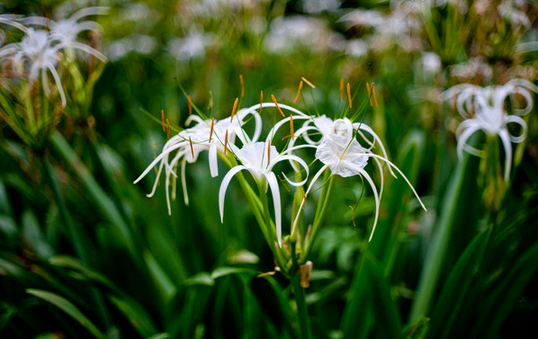
Crinum asiaticum likes a warm, humid, well-lit, fertile sandy loam environment. It is not cold-tolerant and tolerates saline-alkaline soil, but during the seedling stage it should be kept from strong direct light. Its optimum growing temperature is 15-20°C. During the winter bulb dormancy period, the suitable storage temperature is about 8°C. For potting, a sandy culture soil with high humus content, loose and fertile, and strong permeability is suitable. Crinum asiaticum has great ornamental value; it can be enjoyed both for its leaves and its flowers, and is deeply loved by many people. So what are the cultivation methods and precautions for Crinum asiaticum? Let's take a look at the content below.
Crinum asiaticum Cultivation Methods1. Soil: Crinum asiaticum has no strict requirements for soil and tolerates saline-alkaline soil; it grows better in soil rich in humus, loose and fertile, and well-drained.
2. Watering: Crinum asiaticum needs ample water during the growing season, and the soil should be kept moist regularly, but it must not become waterlogged; after autumn, watering should be reduced.
3. Sunlight: To keep the leaves emerald green, beautiful and neat, without affecting light exposure, Crinum asiaticum should be properly shaded during the intense heat of midsummer: from 7 a.m. to 12 noon it should receive full sun, and from 12 noon to 3 p.m. a shade frame should be set up for shade.
4. Temperature: Crinum asiaticum likes warmth and is not cold-tolerant. Its optimum growing temperature is 15——20°C, and in winter it needs to overwinter indoors at no less than 5°C.
5. Fertilizing: Crinum asiaticum likes fertilizer; apply manure 2——3 times a month, and apply phosphorus fertilizer 2 more times before and after flowering, which helps it bloom more and last longer.
6. Pruning: After Crinum asiaticum flowers, if seed is not wanted, the flower stalk should be cut off, and old yellow leaves should also be removed at the same time.
7. Propagation method: Crinum asiaticum can be propagated by division or by cuttings, generally from spring to autumn. The suitable growing temperature is 22——28 degrees Celsius; generally, when it falls below 10 degrees Celsius, cold protection measures should be taken.
Precautions for Growing Crinum asiaticum1. Cooling and humidifying in summer: Crinum asiaticum fears harsh sun exposure in summer. Therefore, after summer begins, the plant should be moved to a shade frame or a north-facing balcony for care, and water should be sprinkled on the ground frequently to create a cool, humid micro-environment.
2. Fertilize frequently during the growing period: during the growing period, apply dilute fertilizer frequently. In spring, apply a dilute fertilizer mainly of nitrogen; during scape emergence and bud formation, apply a liquid fertilizer mainly of phosphorus and potassium; in autumn, apply rotted cake fertilizer. The interval between fertilizations is 2 weeks.
3. Water frequently during the growing period: in spring, water once every 1—2 days; in summer, water once every evening; after autumn begins, reduce watering; in winter, strictly control watering (generally water once about every 2 weeks).
4. Do a good job of keeping warm in winter: in northern regions in early October, and in southern regions in early November, move the plant indoors, place it in a sunny spot, and keep the temperature between 8—10°C for it to overwinter.