A Detailed Guide to Making and Caring for Serissa Bonsai
1. Making a Serissa Bonsai
Serissa has small leaves, small flowers, and twisted stems, with a well-developed, gnarled and interlocking root system, many branches, and strong sprouting ability. It can be made into bonsai styles such as single-trunk or double-trunk, multi-trunk, root-on-rock, and cascade.
(1) Material selection. In spring, March to April, select tree stumps with thick, sturdy stems, many branches, a well-developed root system, and a certain form. Dig them out of the ground or remove them from a growing pot, and conceive and shape them according to the tree form. Single-trunk specimens are mostly trained into curved-trunk or cascade styles, double-trunk ones mostly into mutually leaning styles, and multi-trunk ones into forest styles. Determine the trunk height according to the thickness of the trunk, and thin out excess branches and trunks.
(2) Potting. Take the selected Serissa stump, remove the soil from the roots so they are exposed, and prune the roots appropriately. For small stumps, pull the roots together by hand and plant them into the pot, then cover with growing soil, leaving the gnarled roots exposed. For slightly larger stumps with thicker roots, use plastic strips to bind and pull the roots together, forming gnarled roots and claw-like roots, then pot and cover with soil, leaving part of the roots exposed. For root-on-rock styles, press the roots into stone crevices, stone grooves, or through holes, keep the roots tight against the stone body, bind firmly with plastic strips, then pot and cover with soil. Cover the pot soil up to 1/2 to 1/3 of the root-on-rock section, leaving part of the roots exposed. Newly potted Serissa should be placed in a cool, moist place for a period of care. When the new branches grown from the pruned stump reach 3 to 5 cm, move the pot to a semi-shaded place for normal management.
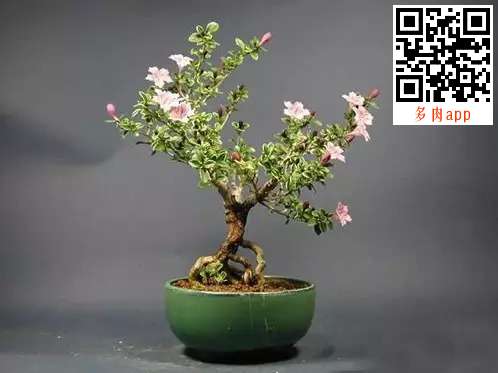
Serissa Bonsai Care Tips:
Making a Serissa bonsai takes considerable time, so its care cannot be neglected either, otherwise it will affect the bonsai's ornamental effect. Only by understanding Serissa's growth habits can you care for it better.
Serissa likes sunlight and is also fairly shade-tolerant, but fears fierce winds and scorching sun; in hot, sweltering weather it should be given light shade. Serissa is best planted by division in spring, or propagated by cuttings during the yellow plum rain season, and is best watered with light tea. It is not strict about temperature; in South China it is evergreen, and in the Southwest it is semi-evergreen. It has strong drought tolerance and is not strict about soil. For potted Serissa, a humus-rich, loose, fertile, highly permeable, slightly acidic, moist growing soil will help it grow well.
For cultivating Serissa bonsai, soft mountain soil must be used, and it should be placed in a sunny spot, not kept indoors for long periods. During the growing season it needs 1 to 2 applications of fertilizer, and the pot soil is best kept on the drier side; too much or too concentrated fertilizer and water will cause excessive leggy growth of branches and leaves. In addition, to ensure the Serissa bonsai has a well-balanced, full shape, pruning and shaping for artistic processing are also needed.
A Serissa bonsai should have a fixed position and should not be moved here and there, as Serissa is particular about phototropism. In summer, shade it from above under the scorching sun, keep it ventilated, and spray water on its leaves 1 to 2 times a day to maintain air humidity. In severe cold, it can be wrapped lightly with rice straw (at around -10°C) to prevent it from freezing to death.
Serissa Bonsai Making / Care and Management
Making a Serissa BonsaiIn midsummer, Serissa produces pure white fresh flowers, and its blooms are so dense they are like snow, which is how it got its name. Serissa is an evergreen small shrub, suitable for miniature bonsai, and can be placed indoors to embellish the environment. Placing a pot of Serissa bonsai on a spotless table by a bright window gives a special touch of elegance.
Material Collection and Propagation Measures for Serissa Bonsai1. Artificial propagation: Usually propagated by cuttings or tillering. Cuttings can be hardwood or softwood cuttings; hardwood cuttings are done in February to March, using dormant branches as cuttings; softwood cuttings are done in June to July during the plum rain season, using semi-ripened branches as cuttings. The seedbed soil should be deep, fertile, and moist, with cuttings 6 to 8 cm long and inserted to a depth of 12; after insertion, a shed must be built for shade, with attention to watering to keep the soil layer moist. They root very easily, and can be transplanted in spring of the following year. Tillering propagation is done in March in spring: dig up the plants that have sprouted from the roots at the base, roots and all, divide them with a sharp knife, and plant them separately with roots attached; they also root easily.
2. Collection from the wild: Serissa grows in great abundance wild in the mountains. Old stumps with thick, sturdy rootstocks can be selected, dug up, and then cultivated in a shady, moist, fertile soil spot. Once the root system has resumed growth and the branches and leaves are lush, they can be transplanted into pots.
Potting Process for Serissa Bonsai1. Pot selection: Serissa mostly uses relatively shallow rectangular or oval pots; the material can be purple clay pottery or glazed pottery, and the color should preferably be darker.
2. Soil: Serissa is best grown in a humus-rich, loose, well-drained, slightly acidic loam. For potting, leaf mold or sun-dried, freeze-thawed pond mud can be used, with a layer of river sand and leaves placed at the bottom of the pot to aid drainage.
3. Planting: Transplanting and potting can be done in early spring or late autumn. When planting, part of the long roots can be cut off. If it is a wild old root stump, the roots can be raised appropriately to display an aged posture.
Styling Techniques for Serissa Bonsai1. Processing: Serissa is generally shaped by combining pruning and wiring; the main branches need only be wired appropriately, and the rest are shaped by pruning. For wiring, palm fiber is best, and care should be taken not to damage the branches and bark when bending into shape. For old root stumps, root-raising treatment can also be done to add to the beauty of the tree's posture.
2. Tree forms: Common Serissa bonsai forms include slanting-trunk, curved-trunk, cascade, forest, and raised-root styles. Serissa is also suitable for use in landscape bonsai and water-and-land bonsai. Its branches and leaves spread horizontally and are best shaped into a steamed-bun shape, but not too regular; pay attention to variations in density. Side branches can droop appropriately, which is quite picturesque. Serissa can also be made into root-on-rock bonsai, rooting in stone crevices, with suspended roots and exposed claws, and gnarled, interlocking branches, ancient and peculiar, full of natural wild charm.
Serissa Care and Management1. Care and management: Placement location: Serissa is best placed in a semi-shaded, semi-sunny, warm, and moist spot. In summer it must not be exposed to the sun, and in winter it must be brought indoors; a temperature not lower than 2°C is sufficient. A Serissa stump bonsai beautifies the home and gives a fresh, refreshing feeling.
2. Watering: During the spring and summer growing season, the pot soil must be kept sufficiently moist. In high summer temperatures, spray water on the leaves morning and evening, which is good for flowering. During the dormant period after autumn, be careful to prevent water accumulation in the pot soil, so as to avoid root rot.
3. Fertilizing: Serissa is fairly tolerant of poor, lean conditions, and should not be fertilized too frequently, otherwise it easily grows rampant and ruins the tree shape. Generally, one light application of fertilizer each in spring and autumn is sufficient.
4. Pruning: Shaping and pruning can be done once each in April and October every year. Overly vigorous branches and tiller branches sprouting from the roots can be pruned, to achieve balanced vigor among the branches and maintain the beauty of the tree shape. At the same time, overly dense branches must be thinned out. Pruning in October should not be too heavy, to prevent renewed sprouting in autumn. In addition, frequent pinching in summer can make the branches and leaves lush.
5. Repotting: Serissa bonsai should be repotted once every 2 to 3 years, mostly in March in spring. When repotting, be careful to cut off dead roots, appropriately remove some old roots and old soil, and replace with loose leaf mold, which is good for root development. In addition, combined with repotting, root-raising and root-exposing processing can be carried out gradually. After repotting, it is best to place it temporarily in a cool, ventilated spot, and resume normal management after one week.
6. Pest and disease control: Serissa occasionally suffers from aphid damage, which can be controlled by spraying with 80% dichlorvos at 1200 times dilution.
7. Ornamental value: The Serissa tree form is delicate, with sparse, graceful branches and leaves. It blooms in midsummer, with dense blossoms as white as snow, making it most suitable for viewing. Serissa can also be made into miniature bonsai and water-and-land bonsai. It is an excellent choice for indoor greenery embellishment, and looks very elegant placed on a windowsill or a desk.