What are the common propagation methods for Serissa japonica?
Serissa japonica is mainly propagated by cuttings, and can also be divided and layered.
1. Cutting propagation
This is mostly done during the plum rain season. Choose strong, pest- and disease-free branches and cut them into 8-10 cm long cuttings, which can be inserted directly into plain sand. After inserting, water thoroughly, provide appropriate shade, maintain a certain humidity and a temperature of 20-25°C, and roots will form in about 1 month. When new shoots grow, they can gradually be exposed to sunlight, but still avoid direct exposure to strong sunlight.
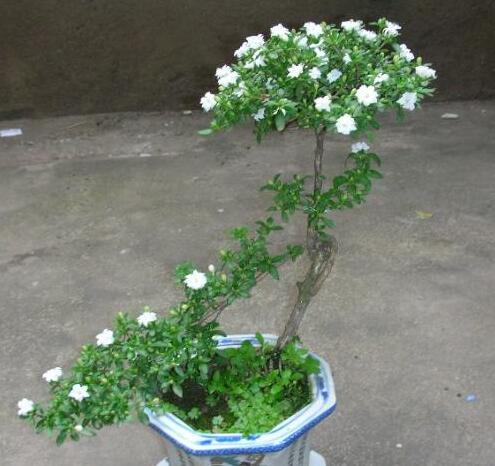
Serissa japonica in full bloom
[How to grow Serissa japonica]1. Soil selection for growing Serissa japonica
Serissa japonica is not strict about soil quality, and slightly acidic soil rich in humus and with good drainage is best. For potting soil, fertile mountain soil can be used, or a mix made of 4 parts garden soil, 4 parts leaf mold, and 2 parts sand.
2. Fertilization method for growing Serissa japonica
Serissa japonica is relatively tolerant of drought and poor soil, so fertilization should not be too frequent or too concentrated, otherwise it tends to grow excessively and affect the tree shape. Generally, applying cake fertilizer water once each in spring and summer is enough. When potted, some light fertilizer must be applied in winter, and fertilization is not suitable in other seasons. After the Start of Winter, it should be moved indoors for care, and in the cold winter season the indoor temperature must not be lower than 0°C, otherwise it is prone to dying.
Fertilization should be light. In addition to base fertilizer, generally applying 1 time of dilute decomposed liquid fertilizer in early summer or late autumn is enough. Too much fertilizer water easily causes excessive growth and makes the tree shape difficult to control.
3. Watering method for growing Serissa japonica
Serissa japonica has strong adaptability and very good drainage, so it should not be watered too much, but the potting soil should be kept moist and drainage must be smooth, otherwise it will grow too vigorously and affect the overall beauty. Serissa japonica likes moisture. Generally, water once a day in spring and autumn, and twice a day in summer, but watering should not be excessive either, because water accumulation in the pot easily causes root rot.
4. Light requirements for growing Serissa japonica
Serissa japonica is not strict about light requirements and likes light while also being slightly shade-tolerant. Newly potted plants need to be placed temporarily in a shaded place, and after half a month they should be moved to a place with scattered light for care. In slightly shaded and relatively moist places, it grows especially vigorously.
5. Shaping methods for growing Serissa japonica
For the shaping of Serissa japonica, styles such as slanting trunk, curved trunk, cascade, forest, or exposed-root styles can be used. Regardless of the style, generally the extremely developed root system of Serissa japonica is used to expose roots or raise roots, or it is made into a root-stone style with roots and stones merged together; the trunk and main branches are bound and bent according to the shaping requirements, while small side branches are pruned and shaped so that the branches and leaves spread horizontally into cloud-like forms of different sizes and densities. The branches of Serissa japonica are relatively brittle and the bark is thin, so when binding and bending, be careful not to damage the branches and bark. In addition, Serissa japonica has fine, dense small branches and strong sprouting ability, so the branch pads should be pruned regularly to maintain the tree shape.
Green Serissa japonica
6. Propagation methods for growing Serissa japonica(1) Cutting propagation: dormant branch cuttings are taken from February to March, and semi-mature branch cuttings are taken from June to July. Both are cut into 7-8 cm lengths, the lower leaves are removed, and they are soaked in 500-1000 mg/kg naphthaleneacetic acid or indolebutyric acid for 5-10 seconds, then inserted into the seedbed and shaded with a frame. After inserting, pay attention to watering, keep the temperature at 25-30°C and the seedbed moist, and roots will form in 20-25 days.
(2) Division propagation: generally when the seedlings enter dormancy, that is, from September to October, the whole seedling is divided into several young seedlings, or some young seedlings are cut from the side, and division can also be carried out before sprouting.
[Efficacy and effects of Serissa japonica]
Serissa japonica is also known as Many Stars, Daily Bloom, etc. It belongs to the Rubiaceae family and is a medicinal flowering plant. Its nature and flavor are bitter and cool, and it has the effects of dispelling wind and dampness, relaxing muscles and activating collaterals, clearing heat and detoxifying, and regulating the spleen and qi. It has a certain therapeutic effect on rheumatism pain, migraine, toothache, sore throat, stomatitis, neurodermatitis, damp-heat jaundice, herpes zoster, leukorrhea and white turbidity, and other conditions.