A Detailed Guide to Five-Color Pepper Planting Techniques and Management Methods
Five-color pepper planting techniques. Five-color pepper, also known as five-color chili, five-color pepper, or heavenly-facing pepper, is a perennial semi-woody plant in the Solanaceae family, often grown as an annual. Its leaves resemble those of chili peppers, the plant is slightly smaller, the flowers are white, and the fruit shapes are varied; it is a variety of chili pepper. There are many varieties or horticultural cultivars of the same kind: those that are bright red and grow in clusters facing upward are called heavenly-facing pepper; those that are round, drooping, and five-colored are called colored lantern. In addition, there are also types that are first white then red, half-colored and half-yellow, or red, yellow, and purple in alternating colors; the colors differ and the cultivar names vary. The fruiting period lasts from summer to autumn, spanning about half a year.
Five-color pepper is native to tropical America and is now widely planted around the world. It prefers a warm climate, long sunshine hours, and a dry atmosphere.
Planting Methods for Five-Color Pepper
Five-color pepper can be planted in the ground or in pots. For pot cultivation, use matured garden soil with an appropriate amount of base fertilizer as the growing medium, or mix garden soil, leaf mold, and sand in a 5:4:1 ratio. Plant 1-3 small seedlings per pot. If sowing in a pot, sow 1-3 seeds with a certain spacing, water thoroughly after sowing, and place in a sunny, well-ventilated spot.
Soil Selection for Five-Color Pepper
Five-color pepper is not strict about soil requirements, but fertile, moist, well-drained sandy loam is best.
Light Conditions for Five-Color Pepper
Five-color pepper likes sunlight. Give it more than 4 hours of direct sunlight daily; indoors, place it in front of a south-facing window. If the light is too dim, the plant will not bloom. After the last frost, the pot can be placed on a balcony or in a wind-sheltered, sunny spot in the courtyard.
Watering Methods for Five-Color Pepper
Five-color pepper likes moist to wet soil. During the growing period, water 1-2 times a day to keep the potting soil moist but not waterlogged. During the flowering period, watering should be properly controlled; water once every two days, as too much water easily causes flower drop. During the fruiting period, watering should be sufficient, keeping the soil moist at all times; if it is too dry, the fruit color will become dry and yellow. After the fruit matures and changes color, watering can be reduced, keeping the potting soil merely moist.
Fertilizing Time for Five-Color Pepper
Five-color pepper likes fertilizer and tolerates it. However, during the growing period, topdressing should not be excessive, to avoid excessive vegetative growth of branches and leaves. The normal growth and development of five-color pepper requires organic fertilizer with a high phosphorus content. To make flowers plentiful and fruit abundant, apply 1-2 times of phosphorus-containing liquid fertilizer such as bone meal before flowering. After fruit set, apply a dilute cake fertilizer solution once every 10 days, with an appropriate amount of superphosphate added.
Propagation Methods for Five-Color Pepper
Five-color pepper is mostly propagated by seeds. The fruit used for sowing should be selected from early- or mid-season ripe fruits according to ornamental requirements. Sowing is generally done in early spring, indoors; after emergence, the seedlings are transplanted 1-2 times before being potted for final planting. Generally, a 3-month-old plant begins to bear fruit for ornamental display. The above is an introduction to the planting techniques of five-color pepper.
Cultivation and Management Techniques for Five-Color Pepper
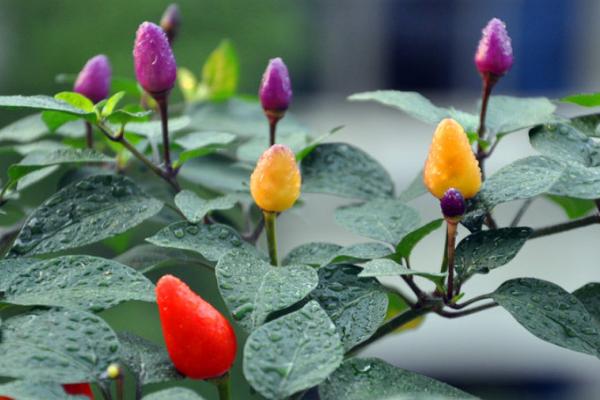
Five-color pepper is a treasure among chili peppers and also an excellent potted ornamental fruit plant. The fruits on the same plant come in five colors: green, yellow, white, purple, and red. They are bright and eye-catching, glossy, dotted among the green leaves, and delicate and lovely. The plant height is about 50 cm, and a single plant can produce up to 250 fruits. It combines edible, medicinal, and ornamental uses, and its capsaicin content is 10 times that of ordinary chili peppers.
1. Seedling raising: The suitable germination temperature is above 25°C. If a plastic film shed is used for insulation, it can be cultivated in all four seasons. It is best to sow in a seedbed or in pots. The soil should be fertile, loose, and well-drained. The soil must be sieved and disinfected. Simple disinfection methods include sun exposure, fumigation, and high-temperature treatment; the purpose is to kill bacteria or insect eggs in the soil. Before sowing, spray the seedbed with enough water. After the water seeps in, evenly scatter the seeds, then cover with fine soil 1 cm thick, and finally spray water to moisten the bed. If the temperature is low, build an arched film cover; if the temperature is too high, remove the film to avoid burning the young sprouts. After the young sprouts emerge, apply 1-2 moderate waterings of human feces and urine or a 0.1% urea solution. After watering, immediately use a fine watering can to sprinkle clear water to wash off the fertilizer liquid on the leaves, so as not to burn the young leaves. When the seedlings grow to 5-6 true leaves, they can be transplanted.
2. Pot cultivation: For flower pots with a diameter of 15-25 cm, plant one plant per pot; larger pots can hold 2-3 plants. The soil used should be mainly farmyard manure, supplemented by phosphate fertilizer, urea, and compound fertilizer. The soil in the pot should be loose and well-drained, and keep it in sufficient sunlight. If the indoor temperature is suitable in winter and care is proper, it can continue to bloom, and the ornamental fruit period of potted plants can often be extended to the New Year.
3. Field planting: For open-field cultivation, sowing is required from March to May each year. Before transplanting, sufficient base fertilizer must be applied to the field, with more than 1,000 kg of human and livestock manure per mu, and 50 kg of phosphate fertilizer or compound fertilizer as appropriate. For transplanting density, the row spacing should be 40-50 cm and the plant spacing 30 cm. Provide sufficient water to retain moisture, weed thoroughly, and at the beginning of the flowering period use 10 kg of urea per mu; if conditions permit, apply plant vitality agents such as Yemianbao and Fengchanling.
4. Pest and damage prevention: In dry, hot weather or with much cloudy rain, growth weakens. Water during high temperature and drought; in the rainy season, dig field drainage ditches well to prevent water accumulation from causing leaf drop, flower drop, and fruit drop. To prevent and control diseases and insect pests, refer to plant insecticides and spray accordingly.
5. Harvesting: The fruits of field-planted five-color pepper generally begin to mature successively from mid-to-late August. They should be picked and cut in time to increase yield and improve economic benefits. The cut mature peppers can be sold on the market or strung up and hung in a ventilated, dry place to dry into dried peppers, to be kept for consumption or sold as commercial peppers.
How Many Years Can Five-Color Pepper Live? Can Five-Color Pepper Survive the Second Year?
Speaking of five-color pepper, everyone is probably fairly familiar with it; it is a kind of chili pepper we eat quite often. As the name suggests, five-color pepper has many beautiful colors, and there are also many varieties, with bizarre shapes that are especially interesting. Five-color pepper is not only tasty but can also be used as an ornamental plant, and quite a few people even grow it to decorate rooms. So how many years can five-color pepper survive?
How Many Years Can Five-Color Pepper Live
Generally one year. Five-color pepper is an annual herbaceous plant and dies after the fruit matures in autumn. Five-color pepper, also known as five-color chili, is a variety of chili pepper and a perennial herbaceous plant of the genus Capsicum in the Solanaceae family, but it is often cultivated as an annual. The plant height is 30-60 cm, the stem is upright and often semi-woody, with many branches and alternate simple leaves.
Can Five-Color Pepper Survive the Second Year?
Five-color pepper is an annual herbaceous plant, so it can basically only survive one year, and therefore basically cannot survive the second year.
How to Propagate Five-Color Pepper by Sowing
The sowing time is generally chosen in late spring, indoors or in the open field when the weather is clear and warm. The suitable germination temperature is between 25-30°C, and germination occurs about 5-10 days after sowing. During the seedling stage, liquid fertilizer needs to be applied 1-2 times, and transplanting is carried out when the plant height reaches 8-10 cm.
In a greenhouse environment, sowing is generally done in late March. Sowing can be done in indoor pots or in a seedbed, and transplanting is carried out when 3-4 true leaves have grown. In mid-to-late June, plant out in the open field. If it is to be grown as a potted ornamental, it can be planted in early June into a flower pot with a diameter of about 20 cm, and it can begin to bear fruit in August.
The suitable germination temperature for five-color pepper plants needs to be above 25°C. If a plastic film shed is used for insulation, it can be cultivated in all four seasons. Sowing can be done in a seedbed or in pots.
Choose fertile, loose soil with good drainage and air permeability. The soil needs to be sieved and disinfected by methods such as sun exposure, fumigation, and high-temperature treatment to kill bacteria and insect eggs in it.
Before sowing, spray the seedbed with sufficient water. After the water seeps in, evenly scatter the seeds into the soil, then cover with fine soil about 1 cm thick, and finally spray water once more. If the temperature is low, build an arched film cover.
After the young sprouts emerge, water 1-2 times with human feces and urine or apply an appropriate amount of 0.1% urea solution. After watering, remember to spray clear water to wash off the fertilizer liquid remaining on the leaf surface, to avoid burning the young leaves. When 5-6 true leaves have grown, they can be transplanted.
What Varieties of Five-Color Pepper Are There?
1. Heavenly-facing type
The fruit points upward and is round, heart-shaped, or conical, with a single fruit growing in the leaf axil. The fruit color changes from white to red, or from white or yellow to blue-purple and then to red. In addition, there are also single-colored types, and types that change from green or white to yellow or red.
2. Clustered type
Also called Buddha's hand pepper, most of the fruits of this variety are clustered at the tips of the branches, mostly long heart-shaped or conical, and the color is mostly from white to red or from green to red.
3. Drooping type
The fruit grows in the leaf axil. The fruit droops and is mostly irregularly conical. Depending on the variety, the size varies, and the fruit color changes from green to red or yellow.
4. Lantern type
The fruit grows in the leaf axil. The fruit droops and is mostly truncated-cone-shaped, round-square, and also multi-ribbed, with smooth-rounded corners. The fruit color generally changes from green to white, red, yellow, or black-purple, and so on. There are also distinctions in length, shortness, height, and dwarfness.
In addition, they can also be divided according to plant type into tall, medium, and dwarf. Tall ones can reach 1 m, while dwarf types are only 10 cm.
Through the above content, I believe everyone has gained a certain understanding of five-color pepper. Although five-color pepper can only survive one year, growing it again the following year is also very simple and convenient. Friends who like it can plant some! It is not only beautiful but also delicious!