Why is it so difficult to propagate and care for spotted laurel?
Why is spotted laurel difficult to propagate and care for? When potted spotted laurel grown at home performs poorly and cuttings are slow to root, it is mainly because the plant's biological characteristics have not been fully understood and mastered. Spotted laurel is a small shrub in the dogwood family. Its leaves are strikingly shaped and brightly colored, with golden-yellow blotches of various sizes scattered across the deep green leaf blades, shifting between light and dark, intermingling green and yellow; it is a very popular indoor ornamental plant.
Because it is extremely shade-tolerant and highly resistant to smoke, dust and air pollution, it is especially suitable for indoor display in urban homes, and its branches and leaves can also be used as cut flower material. Spotted laurel is propagated mainly by softwood cuttings in summer. In early June, cut current-year green shoots that are slightly more than semi-lignified into 10-15 cm stem sections; cuttings with a terminal bud and 3-4 upper leaves retained are the easiest to root. The ideal rooting medium is rice husk ash and fine sand mixed at a ratio of 1:1. Put the evenly mixed rooting medium into a large flowerpot or a trough, generally 20-30 cm deep, insert the prepared cuttings into the medium at a spacing of 5 cm x 5 cm, with the insertion depth about 1/2-2/3 of the stem length, leaving only the upper part of the cutting and the leaves exposed above the medium, and spray water frequently to keep the medium moist.
It is best to cover with plastic film to retain moisture while also providing shade with a frame. Usually after half a month, milky white callus tissue forms on the wound; after about a month, well-developed roots can differentiate; after another 20-30 days, the plants can be divided and replanted or potted up. Spotted laurel likes shade and moisture, so during care the potting soil should be kept moist and moderate shading provided. It grows well in potting soil that is well drained, loose and fertile. Because it is not very cold-tolerant in winter, when cultivated in areas north of the Huai River it must be kept indoors to overwinter safely.
In summer it fears heat and sunscald, so it can be kept indoors for long periods. Throughout the growing season, apply cake fertilizer water once every half month, and place it on the balcony in the morning and evening to receive sunlight. In hot seasons, spray water on the leaves frequently; only in this way can the leaves remain tender and bright for a long time.
Why is spotted laurel difficult to propagate and care for?
Why is spotted laurel difficult to propagate and care for?
Why is spotted laurel difficult to propagate and care for? When potted spotted laurel grown at home performs poorly and cuttings are slow to root, it is mainly because the plant's biological characteristics have not been fully understood and mastered. Spotted laurel is a small shrub in the dogwood family. Its leaves are strikingly shaped and brightly colored, with golden-yellow blotches of various sizes scattered across the deep green leaf blades, shifting between light and dark, intermingling green and yellow; it is a very popular indoor ornamental plant.
Because it is extremely shade-tolerant and highly resistant to smoke, dust and air pollution, it is especially suitable for indoor display in urban homes, and its branches and leaves can also be used as cut flower material. Spotted laurel is propagated mainly by softwood cuttings in summer. In early June, cut current-year green shoots that are slightly more than semi-lignified into 10-15 cm stem sections; cuttings with a terminal bud and 3-4 upper leaves retained are the easiest to root. The ideal rooting medium is rice husk ash and fine sand mixed at a ratio of 1:1. Put the evenly mixed rooting medium into a large flowerpot or a trough, generally 20-30 cm deep, insert the prepared cuttings into the medium at a spacing of 5 cm x 5 cm, with the insertion depth about 1/2-2/3 of the stem length, leaving only the upper part of the cutting and the leaves exposed above the medium, and spray water frequently to keep the medium moist.
It is best to cover with plastic film to retain moisture while also providing shade with a frame. Usually after half a month, milky white callus tissue forms on the wound; after about a month, well-developed roots can differentiate; after another 20-30 days, the plants can be divided and replanted or potted up. Spotted laurel likes shade and moisture, so during care the potting soil should be kept moist and moderate shading provided. It grows well in potting soil that is well drained, loose and fertile. Because it is not very cold-tolerant in winter, when cultivated in areas north of the Huai River it must be kept indoors to overwinter safely.
In summer it fears heat and sunscald, so it can be kept indoors for long periods. Throughout the growing season, apply cake fertilizer water once every half month, and place it on the balcony in the morning and evening to receive sunlight. In hot seasons, spray water on the leaves frequently; only in this way can the leaves remain tender and bright for a long time.
The family Aucubaceae has only one genus, Aucuba, with about 3-10 species, all growing in East Asia, distributed from the eastern end of the Himalayas to Japan. They are evergreen shrubs or small trees (2-13 m tall), with opposite, leathery, simple leaves resembling laurel, 8-25 cm long and 2-7 cm wide, dioecious, with flowers 4-8 mm in diameter and 4 petals; the fruit is a red berry about 1 cm in diameter.
The 1981 Cronquist classification placed the genus Aucuba in the dogwood family; the 1998 APG classification, based on genetic relationships, placed the genus Aucuba in a family of its own under the order Garryales; the 2003 APG II classification, based on genetic relationships, considered that this family could optionally be merged with the Garryaceae.
It has now been introduced in various places as an ornamental plant, the most famous being spotted laurel (Aucuba japonica Variegata), whose leaf surface bears yellow star-like speckles; it is a well-known foliage plant.
Propagation and Care of Spotted Laurel
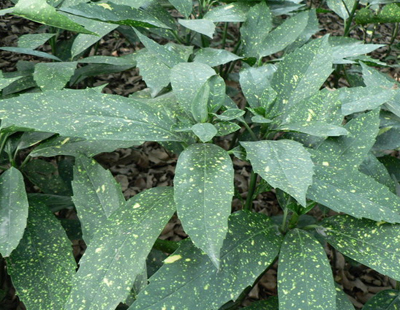
Spotted laurel is propagated mainly by softwood cuttings in summer. In early June, cut current-year green shoots that are slightly more than semi-lignified into 10-15 cm stem sections; cuttings with a terminal bud and 3-4 upper leaves retained are the easiest to root. The ideal rooting medium is rice husk ash and fine sand mixed at a ratio of 1:1. Put the evenly mixed rooting medium into a large flowerpot or a trough, generally 20-30 cm deep, insert the prepared cuttings into the medium at a spacing of 5 x 5 cm, with the insertion depth about 1/2-2/3 of the stem length, leaving only the upper part of the cutting and the leaves above the soil, and spray water frequently to keep the medium moist. Usually after half a month, milky white callus tissue forms on the wound, and after about a month, well-developed roots can differentiate. After another 20-30 days, the plants can be divided and replanted or potted up.
Spotted laurel likes shade and moisture, so during care the potting soil should be kept moist and moderate shading provided. It grows well in potting soil that is well drained, loose and fertile. It is not very cold-tolerant in winter and must be kept indoors to overwinter safely. In summer it fears heat and sunscald, so it can be kept indoors for long periods. Throughout the growing season, apply cake fertilizer water once every half month, and place it on the balcony in the morning and evening to receive sunlight; in hot seasons, spray water on the leaves frequently; only in this way can the leaves remain tender and bright for a long time.