Detailed Explanation of Camellia Planting Methods and Care Points
Camellia planting methods. The camellia is native to China's Yunnan-Guizhou Plateau, where winters are not severely cold, summers are not scorching hot, rainfall is abundant, air humidity is high, sunlight is soft, there are no dry winds, and the soil is acidic. Growing camellias in the south is relatively easy, but the climate and soil in northern China are the exact opposite of the south.
Therefore, when growing camellias you should first prepare an acidic potting soil; it is best to use pine needle soil for potting, and after the flowers fade each year, repot and change the soil once. Camellias grown in Beijing, due to the influence of water quality, will cause salinization of the soil, so "black alum water" must be applied frequently. Ordinary watering water should be left to stand for a few days before use. If the leaves are found to be turning yellow, a ferrous sulfate solution should be poured on immediately.
When topdressing, pour on sesame paste residue water and a 1000-fold dilution of monopotassium phosphate. In summer, when the plant produces overly dense branches, leggy branches, diseased or pest-damaged branches, and inward-growing branches, they must be pruned off to maintain ventilation, light penetration, and a good tree shape. When cultivating camellias, appropriate shading should be provided in spring and summer, while more sunlight can be given in autumn.
Before flowering, the plant should be cared for outdoors to enhance ventilation. Frequently spray water around the plant to raise air humidity. The potting soil should alternate between dry and moist to create good aeration conditions for the roots. In winter, the room temperature must not be lower than 8°C, nor should it exceed 16°C. Immediately after the flowers fade, shorten the flowering branches to encourage axillary buds to sprout and produce new branches, preparing for another bloom. If shortened too late, the new branches that grow will not have time to differentiate flower buds and will not be able to bloom again. For perennial old plants, thinning pruning should be carried out, cutting off some overly dense side branches from the base to facilitate ventilation and light penetration, extend the plant's lifespan. That concludes the introduction to camellia planting methods.
Camellia planting methods|Camellia planting techniques|Camellia cultivation methods
This article mainly introduces camellia planting methods as well as camellia planting techniques and camellia cultivation methods. [Overview]Camellia, also known as the camellia flower, is a plant of the genus Camellia in the family Theaceae. The camellia flower is full and graceful in form, dignified and elegant, and is one of China's traditional top ten famous flowers. It is also one of the world's famous flowers.
The camellia is native to China. In the early 7th century AD, Japan introduced camellias from China, and by the early 15th century it was introducing large numbers of Chinese camellia varieties. In 1739, the United Kingdom introduced Chinese camellias for the first time, after which camellias spread to various countries in Europe and America. To date, countries such as the United States, the United Kingdom, Japan, Australia, and Italy have developed rapidly in camellia breeding, cultivation, and production, and have entered the stage of industrialized production, with interspecific and intraspecific hybrids and new varieties continuously coming onto the market.
China has a long history of cultivating camellias. Cultivation of camellias dates back to the Southern Dynasties. In the Tang Dynasty, camellias were cultivated as precious ornamental plants. By the Song Dynasty, camellia cultivation was already very widespread. In the Southern Song Dynasty, camellias from Wenzhou were introduced to Hangzhou and developed rapidly. In the Ming Dynasty, the "Flower History" described and classified camellia varieties. By the Qing Dynasty, camellia cultivation was even more flourishing, and camellia varieties continuously emerged. Since 1949, China's camellia cultivation level has improved to a certain extent, and variety selection and breeding have further developed. At present, China has more than 300 camellia varieties. In Zhejiang, Fujian, Jiangsu, and other places, mass production has begun. At present, it has become the main potted ornamental flowering plant in the flower market in winter.
[Morphological Characteristics and Varieties]
The camellia is an evergreen broad-leaved shrub. The leaves are alternate, leathery, elliptical, with serrated edges, and dark green. The flowers are solitary or 2-3 borne at the tips of branches or in leaf axils. The flowers are single or semi-double. Double. Common varieties include single-petaled types such as 'Chenxi', with ruffled petals, pure white; 'Saijinguang', white flowers marked with peach-red lines and sprinkled with fine dots; 'Dahua Jinxin', with large red flowers, flower diameter 6-7 cm; semi-double types include 'Sai Luoyang', red flowers with white blotches; 'Da Songzi', deep red flowers; 'Zui Yangfei', pink flowers; 'Xingtao Mudan', peach-red flowers. Double types include 'Bai Baozhu', pure white flowers; 'Hong Furong', flowers with an oleander-red color; 'Hua Furong', white flowers with red lines; 'Hua Baozhu', pink flowers with irregular red stripes; 'Wuhe Pengqiu', large red flowers; 'Hua Foding', large red flowers with a small amount of white blotches; 'Hong Shiba Xueshi', red flowers; 'Chidan', large red flowers; 'Hua Heling', light red flowers with white spots. Varieties selected and bred abroad include Adolphe Audusson, with large, deep red, double flowers. Alba Plena, with large, white, double flowers. Berenica Boddy, with light pink, semi-double flowers and strong cold resistance. Debutante, with large, peony-form, light pink flowers. Donckelarii, with red flowers bearing white marbled stripes, semi-double. Elegans, with large, anemone-form flowers, rose-red with white spots. Finlandia, with light pink, semi-double flowers. Glen 40, with large, deep red, double flowers. Herme, with pink flowers bearing irregular white edges and deep pink stripes, semi-double. Kumasaka, with a hybrid tea rose form, rose-red flowers. Magnoliaeflora, with light red, semi-double flowers. Mathotiana, with large, hybrid tea rose form, deep red, double flowers. Purity, with white flowers, hybrid tea rose form, double. Among hybrid camellias there are Donation, with large, pink, semi-double flowers; and Fragrant Pink, with small, peony-form, deep pink flowers that are very fragrant.
[Biological Characteristics]
The camellia is native to China. It prefers warm, humid, and semi-shaded environments. It fears high temperatures and avoids scorching sun.
The suitable growth temperature for camellias is 18-25°C, 13-18°C from March to September, and 10-13°C from September to March of the following year. When the temperature is above 12°C, budding begins; above 30°C, growth stops. The initial flowering temperature is 2°C, and the suitable temperature for flower opening is 10-20°C. Cold-hardy camellia varieties can withstand -10°C for a short time, while ordinary varieties withstand -3 to -4°C. When summer temperatures exceed 35°C, leaf scorching will occur.
Camellias are suited to environments with sufficient moisture and humid air, and they avoid dryness. In the hot, dry summer and autumn, water or spray promptly; the ideal relative air humidity is 70%-80%. During the plum rain season, pay attention to drainage to avoid waterlogging and root rot.
The camellia is a semi-shade plant, suitable for growing under diffused light, and it fears direct sun exposure; seedlings need shading. However, long-term excessive shade is unfavorable to camellia growth, resulting in thin leaves and few flowers, affecting ornamental value. Mature plants need more light to facilitate flower bud formation and flowering.
For open-field cultivation, choose deep, loose soil with good drainage; a pH of 5-6 is most suitable, and alkaline soil is not suitable for camellia growth. For potting soil, use fertile, loose, slightly acidic loam or leaf mold.
[Cultivation Methods]
Commonly used methods include cuttings, grafting, layering, sowing, and tissue culture.
Cutting cultivation: mid-June and around the end of August are most suitable. Select current-year semi-mature branches from the outer part of the canopy with substantial tissue, intact leaves, and plump leaf buds as cuttings, 8-10 cm long, retaining 2 leaves at the tip. When cutting, keep a little old wood at the base if possible; after insertion, callus tissue forms easily and roots develop quickly. Cut the cuttings in the early morning and insert them immediately after cutting, inserting about 3 cm into the substrate. When inserting, the leaves should overlap each other, and after insertion press firmly with your fingers. Shallow insertion is better, as it allows air penetration and rapid healing and rooting. The cutting bed needs shading; mist the leaf surface daily to keep it moist, and maintain the temperature at 20-25°C. About 3 weeks after insertion, healing begins, and roots form after 6 weeks. When the roots are 3-4 cm long, transplant into pots. When cutting, dip the base of the cuttings in a 0.4%-0.5% indolebutyric acid solution for 2-5 seconds, which has a clear effect of promoting rooting.
Grafting cultivation: often used for varieties that are difficult to root from cuttings or for which propagation material is scarce. Grafting from May to June, when new shoots have become semi-lignified, gives the highest survival rate, and after successful grafting, budding and shoot growth are rapid. The main rootstock is Camellia oleifera; seeds are collected in October, stored in sand in winter, sown in early April of the following year, and when the seedlings grow to 4-5 cm they can be used for grafting. Using the greenwood cleft grafting method, use a blade to cut off the embryo bud portion of the bud rootstock, make a vertical cut upward along the pith at the center of the cross-section of the hypocotyl, then take a section of camellia scion, also cut the base below the node into a regular wedge shape, immediately insert the prepared scion into the bottom of the rootstock cleft, align the cambium on both sides, bind with cotton thread, and cover with a clean plastic bag. Remove the bag after about 40 days; budding and shoot growth occur after about 60 days.
Layering cultivation: in the plum rain season, select vigorous 1-year-old branches, make a ring cut 20 cm from the tip, 1 cm wide, wrap with leaf mold and then cover with plastic film; roots form after about 60 days, and the cut-off layer can be potted directly, with a high survival rate.
Seed sowing cultivation: suitable for single or semi-double varieties. Seeds mature in mid-October and can be sown immediately. Shallow sowing is better, using vermiculite as the substrate, covering 6 mm, at a room temperature of 21°C, with 10 hours of light each night, which can promote seed germination. Germination begins 15 days after sowing, and within 30 days the seedlings reach 8 cm in height; transplant when the seedlings have 2-3 leaves.
Tissue culture cultivation: the explant is commonly a seedling; after routine disinfection, cut into 1 cm lengths and inoculate onto MS medium supplemented with kinetin 1 mg/L, 6-benzylaminopurine 1 mg/L, and indoleacetic acid 0.1 mg/L. After 4 weeks of culture, only callus tissue forms, without shoots. After transferring to fresh medium, single shoots 4 cm long begin to form, then soak in an indolebutyric acid 0.5 mg/L solution for 20 minutes, then transfer to 1/2 MS medium, and roots grow after 4 weeks. After growing for 8 weeks on the rooting medium, transplant the plantlets into pots filled with perlite and peat.
[Cultivation Management]
Potted camellias commonly use 15-20 cm pots. Camellia roots are fragile, so take care not to damage the root system when transplanting. For potted camellias, repot each year after flowering in spring or in September-October, prune off leggy or dead branches, and replace with fertile leaf mold. Camellias like moisture, but the soil should not be overly wet, especially in pots; overly wet potting soil easily causes root rot. Conversely, insufficient watering and excessive dryness will cause leaves to curl and also affect flower bud development.
After repotting camellias in spring, there is no need to fertilize immediately. After summer begins, during the vigorous growth period of stems and leaves, fertilize once every half month or use "Huiyou" 21-7-7 acid fertilizer. From bud appearance in September to the flowering period, apply 1-2 additional applications of phosphorus-potassium fertilizer. In late summer and early autumn, camellias begin to form flower buds; each branch tip should retain 1-2 flower buds, not too many, to avoid consuming nutrients and affecting the opening of the main flower bud. When removing buds, pay attention to the position of leaf buds to maintain an attractive plant shape. At the same time, remove dried and useless buds by hand.
[Pest and Disease Control]
When camellias are cultivated indoors or in greenhouses, if ventilation is poor, they are susceptible to red spider mites and scale insects, which can be controlled by spraying a 1000-fold dilution of 40% omethoate emulsifiable concentrate or by washing them clean. In the plum rain season, air humidity is high and anthracnose often occurs, which can be prevented and controlled by spraying an equal-part Bordeaux mixture or a 1000-fold dilution of 25% carbendazim wettable powder.
[Post-Production Handling]
The camellia has a graceful canopy, bright green leaves, large and brilliantly colored flowers, and a long flowering period, blooming right at New Year's Day and the Spring Festival. Potted plants placed in living rooms, studies, and on balconies present an elegant and luxurious atmosphere. Planted in courtyards, accompanied by flower walls and the rocks in front of pavilions, the scenery is natural and pleasant. During storage and transportation, prevent high temperatures and dry air, otherwise buds and flowers easily drop off, affecting quality.
Camellia planting methods. When does the camellia bloom?
Camellias are mainly distributed in China and Japan. They are mostly cultivated in the open field in the central and southern provinces of China, with a cultivation history of 1400 years. There are many propagation methods; both sexual and asexual propagation can be used, among which cuttings and approach grafting are the most commonly used. Let's take a look at these camellia planting methods below!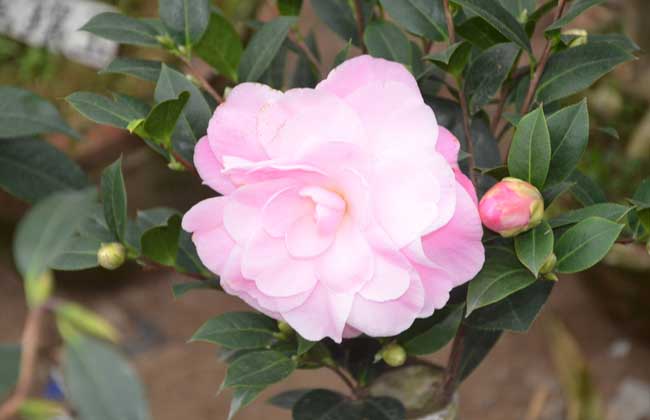
Cutting propagation of camellias
This method is the simplest. The most suitable time for cuttings is September; spring also works. Select well-grown, semi-lignified branches, remove the lower leaves, retain the upper 3 leaves, cut with a sharp knife into a slanted cut, immediately soak the cut end in 200-500 ppm indolebutyric acid for 5-15 minutes, dry in the sun, then insert into a sand pot or vermiculite pot. After insertion, water; the wound heals after about 40 days, and roots form after about 60 days. Cuttings treated with hormones root 2-3 months earlier than those not treated with hormones. Using vermiculite as a cutting bed also results in much faster rooting than a sand bed.
Approach grafting propagation of camellias
Select a suitable variety such as 'Chazhongcha' or Camellia oleifera as the rootstock, and approach graft a precious camellia onto it. The approach grafting time is generally between Qingming Festival and Mid-Autumn Festival. First plant the rootstock in a flower pot, use a knife to cut away about half at the parts to be joined, with smooth cuts, then press the cut surfaces of both parties tightly together, bind with plastic film, and water the rootstock twice a day. After 60 days they will have healed, at which point they can be cut off and planted, placed under tree shade to avoid direct sunlight. In February of the following year, use a knife to cut off the tail end of the rootstock, then plant out.
Leaf cutting propagation of camellias
Camellia propagation generally uses branch cuttings, but some precious varieties, due to limited availability of branches or because taking material would affect their tree shape, are also propagated by leaf cuttings. Use mountain soil as the cutting substrate, which can be mixed with 1/3 river sand to facilitate aeration and drainage. Put the substrate in a clay pot, then insert the leaves in the pot. Leaf cuttings are best done in the rainy season. Take one-year-old leaves as leaf cutting material; leaves that are too old do not root easily, and those too tender rot easily. Insert about 2 cm into the soil, press the soil firmly after insertion, water thoroughly, then place in a cool, ventilated place. Generally roots develop in 3 months, and in the spring of the following year they can sprout and send out shoots.
High-altitude layering propagation of camellias
The greatest feature of the high-altitude layering method is that it can give new life to all the weak, small branches on a camellia that would otherwise have been pruned off. Moreover, this method has a high survival rate, rapid rejuvenation, and early flowering. Take the thin, weak branches that need to be pruned off, make a ring cut at an appropriate position (generally 15-25 cm of branch can be left on the upper part), with a ring-cut length of 5-8 mm, tie on a suitably sized plastic film, add sterilized and disinfected peat moss or leaf mold inside the film, and after 7-10 days, make another ring cut of 5-8 mm on the lower part of the plastic film; this is called the double ring-cut high layering method.
Tree grafting propagation of camellias
Camellias are plants that are relatively difficult to keep alive. There are many and varied propagation methods for camellias, among which grafting is the most commonly used. Grafting propagation of camellias has many advantages: it can maintain the excellent traits of the variety, accelerate plant growth so that it quickly takes shape, enable large-scale production, and save scion wood, which is especially important for rare varieties with few sources of scion wood. Technique for grafting camellias onto Camellia oleifera: the grafting time is preferably June to July, when the leaves of the new shoots of the camellia scion have already unfolded and the temperature is relatively high, so the graft wound heals quickly and the survival rate is high. The grafting method uses the cut grafting method among branch grafting methods. Because the grafting position is relatively high, it is often called "high grafting to change the head."
When does the camellia bloom?
Depending on the variety, camellias bloom successively from the end of September to the beginning of May. In late autumn, severe winter, and early spring they present a scene of vigorous vitality. Camellias send out new shoots twice a year; the first is the spring shoots, beginning in March-April; the summer shoots emerge in July-September.
That is all for the information about camellia planting methods and when camellias bloom. We hope it is helpful for your camellia growing!