What are the planting methods for Scutellaria barbata?
Planting methods for Scutellaria barbata. The plant grows 30-40 cm tall. The lower part of the stem creeps and roots, while the upper part is upright; the stem is square and green. The leaves are opposite, with triangular-ovate or ovate blades, wavy blunt teeth along the edges, larger lower leaves, and very short petioles. The flowers are small, borne in opposite pairs. The flowering period is from May to June, and the fruiting period is from June to August.
Scutellaria barbata prefers a warm, humid climate and has low requirements for soil conditions. In the wild, it is mostly found in moist places beside ditches, field edges and roadsides; soil that is too dry is unfavorable for its growth. After generally 3-4 years of cultivation, the plants begin to age and their sprouting ability weakens, so they must be divided and replanted or resown. The seeds germinate easily, with an optimum germination temperature of 25°C, and the seeds remain viable for 1 year.
Seed propagation is the main method, though division propagation can also be used.
①For seed propagation, direct sowing is mostly used, from late September to early October, in rows or in holes. For row sowing, open furrows at a row spacing of 25-30 cm, with a furrow depth of about 4 cm; for hole sowing, open holes at a spacing of about 27 cm. When sowing, first mix the seeds into plant ash mixed with fertilizer to make seed ash, then evenly scatter it into the furrows or holes, and cover with a layer of fine soil or plant ash no more than 0.5 cm thick. After sowing, the soil must be kept absolutely moist before emergence; seedlings emerge about 20 days after sowing.
②Division propagation is carried out in spring and summer. Dig up the old roots of the plants, select healthy plants free of pests and diseases for division, with 3-4 shoots per plant, and plant them in holes at a spacing of about 27 cm; water after planting. That concludes the introduction to the planting methods for Scutellaria barbata.
How to plant Scutellaria barbata? Planting methods for Scutellaria barbata
Many people like to grow Scutellaria barbata, but do you know the planting methods for Scutellaria barbata? Next, the editor will introduce the planting methods for Scutellaria barbata in detail.
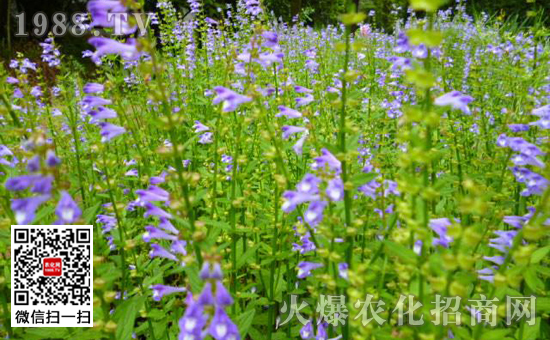
Planting methods for Scutellaria barbata:
Planting Scutellaria barbata: Preparing the pot and soil
Although "tolerance of poor soil" is one of the characteristics of Scutellaria barbata and its growth does not depend on whether the soil is good or bad, as flower growers we always hope the flowers can grow with strong roots, abundant leaves and bright blooms, so it is still best to prepare a loose, breathable soil with good fertility.
During this period, you can collect expired oil-rich foods from home, such as sesame powder, the okara (soybean dregs) left over from homemade soy milk (let it ferment), or fish intestines (fermented in advance) to use as base fertilizer.
Planting Scutellaria barbata: Sowing and cultivation
At the end of April and the beginning of May, the climate conditions in the Jiangnan region are most suitable for sowing. With a growth period of about 1.5 months, it can be described as fast-growing and fast-developing, and the secret lies in the sowing step.
To make the seeds come into close contact with the soil, when sowing Scutellaria barbata seeds you only need to evenly scatter the seeds on the surface layer of fine-grained potting soil, then cover with a very thin layer of fine soil.
Raising seedlings
To ensure the seedlings pass through this critical period safe and sound, the seedling-raising stage is very important. You need enough patience to care for and tend them, just like treating a baby in swaddling clothes; with the slightest carelessness the seedlings die, greatly reducing the survival rate of the seedlings.
Thinning and transplanting seedlings
Thinning, also called pulling out seedlings, is simply keeping a certain spacing between seedlings. Choose a pair of pointed tweezers as the thinning tool. Once the flower seedlings grow a few mm tall, you can begin thinning. Use a batch-by-batch, time-by-time approach, always pulling out the relatively weak ones and keeping the sturdy ones, until there is still a gap of 3-4 cm between seedlings.
Pinching
When the small seedlings grow to 3-4 cm tall, branches also grow from the roots. At this point, pinch off the tip of the main stem, and soon a cluster of new shoots will sprout from the cut. When the branches at the roots grow to a certain length, you can also pinch the branches. After such treatment, Scutellaria barbata is dwarfed and the plant shape also becomes more attractive.
Watering
During the seedling-raising stage, the weather is not yet very hot and water evaporates slowly, so it is not suitable to water too much. During the flowering period, which falls in the hottest days of summer, it needs to be watered thoroughly so it can fully absorb water.
Planting Scutellaria barbata: Collecting seeds
Ripe Scutellaria barbata seeds are silver-gray, yet it is very difficult to harvest them at exactly the right moment; either the seed pods have split open, or the seeds have already flown away. So you should often touch those yellow seed husks with your hand; the husks that fall off at a touch are the best; if they do not fall off at a touch but the outer shell has turned so yellow it is almost white, pick them too, and pinch them with two fingers; what is revealed is black seeds, because they are still a bit damp, and after a little while the black seeds turn into silver-gray seeds.
Planting methods for Scutellaria barbata: What needs attention
Scutellaria barbata is an excellent flower for beautifying and decorating; its bright, striking colors and graceful, skillful flower form make it a very good choice for decorating rooms and courtyards. Today, the editor brings you the planting methods and precautions for Scutellaria barbata; let's take a look at the details.
Planting methods for Scutellaria barbata:
Environment
It prefers a warm, dry environment with ample light, is drought-tolerant, dislikes waterlogging, and has strong adaptability.
Planting
Cuttage propagation is the main method. After cutting off the branches, place them in a shaded environment for 1 day, then the next day insert them directly into plain sand; after watering, they root in a warm environment, and rooting is easy.
Temperature
It prefers warmth and is not cold-tolerant; the suitable growth temperature is 20-30°C.
Light
It is sensitive to light and is a strongly sun-loving flower. It is not shade-tolerant; in summer's high-temperature weather, which is exactly the peak period of plant growth and flowering, it also needs sufficient sunlight so the plant can bloom abundantly and the flowers can be brightly colored.
Watering
Because the succulent stems and leaves can store water, it has a relatively strong drought resistance and can also grow and bloom under relatively dry conditions. But to enable the plant to grow and bloom well, appropriate water must also be supplied.
Pests and diseases
It is harmed by pests and diseases such as rust disease and hawk moths.
Overwintering of seedlings
After the Frost's Descent solar term each year, move the double-petaled moss rose indoors to a sunny spot. After the beginning of winter, place it inside a glass window and let the potting soil be a bit on the dry side, and it can overwinter safely.
Cultivation precautions
Avoid excessive moisture and water accumulation; when there is too much 7-foot [sic] water, it easily causes leggy stems and leaves, and even root rot and death. When a cold wave hits, it needs to be brought inside the window for care. Throughout the entire growth period, sufficient light is needed for the plant to grow and bloom normally.