What are the reasons why Clivia does not bloom?
Why does Clivia not bloom? For a Clivia that has reached flowering age, failure to bloom normally is mainly due to the following reasons:
① Too much nitrogen fertilizer and too little phosphorus and potassium fertilizer, so it does not form buds when it comes time to bud and bloom.
② Too strong sunlight in summer has an adverse effect on budding and blooming.
③ In winter it is placed in a place with too high a temperature, so it cannot enter a good dormant state.
To make Clivia bloom every year, the preparation of the growing medium is key. First find some pig manure, bone meal, pine leaves, coal cinder and wood shavings, compost them, disinfect with a 0.3% potassium permanganate diluted solution, then take 3 parts of the composted fertilizer and 1 part pond mud or vegetable garden soil, mix them well and put the mixture into a pot, and then you can plant the Clivia. Usually, take care to apply 1 to 2 times a month a potassium dihydrogen phosphate fertilizer solution, and from October each year to March of the following year, also spray the leaves once a month with 0.1% to 0.3% potassium dihydrogen phosphate.
During the growing season each year, drench with 10 to 30 ppm of 2,4-D or a mixture of naphthaleneacetic acid and 2,4-D 2 to 3 times, which can promote flowering. In summer, it is best to place it in a shady spot where it can see light in the morning and evening but avoids strong direct sunlight around noon, and in addition to watering the pot soil every day, also sprinkle water on the nearby ground. In winter, it should be placed in a slightly sunny spot; in winter avoid dry cold, keep the pot soil moisture at about 60%, and do not water too much. The above is an introduction to why Clivia does not bloom.
Why does Clivia not bloom
Clivia (detailed introduction) is native to Africa, and it gets its name because its plant form is elegant and handsome, with the bearing of a gentleman, and its flowers are like orchids. As one of the flowers and plants, it is deeply loved by the public. However, many people find that the Clivia they grow does not bloom. What exactly is going on? Now let the editor of Boqi Network analyze for everyone why Clivia does not bloom.
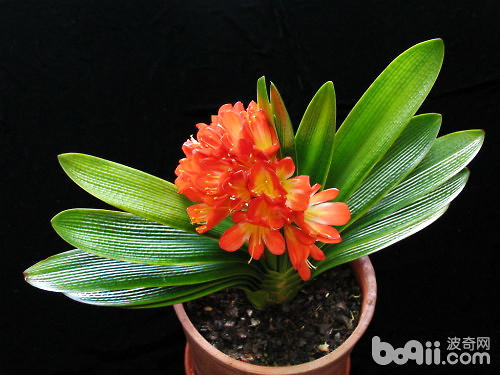
Clivia blooming
The flowers of Clivia are very beautiful and elegant, and its flowering period is mostly from November to April of the following year. If during the Spring Festival there is a pot of Clivia full of flowers, the indoor atmosphere will also be much more brilliant, but Clivia is very delicate, and the slightest neglect will make it go on strike and not bloom. If we want Clivia to bloom on schedule, we must pay more attention. Household care should mainly start from aspects such as temperature, soil, water, light and nutrition.
1. Light and temperature:
Autumn and winter are the flower bud differentiation period of Clivia (detailed introduction), and at this time insufficient light is unfavorable to flower bud differentiation. After the weather turns cooler, gradually strengthen the light (bright indirect light), but do not let strong light shine directly on it. If you want Clivia to bloom, there must also be a sufficient day-night temperature difference, with the daytime temperature at around 25°C and the nighttime temperature between 10-15°C, keeping the day-night temperature difference at around 10°C, and maintaining this for about one month, then move it indoors for protected cultivation, and the room temperature should not be too high, preferably around 15°C, and around the Spring Festival raise it slightly to around 20°C.
2. Soil and nutrition:
Before the flower bud differentiation of Clivia, appropriately control the amount of nitrogen fertilizer and apply 1-2 additional applications of fertilizer containing more phosphorus (such as bone meal, fish scales, etc.) to help the flower stalk emerge and bloom. In addition, not changing the soil for a long time will also cause nutrient deficiency, so when necessary, change the soil and repot. What I want to remind you is please do not apply a large amount of fertilizer; poor permeability of the flower soil, watering too frequently, applying fertilizer too concentrated, or long-term drought will all cause root damage and may cause failure to bloom.
3. Water:
The cells in the body of the Clivia plant must contain a certain amount of water to carry out normal life activities, and at the same time the nutrients in the soil can only be absorbed by the Clivia root hairs after being dissolved by water, so water reasonably to make the plant's vegetative growth good, and after entering the reproductive growth period, normal flower bud differentiation and timely flowering can occur. Watering too much or too little will cause root rot and cause poor nutrient uptake by the plant, leading to failure to bloom. Please always pay attention to the dry and wet condition of the pot soil; when it becomes half dry, water once, but the amount watered should not be much, and keeping the pot soil moist but not soggy is fine.
Why does Clivia not bloom
Although Clivia is a foliage plant, the Clivia grown by the editor's family bloomed during the New Year, and the flowers were beautiful, and people who came to pay New Year's calls praised them one after another, but some said that their own Clivia had been grown for several years and still had not bloomed. Why is that?
Although Clivia is mainly grown for its foliage, blooming is still something to pursue. Under normal circumstances, there are two rules for Clivia to enter the flowering stage: first, it has been planted for a full four years, and second, each side has seven leaves, for a total of fourteen leaves.
If your Clivia has already been cultivated for four years but still has fewer than fourteen leaves, it means there are still problems with care. You can check whether any of the following situations have occurred:
1. Excessive sunlight
Clivia is averse to scorching sun exposure; direct summer sunlight will cause sunscald and inhibit growth. From May to September each year, it should be cultivated under a shade shed or in a semi-shaded environment without direct sunlight.
2. Too high temperature and too dry environment
The suitable temperature for Clivia is 15-25°C. If the temperature is too high, the air is too dry, and ventilation is poor, it cannot grow normally and may even be harmed. When the weather is dry and hot, place the Clivia in a ventilated, cool place where the air is relatively moist, and spray water on the leaves and the surrounding environment to lower the temperature and increase humidity; before Frost's Descent, when the temperature drops to around 10°C, it must be moved indoors, and the indoor temperature should preferably be kept at around 15°C so it can safely overwinter.
3. Compacted pot soil
Clivia likes loose soil that is breathable and drains well. If the soil is compacted and drainage is poor, it will cause root rot. It is best to buy special soil for Clivia for planting. Special soil for Clivia is leaf mold soil, which is extremely suitable for the growth of Clivia.
4. Lack of fertilizer
Although Clivia does not particularly like fertilizer, if it lacks fertilizer it will grow poorly and cannot bloom. When planting, use decomposed organic fertilizer as a base fertilizer. You can also evenly apply a handful of sunflower seeds around the pot soil in places that do not touch the roots, and they can slowly release fertilizer for Clivia to absorb. During the peak growing season, apply more phosphorus and potassium fertilizer, about once every ten days, for 3-4 consecutive applications; in winter, potassium dihydrogen phosphate can be scattered around the surface of the pot soil, which can promote bud formation and blooming. If too much nitrogen fertilizer is applied, although the leaves are very green, it cannot bloom.
5. Improper daily management
Clivia must be cared for carefully. Change the soil once every spring, and do not water too much normally; in summer, watering should be controlled even more; pay attention to keeping the leaf surface clean to promote photosynthesis, which is beneficial for bud formation and blooming. You can often use a soft cloth dipped in tea water to gently wipe the leaves, which can keep the leaves glossy and shiny. When changing the soil, carefully straighten and separate the root system so that it fully extends, which can promote growth; the pot used should not be too large, and a deeper clay tile pot is preferable, a purple clay pot is still acceptable, and avoid using porcelain pots.
If Clivia can be given attention on the above points, it will certainly bloom every year.