How to Handle Yellowing Leaves on Clivia? Causes and Solutions
Clivia has sturdy, vigorous sword-shaped leaves, deep green and glossy, with beautiful flowers, but improper care often causes the leaves to turn yellow, spoiling its ornamental effect. Here is a brief summary of the causes of yellowing leaves in clivia and how to prevent and treat them:
Cause 1 of yellowing clivia leaves: lack of water
Not watering for a long time or only watering halfway each time makes the potting soil too dry or creates "halfway water," and the two to three layers of old leaves at the bottom will develop yellow tips, and in severe cases the whole leaf turns yellow and drops off.
Prevention and treatment: Do not fill the pot too full with soil; leave 1-2 cm of depth for watering. Stick to the principle of "if you don't water, fine, but if you water, water thoroughly"; filling the pot with water each time and calling it done is a major taboo in watering plants. Water in good time; if no one is home for a long time, place the potted plant in a shady, damp spot or ask someone to look after it.
Cause 2 of yellowing clivia leaves: too much water
Poor drainage in the flowerpot causes water to accumulate, shown by the tender leaves at the tip turning yellow and the yellowing spreading from top to bottom; if water accumulates for a long time and causes root rot, the old leaves at the bottom also all turn yellow and drop off.
Prevention and treatment: Reduce watering and stop fertilizing until conditions return to normal, and loosen the potting soil fairly vigorously. In serious cases, replace the potting soil, remove the rotted roots, let them dry for three to five days, and replant.
Cause 3 of yellowing clivia leaves: too much fertilizer
This causes root burn or reverse flow of water within the plant, and most of the leaves develop yellow tips from the bottom upward.
Prevention and treatment: Stop fertilizing and increase watering appropriately. Without damaging the roots, dig out the upper part of the potting soil and replace it with sandy loam of lower fertility.
Cause 4 of yellowing clivia leaves: too little fertilizer
If nitrogen fertilizer is lacking, new leaves are thin and yellowish-white and grow weakly; if iron is lacking, the leaf tips turn yellow first.
Prevention and treatment: Gradually apply more liquid fertilizer containing nitrogen and iron. Repot and replace with loose sandy loam of higher fertility.
Cause 5 of yellowing clivia leaves: sunscald
Long hours of direct sunlight and excessively high temperatures in summer turn the leaves red-yellow.
Prevention and treatment: Shade the sunlight appropriately and move the pot to a spot with half shade and half sun.
Cause 2 of yellowing clivia leaves: freeze damage
Clivia can suffer freeze damage in temperatures below 5°C, causing the leaves to turn yellow.
Prevention and treatment: Place the pot in an environment above 8°C.
Yellowing clivia leaves - What causes yellowing clivia leaves? How to handle yellowing clivia leaves?
Clivia is a perennial herbaceous plant of the genus Clivia in the amaryllis family (Amaryllidaceae). It is a semi-shade plant that likes cool conditions and dislikes high temperatures. The suitable growing temperature is 15-25°C; below 5°C it stops growing. It has high ornamental value. However, clivia also runs into trouble during growth. What should be done about yellowing clivia leaves, and what are the causes?
Editor's recommendations:Which plants absorb formaldehyde? What is the best anti-radiation plant - the golden barrel cactus (Echinocactus grusonii), and how do you grow the golden barrel cactus?
What causes yellowing clivia leaves? How to handle yellowing clivia leaves?
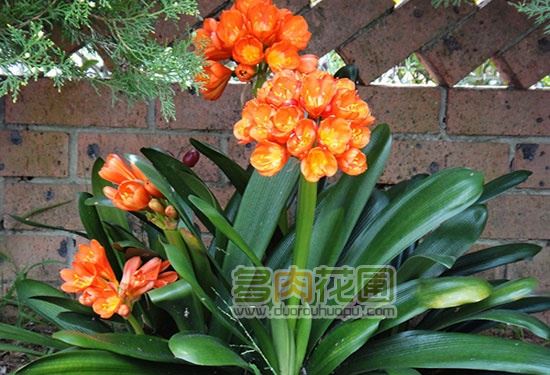
>>Click the image to learn more related content<<
Cause 1 of yellowing clivia leaves: temperature
The suitable temperature for clivia growth is 15-25°C. A day-night temperature difference of 8-12°C is most suitable for clivia growth. In summer, when the temperature stays above 30°C for a long time, it enters semi-dormancy. At this time, if the air humidity is below 60%, clivia leaves become paler and yellow and even wilt; if the humidity is above 90%, the stems and leaves grow long. To prevent these undesirable conditions, take cooling measures, then ventilate and let light through, and control humidity. In winter, when the temperature drops below 8°C, clivia basically stops growing. If the temperature drops below 6°C, freeze damage occurs, causing the leaf tips and leaf margins to lose green and turn yellow, and even yellow-white necrotic spots to appear.
>>Click the image to learn more related content<<
Cause 2 of yellowing clivia leaves: humidity
Clivia is a moisture-loving plant and has relatively high requirements for the humidity of its growing environment. Its most suitable relative humidity range is 70%-80%. In this humidity environment, clivia leaves are tender green, the veins are clear, and the leaves are short, wide and neat, with high ornamental value. If the potting soil stays too dry for a long time and the temperature is high, the leaves easily turn yellow. But long-term overwatering easily leads to oxygen deficiency, hindering the plant's normal respiration and causing clivia root rot and even death.
>>Click the image to learn more related content<<
Cause 3 of yellowing clivia leaves: soil and fertilizer
Clivia likes loose, fertile sandy soil; compacted soil and insufficient fertilizer supply make the leaves turn yellow and affect flowering. Generally, fertilizing once in spring and once in autumn within a year is enough. Deciduous leaves that rot easily must be fermented before use; if not fermented, they easily burn the roots. Clivia must have its soil changed once a year. When the temperature at the clivia's care location is above 25°C, reduce or stop fertilizing appropriately, so as not to burn the fleshy roots with too much fertilizer; if the temperature can be lowered below 20°C, you can still fertilize as usual.
>>Click the image to learn more related content<<
Cause 4 of yellowing clivia leaves: light
Clivia is a semi-sun-loving flowering plant that prefers relatively weak, scattered light and cannot tolerate strong light; too strong light easily causes sunscald, with mild cases turning the leaves from green to yellow and severe cases causing the leaves to dehydrate, dry up and die. In winter and spring, short-day conditions are more conducive to flowering. Good light is an important condition for ensuring large, brightly colored clivia flowers. But if the placement site is too dark and light is insufficient for a long time, the leaves also lose their luster, the old leaves turn dark green, and the new leaves become thinner and yellow or yellow-green (shade yellowing). At this point, move the clivia to a place with slightly stronger light or supplement the light. Clivia leaves are phototropic, so they should be grown facing the light; only then can they keep the shape of forming a line when viewed from the side and a fan when viewed from the front.
>>Click the image to learn more related content<<
Cause 5 of yellowing clivia leaves: ventilation
While clivia's thick, sturdy fleshy roots store plenty of water, they also place higher demands on the soil they depend on for survival. Only nutrient soil with good air permeability, a loose texture and rich humus is suitable for the growth of clivia's fleshy roots. If clivia is placed too densely and the surrounding environment is closed in, both hinder air circulation and make the plant weak, yellow and thin. So strengthen indoor ventilation and avoid planting too densely.
How to handle yellowing clivia leaves
Clivia is a very popular ornamental plant. Many people find that when growing clivia, its leaves turn yellow as time goes on. Now let us learn together about what to do when clivia leaves turn yellow.
How to handle yellowing clivia leaves1. The entire leaf of the clivia turns yellowIf the entire leaf of the clivia has turned yellow, this may be sunscald from too strong sunlight. First remove the yellow leaves, then shade it appropriately, and that will do. Handled this way, yellowing clivia leaves will naturally become less common.2. The clivia leaf starts turning yellow from the leaf tip
If the clivia leaf starts turning yellow from the leaf tip, this is caused by the soil used to grow the clivia being too raw or too rich in fertilizer. If the soil is too raw, add some fertilized soil; if the soil is too rich in fertilizer, add some raw soil. Once mixed and neutralized this way, the yellowing of the clivia leaves is eased.3. Individual clivia leaves turn yellow
If individual clivia leaves turn yellow, this may be caused by insufficient light. Many people grow clivia at home and rarely take it outside to sun it. At this point, take it outside to sun for a while every day, and the problem of yellowing clivia leaves can be solved.