A Detailed Guide to Growing Dahlias in Pots
How to grow dahlias in pots: the key to whether potted dahlias grow well lies in strengthening the management of the potting soil, giving the plants plenty of light, watering and fertilizing regularly, and carrying out timely shaping and pruning.
(1) Strengthen the management of the potting soil. Dahlias are suited to loose, humus-rich, well-drained sandy loam. For planting potted dahlias, the soil is generally best as a growing mixture made of vegetable garden soil (50%), leaf mold (20%), sandy soil (20%) and dried manure (10%). Compacted soil easily causes waterlogging and root rot, so it must not be used. In daily care, loosen the soil promptly and drain any standing water from the pot, because the fleshy tuberous roots of dahlias rot when the soil holds too much water and the air permeability is poor.
(2) Light. Dahlias love light and cannot tolerate shade. If kept in a shaded place for a long time, they grow poorly, their roots weaken, the leaves become thin and the stems slender, the flowers are small and pale, and some may even fail to bloom. Therefore, potted dahlias should be placed in a spot with ample sunlight, requiring more than 6 hours of light per day, so that the plants are robust and the flowers large and full. If sunlight is less than 4 hours per day, stem and leaf branching and flower bud formation will be affected to some extent, and especially under overcast and rainy conditions with little sunlight, flowering will be poor, stems and leaves will grow poorly, and the plants will be prone to disease.
(3) Water regularly. Dahlias like water but hate waterlogging; they fear both flooding and drought, because dahlias have fleshy tuberous roots and too much watering easily rots the roots. But dahlias have lush branches and leaves and a high transpiration rate, so they also need a fair amount of water. If a plant wilts from lack of water and is not watered in time, then is exposed to sunlight again, in mild cases the leaf edges scorch, and in severe cases the lower leaves drop off. Therefore, watering should follow the principle of "water thoroughly once the soil is dry." Generally, in the early growth stage when the plants are small seedlings, their water needs are limited, and on sunny days watering once a day is enough, keeping the soil slightly moist; neither too dry nor too wet is suitable. In the later growth stage, when branches and leaves are lush and water consumption is greater, on sunny days or days with a north wind, note that water shortage is likely around noon or in the evening, and the amount of watering should be increased appropriately.
(4) Fertilize appropriately. Dahlia is a flowering plant that loves fertilizer. Starting from the seedling stage, generally apply a dilute liquid fertilizer once every 10-15 days. After flower buds appear, apply once every 7-10 days, and once the flower buds begin to show color, stop watering with fertilizer. Fertilizing is also unsuitable when temperatures are high, and the amount of fertilizer depends on the plant's growth. If the leaves are pale and thin, this indicates a lack of fertilizer; conversely, if too much fertilizer is applied, the leaf edges scorch or the leaf tips turn yellow, while thick, deep green leaves indicate that fertilizing is appropriate. The concentration of the fertilizer should be increased each time, which makes the stems thick and sturdy.
(5) Shaping and pruning. Pruning potted dahlias should be done flexibly according to the variety. Generally, large varieties are shaped to a single stem, while medium varieties are shaped to four stems. Single-stem shaping means keeping the terminal bud and removing all lateral buds, so that nutrients are concentrated, forming a low, large-flowered single-stem dahlia. For four-stem dahlias, pinch out the growing tip of the seedling and keep two nodes at the base, so that 4 side branches form; keep the terminal bud on each side branch, producing a potted dahlia with four stems and four flowers.
(6) Insert stakes to support the plants. Dahlia stems are both hollow and brittle, and are easily blown over and broken by wind, so bamboo stakes should be inserted in time for support. Staking can also prevent the branches from growing crooked, improving the ornamental value of the potted plant. When the plant grows taller than 30 cm, insert a small bamboo stake beside each branch and tie it in place with hemp fiber (or thin string). As the plant grows taller, replace the stakes in time with longer ones, and the final small stake should reach up to just below the flower bud.
(7) Protect the plants so they overwinter safely. Dahlias are not cold-hardy (mainly, the tuberous roots must not freeze). In November, after the branches and leaves wither, cut off the above-ground parts, move the plants indoors and keep them in their original pots, or take out the tuberous roots, let them dry for 1-2 days, and bury them indoors in slightly damp sandy soil, but the temperature must not exceed 5°C; then replant them in pots the following spring. The above is an introduction to how to grow potted dahlias.
Potted dahlia techniques, potted dahlia pictures
The long flowering period and the beauty of dahlia flowers can add much springlike charm and vitality to family life. Many households choose to grow dahlias in pots, but compared with other flowers, the potted cultivation techniques for dahlias are relatively complex. Only by learning to cultivate dahlias scientifically can you make their flowers bloom and the plants full of life. Below, the editor will guide you through the potted cultivation techniques for dahlias.
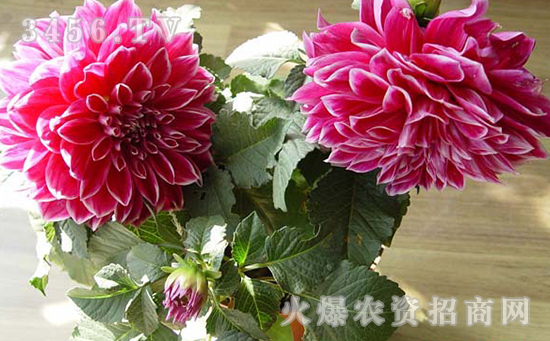
Dahlia ecological habits
Dahlias originate from the highland regions of Mexico and like a warm, humid environment. The optimum growing temperature is 10°C to 25°C; above 30°C growth becomes abnormal and flowering is reduced. Below 0°C, frost damage easily occurs. For storing the tuberous roots, 3°C to 5°C is suitable. Dahlias are relatively sensitive to moisture, intolerant of drought and afraid of waterlogging. They like ample sunlight but avoid direct strong light and need appropriate shading. A loose, fertile mixed substrate is best for the soil.
Dahlia propagation methods
1. Division propagation: Before sprouting, divide the stored tuberous roots. Be careful to keep the sprouting points at the root crown; those without sprouting points cannot form new plants. When dividing, each tuberous root needs to have 1 to 2 sprouting points, and take care not to damage the young shoots during the operation.
2. Cutting propagation: Cuttings can be taken outdoors in spring and autumn, and year-round in a greenhouse. Cut tender shoots from vigorous mother plants, keep 2 nodes, each section about 7 cm, with at least one vigorous axillary bud or terminal bud. Use vermiculite or coarse sand as the cutting bed substrate. After inserting the cuttings, mist frequently and shade 60%; roots form in about 30 days, they can be potted up at 40 days, and they can bloom 90 to 110 days after potting up.
Potted cultivation techniques for dahlias
1. Seedling stage management
Potting up: Dahlia seedlings that have rooted from cuttings can be potted up once they grow to 8 to 10 cm tall. The substrate is made of leaf mold, river sand and organic fertilizer in a 3:1:1 ratio.
Watering: Watering at the seedling stage should be moderate, not too much, to prevent excessive leggy growth. On overcast and rainy days, evaporation is low, so water less; on sunny days or in dry, hot summers, evaporation is high, so in addition to watering every day, mist the leaves 1 to 2 times, and also spray the ground to increase air humidity.
Temperature and ventilation: The most suitable growing temperature at the seedling stage is 22°C to 28°C during the day and 12°C to 16°C at night. Warm days and cool nights are favorable for dahlia growth and development. To ensure the seedlings grow robustly, excessive leggy growth must be prevented, and ventilation should be appropriately increased during the day.
2. Potted plant management
Temperature: Dahlias like a cool environment, and the optimum growing temperature is 10°C to 25°C. If the temperature is above 30°C, growth becomes abnormal and the flowers are fewer and smaller. A day-night temperature difference of about 10°C can make the plants short and sturdy, making growth and flowering even more ideal. Therefore, when producing in a greenhouse, in addition to maintaining the optimum growing temperature, there should also be a certain day-night temperature difference.
Light: Dahlias love light, and ample sunlight can make their stems and leaves grow robustly and produce more flowers with vivid colors. But direct strong light in summer makes the leaves rough and lusterless, and can even cause yellow leaves and dry edges, so they should receive full light in the morning and about 50% shading at noon and in the afternoon.
Watering: Dahlias are sensitive to moisture, intolerant of drought and afraid of waterlogging. Heavy rainfall in the rainy season is extremely unfavorable for outdoor potted dahlias, which often die from waterlogging. The amount of watering can affect plant height, so watering should be appropriately controlled in the early growth stage. In summer, mist the leaves 1 to 2 times a day and also spray the ground to maintain 60% air humidity.
That is all for the potted cultivation techniques for dahlias. Keeping a pot of dahlias at home can not only delight the mood, but the plant can also be used as medicinal material. Once you understand and become familiar with the habits of dahlias, carefully cultivating them at home in your spare time, and when they bloom in competition with one another, a small sense of achievement will also surge in your heart.
The dos and don'ts of potted dahlias
Dahlia (Dahlia pinnata), also known as "Dali flower," is a transliteration of "Dahlia," a herbaceous plant of the Asteraceae family native to Mexico. Because its underground roots resemble sweet potatoes, it is also called sweet potato flower. The flowers are large, and the flower colors include red, orange, yellow, purple, white, pink, bicolor and more. The flowering period is from May to October, and plant height varies greatly. Because of its rich, dazzling flower colors and beautiful flower form, it is deeply loved by people and widely cultivated around the world. How do you grow dahlias in pots on a balcony, windowsill or rooftop garden?1. It is advisable to choose dwarf varieties, and avoid planting tall varieties.
Dahlias range in height from 30 cm to 200 cm, with tall, medium and short grades. For balcony pots, it is best to choose dwarf varieties 30 cm to 60 cm tall. If they are too tall, they not only block the light, but in strong winds they easily fall over, and may even be blown over along with the pot and fall down, possibly causing accidents that injure people or damage objects.
2. The pot should be deep, large and well aerated; avoid shallow, small, lightweight pots. Dahlia fleshy tuberous roots are relatively well developed, so it is best to use earthenware pots or purple clay pots with good permeability and a pot diameter of 30 cm to 50 cm. Plastic pots have poor permeability and are also lightweight, and in strong winds there is a risk of them being blown off the balcony. If plastic tube pots are used, they must be tied to the railing with rope to prevent accidents.
3. It is advisable to use neutral sandy loam, and avoid heavy clay.
Dahlias grow best when planted in sandy loam. You can mix 50% leaf mold, 35% vegetable garden soil, 10% sand and 5% plant ash into a loose, fertile neutral sandy loam for planting. Repot and replace the soil with new soil every early spring, otherwise the plants easily degenerate and produce fewer, paler flowers. Planting in heavy clay easily causes root rot and poor growth.
4. The soil should be moist; avoid drought, and also avoid waterlogging.
It likes a humid environment. During drought, the leaves easily wither and turn yellow. Watering should be moderate; the soil only needs to be slightly moist. Too wet easily causes leggy growth, and waterlogging easily causes root rot. Therefore, when planting, place a layer of broken hard plastic foam blocks at the bottom of the pot to enhance aeration and drainage and prevent root rot. While controlling water appropriately, frequently mist the leaves to increase air humidity and benefit its growth.
5. It is advisable to apply light fertilizer frequently; avoid raw fertilizer, concentrated fertilizer and applying nitrogen fertilizer alone.
It likes fertilizer. When potting up, add some bone meal to the soil. During the growing period, apply light fertilizer frequently, once every 7 to 10 days. It is best to use monopotassium phosphate solution, at a concentration of 0.1% at the seedling stage and 0.2% at the flowering stage, or use 5% superphosphate. Raw fertilizer and concentrated fertilizer easily burn the roots, and using nitrogen fertilizer alone easily causes leggy growth, soft stems and lodging.
6. It is advisable to place it in a spot with ample sunlight; avoid shade.
Dahlia is a sun-loving flower. It needs at least 4 or 5 hours of direct light every day to have lush leaves and abundant flowers. It is best placed on a rooftop garden or a south- or west-facing balcony. When placed on a balcony, rotate it 180° about every 10 days to prevent uneven crown growth. Avoid placing it indoors or in shaded places where it cannot get sun.
7. It is advisable to keep it warm and cool; avoid high temperatures, muggy heat and frost.
Dahlias can adapt between 10°C and 32°C, with 15°C to 25°C being most suitable. Above 32°C growth stalls, and at this time they can be placed on a cool east- or north-facing balcony. In hot, rainy summers, dahlias placed on a rooftop garden need shading and rain protection to prevent root rot. Dahlias are not cold-hardy; once hit by frost, the underground stems wither and the underground tuberous roots go dormant. South of the Yangtze River they can overwinter outdoors; north of the Yangtze River they should be moved into a low-temperature indoor space of 1°C to 10°C to overwinter.
8. It is advisable to have good ventilation; avoid strong winds.
It likes a cool environment with good ventilation. With poor ventilation, the stems grow leggy and weak; in strong winds, because the stems are hollow and brittle, they very easily fall over and break. Generally, when the plant grows to 30 cm, insert 4 bamboo poles as thick as a little finger, or steel rods as thick as chopsticks, into the soil around the pot, protruding about 50 cm above the soil, and use plastic, aluminum or copper wire to make 2 or 3 rings connecting the four small posts, to prevent the plant from falling over.