Clivia Summer Care Methods and Precautions
Clivia summer care. Clivia prefers a cool, humid, semi-shaded environment, and its suitable growing temperature is 15-25°C. If the temperature is higher than 26-28°C, it will enter a dormant or semi-dormant state. If the temperature is even higher, it will develop disease and may even die. Therefore, summer care for Clivia is crucial. If the following measures are taken, you can ensure that Clivia passes through summer safely:
(1) Prevent direct sunlight and avoid exposure to strong sun. In summer, giving Clivia a short period of morning sunlight each day is enough to satisfy photosynthesis.
(2) Prevent high temperature and high humidity, and avoid dryness. In summer, the suitable temperature for Clivia is 18-25°C. It is best to place it indoors in a room with an air conditioner, and a shaded, ventilated spot on a balcony is also relatively ideal; when watering, you must use tap water that has been left in the sun for two or three days, and water once after 6 p.m. every day. Do not let the potting soil become too dry or too wet.
(3) Prevent leggy growth, and do not fertilize. Summer is the dormant period for Clivia. Stopping fertilization, watering moderately, and controlling temperature are effective measures. If the potting soil has already been fertilized or the fertilizer effect is relatively strong, you should pour out the upper part of the soil in the flowerpot, replace it with soil mixed evenly with 1/3 to 2/3 sand, and put it back into the pot. This not only reduces the fertilizer effect but also helps lower the temperature.
(4) Prevent dust pollution, and do not water with dirty water. The leaf surface of Clivia should be kept clean. Once a week, dip a fine gauze cloth in clean water, wring it dry, and gently wipe the leaves once; dirty water will cause the roots and leaves to rot and turn yellow.
(5) Prevent the potting soil from becoming compacted, and do not use loess for potting. Clivia is suitable for cultivation in loose, breathable, water-permeable, fertile humus soil with a pH of around 7.0.
(6) Improve Clivia's own resistance to adverse environments, that is, cultivate robust Clivia plants. In the later stage of spring growth, appropriately reduce nitrogen fertilizer application according to the condition of the seedlings, while increasing the amount of phosphorus and potassium fertilizer. Starting in March, apply 1%-3% monopotassium phosphate or superphosphate as a root drench once every 10 days. One month before the "plum rain" period begins, use 1% monopotassium phosphate for foliar feeding 3-4 times to increase the plant's ability to resist adverse environments.
(7) Remove the flower stalk. If Clivia bolts in summer, it will not only fail to produce good flowers but also consume nutrients, affecting normal blooming in winter, so the flower stalk should be cut off in time.
(8) Prevent disease, and avoid infection. When changing soil or wiping leaves, your hands should be gentle to prevent the roots and leaves from being damaged, oozing sap, and causing infection and decay. The above is an introduction to Clivia summer care.
Clivia Summer Care
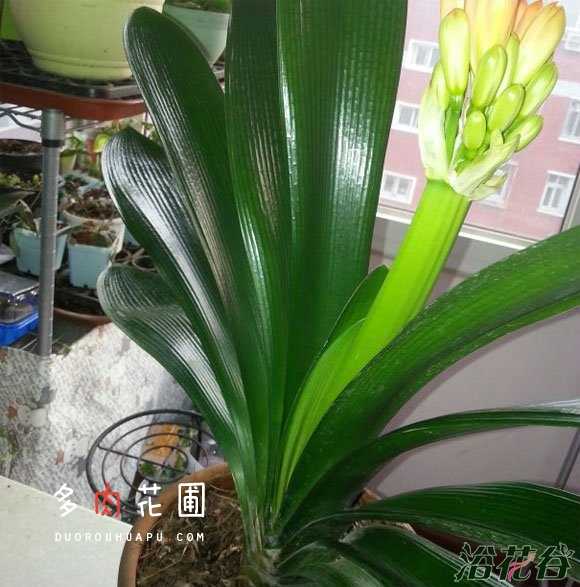
Clivia summer care and management is a difficult point for flower lovers, with problems such as high temperatures, strong sunlight, long daylight hours, and susceptibility to pests and diseases. However, there are always flower lovers who are good at summarizing their experience with getting Clivia through summer. Below is a flower lover's experience of getting Clivia through summer, described from different aspects such as watering and fertilizing.1. Watering:
The root system of Clivia is thick and strong and has the function of storing water. Pay attention to the moisture in the potting soil; it should not be too dry or too wet.
The suitable growing temperature for Clivia does not exceed 30°C. If the temperature exceeds 30°C for several consecutive days, Clivia enters a dormant period. At this time, because the temperature is high, the moisture in the potting soil evaporates quickly, so care should be taken to avoid the potting soil becoming too dry. Once the potting soil is completely dry, you need to change the soil for Clivia, because when the potting soil is too dry it loses its ability to absorb water. Under high-temperature conditions, changing the soil for Clivia is relatively risky, and it is very easy to bruise the flower roots, causing infection and root rot. The potting soil also must not be too wet and cause waterlogging, which can lead to root rot. My experience is to first weigh the flowerpot in your hand; if it feels light, then insert your index finger into the potting soil up to two finger joints. If it feels springy and moist, it is time to water. If it feels moist, it means the moisture is sufficient and watering is not needed. If it feels completely dry but the flowerpot is not very light, you need to water immediately, and you should fully immerse the flowerpot in water, with the water level at least covering 2/3 of the flowerpot. Soak for about half an hour while continuously pouring water from above. If you feel that the potting soil is dry and the flowerpot is also very light, and the plant is wobbling, then you must change the soil immediately.
The water temperature for watering Clivia is best kept consistent with room temperature, and the temperature difference should preferably not exceed 5°C. If the water temperature is too cold, it is easy for the flower roots to "catch a cold" and lose their water-absorbing ability; if the water temperature is too high, it will damage the flower roots.
In summer, it is best not to spray water on the plant. Water droplets staying on the leaves form convex lenses and, when exposed to sunlight, can very easily scorch the leaves. Water flowing into the leaf core can also very easily cause water accumulation in the core and rot the core. The result of decapitating the plant is something no one wants to see.
2. Fertilizing
In summer, Clivia is basically in a dormant state, and the root system's absorption capacity is very poor. At this time, applying fertilizer results in a very low utilization rate and waste, and if the potting soil's drainage and aeration are poor, it can very easily cause root rot. I suggest stopping fertilizer.
3. Shading
In summer, sunlight is very strong and the light duration is long. Direct exposure of the leaves to sunlight can very easily cause sunburn, greatly reducing their ornamental value. Shading measures should be taken, with a light transmittance of no more than 75%.
4. Ventilation
Ventilation helps prevent pests and diseases. In general home flower growing, there are relatively few pests and diseases, but if the air humidity (environmental humidity) is relatively high, it is easy to cause leggy growth of Clivia leaves (leaves becoming narrower, longer, thinner, and softer). It is also prone to soft rot, fever disease, and so on. Indoor ventilation helps reduce indoor temperature and air humidity. If the growing environment has poor ventilation, you can spray the plant and the surrounding environment with a 0.5% aqueous solution of thiophanate to prevent disease.
What I just said are some common problems with Clivia. Not only Clivia, but the vast majority of flowers have problems in summer and autumn. Clivia has strong stress resistance and good drought resistance, but in order for it to present you with beautiful flowers in winter, you should try your best to ensure its health in summer.
How should Clivia be cared for in summer? Essential knowledge for Clivia summer care
In summer, the temperature is high and the sunlight is strong. If care and management are improper, it is very easy to cause Clivia to grow weakly, such as small flowers and few blooms, thin and weak leaves, and dull, lusterless foliage, resulting in poor ornamental effect. So how should Clivia be cared for in summer? Below, the editor will briefly discuss the key care points based on the care experience of flower lovers:
In home flower growing, there are relatively few pests and diseases, but if the air humidity (environmental humidity) is relatively high, it is easy to cause leggy growth of Clivia leaves (leaves becoming narrower, longer, thinner, and softer). It is also prone to soft rot, fever disease, and so on. Indoor ventilation helps reduce indoor temperature and air humidity. If the growing environment has poor ventilation, you can spray the plant and the surrounding environment with a 0.5% aqueous solution of thiophanate to prevent disease. Flowers have problems in summer and autumn. Clivia has strong stress resistance and good drought resistance, but in order for it to present you with beautiful flowers in winter, you should try your best to ensure its health in summer.
In Clivia care, do not let the light be too strong or too weak. Clivia prefers semi-shade. Summer sunlight is strong, and if you do not pay attention to shading and avoiding direct strong light, the strong sunlight will scorch the leaves. If Clivia is kept under too-weak light for a long time, it will also show slow growth and weak, thin leaves. This is mainly because when light is weak, photosynthesis is insufficient and fewer nutrients are accumulated. Therefore, in summer, Clivia should be given a certain amount of light.
Second, Clivia care also requires attention to repotting and changing soil. Weak growth in home-grown Clivia may be related to not repotting or changing the soil. Repotting and changing the soil can provide Clivia with sufficient growing space and nutrients. Generally, small Clivia seedlings need to be repotted once a year, and Clivia over four years old needs to be repotted once every one or two years. Repotting is best done in spring and autumn. In conjunction with repotting, you should first appropriately thin out the original root system and cut off old roots; you should also completely change the soil and apply sufficient base fertilizer; at the same time, it is best to replace the pot with a new one or scrub the old pot to improve the pot's breathability.
Summary: The above is the method for Clivia summer care summarized by the editor for everyone. I hope it is helpful to you.