What are the reasons why Phalaenopsis orchids do not bloom
Why Phalaenopsis orchids do not bloom. Phalaenopsis cultivation requires special management, but that does not mean they cannot grow in living rooms; a large proportion of orchids can grow well in ordinary living rooms. To successfully cultivate Phalaenopsis, light, temperature and humidity must be strictly controlled. In northern regions, light, temperature and humidity generally make it very difficult to guarantee the growth of Phalaenopsis. If one wants to meet, in a living room, the environmental requirements of Phalaenopsis and other plants native to tropical rainforests, it is very difficult to achieve and also very unrealistic. The usual practice is to make some growing containers oneself, for example using transparent boxes, troughs and bottles, and one can even make use of a window (if the window is double-glazed and the gap between the panes is fairly wide), and automatic sprayers and lighting tubes can be installed, or a dedicated small greenhouse can be purchased.
Phalaenopsis generally needs a stable warm and humid environment all year round, even during its brief dormant period. The most suitable temperatures are 25-28°C during the day and 18-20°C at night. Particular attention should be paid to the fact that Phalaenopsis is very sensitive to low temperatures; when kept at 15°C for a long time it stops growing. Below 15°C, Phalaenopsis stops absorbing water, which leads to physiological water deficiency in the plant, yellowing and falling leaves, and if this continues longer, all the leaves drop off the whole plant and the plant dies. If the temperature is 28-30°C, ventilation should be strengthened; high temperatures above 32°C are also unfavorable to Phalaenopsis, and it should be induced to enter a semi-dormant state so as not to affect future flower bud differentiation.
Flower bud formation in Phalaenopsis is mainly affected by temperature; short-day conditions and stopping fertilization early help the flower stem to appear. If, when cultivating Phalaenopsis, the temperature is kept above 18°C, about 4 leaves can grow in a year, and flower buds also form. But if appropriate temperature conditions cannot be maintained, flower buds are not easily formed. Under natural conditions, native Phalaenopsis, after the high temperatures of summer, enters autumn, when the nighttime temperature is lower, which can promote flower bud differentiation, and by the following spring it can bloom. Under cultivation conditions, if the temperature is kept above 20°C for 2 months and then the nighttime temperature is lowered to below 18°C, flower buds can form after about 1.5 months. After the flower buds form, if the nighttime temperature is kept between 18-20°C, flowering can occur after 3-4 months. The above is an introduction to why Phalaenopsis orchids do not bloom.
Why Phalaenopsis orchids do not bloom? Reasons why cultivated Phalaenopsis orchids do not bloom in winter and spring
[Common Questions] Why Phalaenopsis orchids do not bloom? Reasons why cultivated Phalaenopsis orchids do not bloom in winter and spring
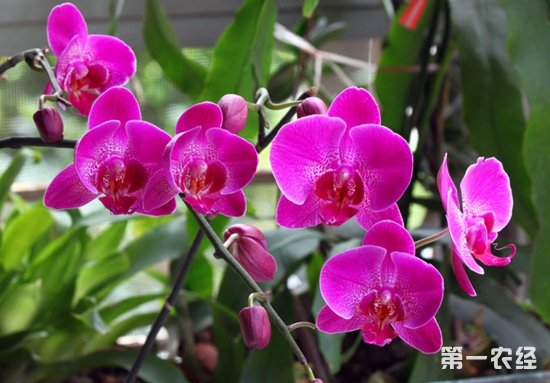
Image: Phalaenopsis
[Expert Answer]
Soil reasons:Phalaenopsis likes acidity, and the optimal soil pH is 4.5 to 5.5, so in daily management special attention must be paid to controlling the soil pH; otherwise, because the soil is alkaline, the absorption of water and nutrients by the roots will be affected, leading to poor growth and failure to bloom.
Temperature reasons:The suitable growth temperature for Phalaenopsis is 23 to 28°C, and only by maintaining this temperature can it bloom well.
Light reasons:If the light is too weak, the growth of Phalaenopsis will be abnormal, often with many leaf buds and few flower buds.
Ventilation reasons:If Phalaenopsis is placed in a poorly ventilated place, the plant is prone to disease, especially during the flowering period, when the tip of the flower stem easily wilts, causing the flower buds to turn yellow and dry up and affecting flowering; even flowers that have already opened tend to fade early.
Fertilization reasons:Applying fertilizer that is too concentrated easily causes the flower buds of Phalaenopsis to drop early. During the vegetative growth period, nitrogen fertilizer can be applied, but during the reproductive growth period nitrogen fertilizer should be stopped and more phosphorus and potassium fertilizer should be applied, which can promote bud emergence and flowering.
Watering reasons:Insufficient watering also easily causes the leaves to turn yellow and dry up, affecting flower bud differentiation and flowering.
[Editor's Summary]
Phalaenopsis is a flowering ornamental plant, and its ornamental value lies mainly in its flowers, but sometimes cultivated Phalaenopsis fails to bloom, so surely many people want to know what the reasons for not blooming are. The First Agricultural Economics editor has compiled for you the article "Why Phalaenopsis orchids do not bloom? Reasons why cultivated Phalaenopsis orchids do not bloom in winter and spring," and hopes it is helpful to you.
Why Phalaenopsis orchids do not bloom?
Phalaenopsis, also called moth orchid, is native to tropical regions of Asia and is a typical flowering ornamental plant. It is named for its flower shape, which closely resembles a butterfly, and it is all the more popular with many people. The full blooming period of Phalaenopsis is around the Chinese Lunar New Year, so it is also an important and popular flower for the New Year season.
Because Phalaenopsis has rather special habits, demanding growing conditions and a relatively high price, many flower enthusiasts always hesitate when choosing Phalaenopsis. For enthusiasts growing Phalaenopsis, a common question is why Phalaenopsis orchids do not bloom. What are the reasons why Phalaenopsis buds wither and drop, or why they do not bloom?

Humidity and watering
Phalaenopsis is suited to a humid and ventilated environment, so during the flowering period of Phalaenopsis good ventilation must be maintained. If the air stagnates and does not circulate, the tip of the flower stem easily wilts, causing the flower buds to turn yellow and drop early. A relative humidity of 70% is most suitable, so excessive dryness, excessive watering or overly wet potting soil will all cause the leaves to turn yellow and dry up, affecting flower bud differentiation and flowering, and even causing buds to drop.
Temperature
Phalaenopsis is tolerant of high temperatures, so the temperature from bud formation to the flowering period should be kept above 15°C; if the temperature is too low, it inhibits plant growth and also affects flower bud formation, leading to failure to bloom.
Fertilization
After Phalaenopsis buds appear, topdressing should be carried out, 1-2 times every half month, continuously replenishing nutrients; otherwise the buds will gradually drop from the bottom upward. Applying too much nitrogen fertilizer while also lacking phosphorus and potassium fertilizer will also affect flower bud formation, resulting in no flowering or very little flowering. Applying fertilizer that is too concentrated, especially concentrated fertilizer after bud formation, easily causes the flower buds to turn yellow and dry up and drop early.