How to grow honeysuckle? Teach you the correct planting method
Honeysuckle planting methods. Honeysuckle, also known as Japanese honeysuckle flower, double flower, honeysuckle vine, and mandarin duck vine, is a perennial semi-evergreen twining woody vine of the Caprifoliaceae family. Two flowers open in succession from a single base, the first opening silvery white, then turning golden yellow after 2 to 3 days, so a single plant bears both silvery white and golden yellow flowers at the same time, blooming profusely in June and July, combining both color and form; the flowers can be used to make tea, and the plant can be enjoyed for its fragrance and blooms, and used as a hedge, penjing, or potted plant. It is native to the provinces of the lower Yangtze River basin and is a fragrant flower of the warm temperate zone, with strong adaptability; it prefers sandy loam, tolerates sun and also shade, moisture and also drought and waterlogging, fertilizer and also poor soil, warmth and also cold.
Key tips for potted honeysuckle:
① Ordinary garden soil is fine for the potting soil, but it grows better in fertile sandy loam; choose a larger flower pot. Repot once every 4 to 5 years.
② Strengthen fertilizer and water management. Before flowering, apply 2 rounds of decomposed fertilizer mainly of phosphorus and potassium to force flowering; after the first round of blooms, apply a dilute liquid fertilizer once a week. During the growing season keep the potting soil moderately moist, slightly on the wet side being better.
③ Prune once before the Spring Equinox to encourage new flowering shoots; after the flowers fade, cut off the flower clusters to reduce nutrient consumption and control new shoot growth; set up a frame for training and tying.
④ Propagation is mainly by cuttings; take 15 to 20 cm long cuttings (from strong current-year shoots), insert them diagonally into the soil to 2/3 of their length, keep moist and shaded, and they will root after half a month. Division or layering can also be used. The above is an introduction to honeysuckle planting methods.
Cultivation methods for honeysuckle
Honeysuckle is also known as mandarin duck vine, double flower, and so on. Because the flowers first open snow white and later turn golden yellow, with the two colors clearly distinct on the branch at the same time, it gets this name. Honeysuckle vines can twine around other objects, so when cultivating it by hand you need to build a support for it to twine around so it can grow.
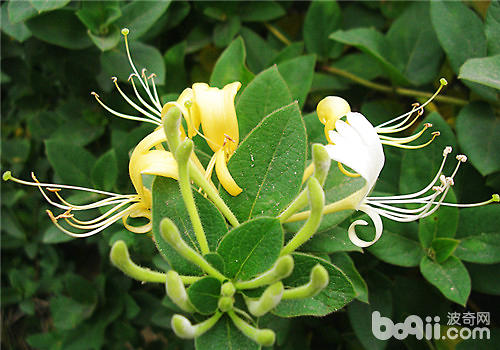
Honeysuckle
Through careful cultivation by working people, some cultivated varieties of honeysuckle have been developed, the common ones being: red honeysuckle, with red flowers tinged with purple, slightly less cold hardy, best planted in North China in a sheltered, sunny spot in the courtyard; purple-veined honeysuckle, with purple leaf veins and a white corolla with a purple flush or purple margin. Four-season honeysuckle blooms throughout the year except when low winter temperatures prevent flowering. Red honeysuckle and purple-veined honeysuckle are less cold hardy and can be grown in pots in North China, moved indoors to overwinter. Families living in apartment buildings can also grow them in pots on the balcony, tying small bamboo canes or wire into a sup
port to guide their twining; the variety chosen should be four-season honeysuckle, so you can enjoy its fragrant flowers throughout the growing season. After winter begins, cut off the twining branches and move the plant indoors for storage, or water thoroughly before the freeze and let it freeze through to overwinter.
Honeysuckle can climb flower trellises, hedges and walls, and fences. The flowers are pleasantly fragrant, especially those of four-season honeysuckle, which blooms continuously from spring to autumn, with golden and silver flowers interwoven in unending clusters. If planted in a courtyard, you can both admire the flowers and enjoy the fragrance; in the heat of summer, cooling off and resting in the shade of a honeysuckle trellis is even more delightful.
Honeysuckle has no special requirements for soil and will grow in ordinary soil, but it should not be planted in spots that are too shady, too dry, or too wet and waterlogged. In the second year after planting, you should set up a flower trellis or move it close to a hedge or wall fence so it can find something to attach to and twine and climb.
After three or four years, a thorough pruning should be done, cutting away messy and crossing branches, otherwise they become too crowded and prone to pests such as aphids and scale insects; at the same time this improves ventilation and light penetration, which benefits flowering. Water promptly in dry periods so the plant does not suffer drought and drop its flowers. Rice-washing water and the dirty water from washing fish and meat can all be used for watering after full fermentation. If aphids or scale insects are found, spray dimethoate diluted 1500 times with water, or use tobacco leaf soak to kill them. In hot, dry weather, sooty mold disease often covers the leaf surface, and it can be controlled by spraying thiophanate-methyl or carbendazim.
Friends living in apartment buildings can also build a flower bed on the balcony, a square about 0.5 m wide, and add 40 cm of fertile soil to plant it; string a few wires or ropes across the balcony or tie a few small bamboo canes for it to climb. In summer it provides shade and lets you enjoy the flowers and fragrance, and beneath its shade you can grow and place other flowers. In winter, simply cover the flower bed with two layers of straw curtains or a sheet of plastic film to overwinter. It leafs out early in spring and keeps its leaves late into winter, adding much color to the balcony.
The flowers, leaves and stems of honeysuckle can all be used as medicine, with effects of promoting fluid, quenching thirst, clearing heat, dispersing wind and releasing the exterior; it is one of the main drugs in Yinqiao Jiedu pills, and is also indispensable for treating colds and preventing and treating measles in children. In the heat of midsummer, pick the flowers and brew them with tea leaves, or use the flowers alone as a tea; drinking it dispels summer heat and brightens the eyes. Picking the unopened honeysuckle buds and drying them gives the Chinese medicine "double flower"; cutting the pruned stems and vines into small pieces gives the Chinese medicine "honeysuckle vine."
How to grow honeysuckle: honeysuckle planting methods and precautions
Honeysuckle has high ornamental and medicinal value. In landscaping it can be used as a hedge, flower corridor, flower trellis and other three-dimensional greening plants in scenic gardens. So how do you grow honeysuckle? Let's look at the planting methods and precautions for honeysuckle.
I. How to grow honeysuckle
1. Soil: Honeysuckle has no special requirements for soil; ordinary soil will do. The best soil is moist, fertile sandy soil.
2. Transplanting: Honeysuckle is generally transplanted in spring before it sprouts. For courtyard planting, usually 2 to 3 plants per clump; dig a deep hole, apply dry mixed manure and a small amount of superphosphate as base fertilizer, and water thoroughly after planting. If growing it on a balcony, use a larger flower pot to plant 1 to 2 honeysuckle plants, and water thoroughly after planting.
3. Watering: Honeysuckle is fairly drought tolerant; generally when there is enough rain, no watering is needed. In drier weather, water appropriately. In normal sunny weather, after picking branches and leaves and flowers, water once every 3 to 5 days. In the plum rain season, guard against waterlogging. Increase watering in summer and reduce it in winter, watering again when the potting soil turns pale.
4. Fertilizing: When repotting honeysuckle in spring, apply an appropriate amount of cake fertilizer as base fertilizer; afterward, before each flush of flowers at the solar terms Grain Rain, Grain in Ear and Major Heat, just scatter some dry cake fertilizer powder on the pot surface; stop fertilizing in other seasons.
5. Pruning: Honeysuckle has extremely strong sprouting ability; with sufficient water and fertilizer it produces shoots very quickly and does not fear pruning. In spring the new shoots are slender, soft and disorderly, which spoils the look. At this time thinning must be done. You can cut out overly dense branches and tangled branches, shorten overly long branches, and for some branches that are out of place, use wire to reshape them so as to maintain the original form. During the growing season, mainly cut away overly long new shoots, and remove root suckers promptly when found. During the dormant period, the main branches and trunk can be retrained and reshaped.
II. Precautions for growing honeysuckle
The growing temperature for honeysuckle is 20 to 30°C, and growth requires ample light, with shading also needed in summer; honeysuckle should not be grown in spots that are too shady, too dry, or too wet and waterlogged; pay attention to drainage in the plum rain season; after the second year of growth, set up a flower trellis or move it close to a hedge or wall fence so it can find something to attach to and twine and climb; when pests and diseases occur, control them promptly.
The above ishoneysuckle planting methodsintroduced; we hope it is helpful to everyone. If you grow some at home, once they bloom you can also use them to brew tea.