How to propagate jasmine? A few common methods
How to propagate jasmine: for home propagation of jasmine, you can use 3 methods: division, layering and cuttings.
(1) Division. If the jasmine you grow is a clumping type with 4-5 or more stems, you can divide it in spring when repotting. Each division should ideally have 2-3 stems; if the original plant has few branches, you can also choose one vigorously growing stem and separate it on its own. When dividing, cut it apart with pruning shears or a sharp knife, and plant the divisions in two pots.
(2) Layering. Between May and June each year, choose a plump, well-grown branch 40-50 cm long, bury it 5 cm deep in the soil; the buried branch should have 1-2 leaf nodes, and score it in several places with a knife. After more than a month it roots, and after more than two months it can be potted, letting it continue growing in the pot until it is divided when repotted in spring of the 2nd year. The above two propagation methods have a high survival rate and produce mature plants quickly, but yield few new plants.
(3) Cuttings. Jasmine roots easily from cuttings; as long as the temperature is above 20°C, cuttings can be taken at any time. Under home conditions, this is generally done in April along with pruning. Choose thick, sturdy branches, cut sections with 3-4 leaf nodes, about 10 cm long, remove the lower leaves and keep only the upper two leaves. When cutting the branch, leave 0.5 cm above the upper leaf node and 0.3 cm below the lower leaf node. Once the branch is cut, use vermiculite or sandy soil as the medium, and choose a pot of appropriate size for the number of cuttings.
If you choose a pot 30 cm tall, fill it with medium to 2/3 of its height; after inserting the cuttings, cover with glass for easier management, or protect them with a transparent plastic bag. For 3-5 cuttings, you can use a small pot and cover it with a wide-mouthed glass bottle or glass cup, then gradually expose it to light and be careful about air circulation. After more than 1 month, new roots grow, and after two months they can be potted and planted separately. A pot with a diameter of 20 cm can hold 4-5 plants, which may bloom in the same year. That is the introduction to how to propagate jasmine.
How to propagate jasmine (secret tips for jasmine cutting propagation)
How to propagate jasmine (secret tips for jasmine cutting propagation)
Jasmine is a flower that everyone often grows. I used to have many at home, but now that I work away from home I have no time to grow them.
When it comes to how to propagate jasmine, two methods are generally used: cuttings and layering, but layering is used relatively rarely. The currently more popular method of jasmine propagation is cuttings, which also has a high survival rate and produces many new plants.
Below let us look at a veteran flower enthusiast's secret tips for jasmine cuttings:
(1) For jasmine, it is best to choose one-year-old branches that have already bloomed; green branches are better, while yellow and gray branches have already aged and the new buds they sprout are of poorer quality.
(2) Trim the branch into two nodes, remove the leaf stalk from the lower part and cut it into a slanted shape, and cut the upper leaves in half.
(3) Use transparent plastic filled with yellow sand as the growing medium, and cut a small cross shape in the bottom of the cup to help with drainage. Cuttings in plastic cups make it easy to observe new roots sprouting from the lower stem, and easy to transplant once they have rooted.
Specific steps and details:
1. Put yellow sand into a used disposable plastic cup, pierce a small drainage hole in the bottom of the cup for drainage, first use a thin stick (such as a bamboo chopstick) to pre-poke a small hole in the yellow sand, then cut the jasmine cutting and insert it into the sand promptly, press it firmly with your fingers and water it thoroughly, and place it in a ventilated spot with sky visible but no sun (that is, a place that gets light but no direct sunlight) for care. Be sure to water often; yellow sand has excellent drainage and helps the lower part of the cutting form nodules and root (a disposable transparent plastic cup lets you observe whether the cutting has rooted). Rooting and survival take about 40 days. Note that only one cutting per cup.
2. Generally, while pruning, use healthy current-year branches that have already bloomed, with two nodes per cutting. Be sure to distinguish the up-down direction of the axillary buds, and never use a cutting with the axillary buds facing down. Remove the leaf stalk from the lower part of the cutting, trim the lower part of the stem slightly into a slanted shape, and keep the leaf stalk and leaf on the upper node of the branch, cutting the leaf in half to limit water uptake, which helps the axillary buds sprout. Usually the axillary buds sprout first and then the fibrous roots grow. After the axillary buds sprout, do not touch or move the cutting, and pay attention to watering and observing whether fibrous roots have appeared inside the transparent plastic cup. Over about 40 days the axillary buds will keep growing, and a few may even sprout flower buds; if there are flower buds, be sure to cut them off, and do not let them take up too much nutrients and hinder the cutting from rooting. When you see the plastic cup filled with white fibrous roots, it proves that this cutting has fully rooted, and at this point it can be transplanted into potting soil for care.
3. Jasmine likes to grow in oil sand soil, vegetable garden surface soil (topsoil), pond mud, and so on. When transplanting, place some tile pieces at the bottom of the pot and use coarse soil (for spring transplanting you can add base fertilizer; for transplanting at other times do not add base fertilizer), which helps with drainage and prevents root rot. Take the rooted cutting out of the cup, keep as much of the root sand ball as possible, and gently place it into the prepared potting soil. Do not shake it; add potting soil at the same time, press the added potting soil firmly with your hands, then water thoroughly, and place it in a spot with sky visible but no sun. After about a week of care, it can be cared for in the usual way. When watering, be sure to water only when dry and let it dry between waterings; do not water all the time, which leaves the fibrous roots no chance to breathe and spread.
How to propagate jasmine by cuttings
Jasmine produces many beautiful small flowers every flowering season, expressing a fresh and delicate style. Jasmine is very common in cities; everyone has seen it, but they may not know the name of this flower. Jasmine has high ornamental value, and if you like this small flower, you can try growing it yourself. Below is an introduction to how to propagate jasmine by cuttings.
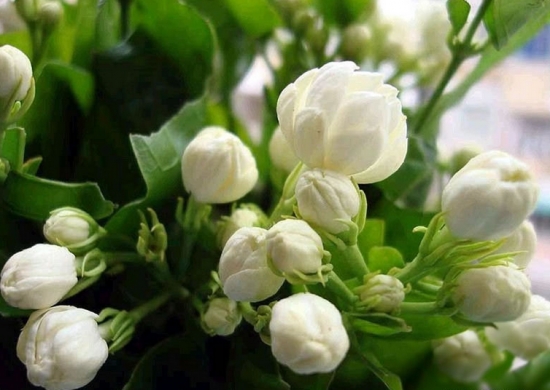
Jasmine propagation generally uses the cutting method. This method has the advantages of a high propagation rate, high survival rate, and easy management. Cutting propagation is divided into two types: hardwood cuttings and softwood cuttings:
①Hardwood cuttings:
Generally in late March, when the survival rate of cuttings is relatively high. Cuttings are best taken from sturdy, pest- and disease-free 2-3 year old branches; cut the chosen branch into small sections 10-15 cm long, cut the upper end flat and the lower end into a slanted shape, and insert them into loose, fertile, well-drained potting soil. Within one and a half months after cutting, water frequently (but with a small amount of water) to keep the soil moist; this is the key to the cuttings surviving.
②Softwood cuttings:
May to August is suitable. At this time the survival rate of cuttings is extremely high. For cuttings, you can use the tender green branches grown in the current year; the requirements for the branches are: vigorous growth and at least 3 pairs of leaves. The method of taking cuttings is: cut off two forked small branches together with a small section of old branch, then separate them in the middle to make two cuttings, and then cut off the pair of leaves at the base of the cuttings. Note that cuttings must be used immediately after cutting and must not be stored too long, otherwise they lose a lot of water and the cuttings are hard to keep alive. Within 20-30 days after insertion, spray water on the leaves 2-3 times a day, and after about one month the cuttings will sprout branches and roots. The young plants should preferably be potted separately during the Qingming and Yushui periods of the following year.
Jasmine is a kind of ornament that women love. In ancient times, women liked to use it to decorate their hair buns; now, some women like to thread it with thin lead wire into flower strings or flower balls and wear them on the chest or braids. Jasmine not only has high ornamental value, but also extremely high economic value. On the international market, jasmine oil is extremely valuable, and the price of each kilogram of oil is equivalent to 1 kilogram of gold. Jasmine can also be used to scent tea, and both the leaves and roots can be used as medicine.