Winter Care Methods and Precautions for Daphne odora 'Aureomarginata'
Winter care for Daphne odora 'Aureomarginata': in winter, the following points should be noted:
(1) Management of current-year rooted cuttings
When there is no frost and the temperature has not yet dropped to 0°C, remove the shade net and open the plastic film to let them directly contact sunlight and emerge, which can promote the growth and development of the seedlings. When the temperature drops below 0°C and frost occurs, cover with the plastic film to prevent frost from damaging the seedlings. In northern regions where temperatures are lower, more effective insulation measures should be taken to keep the indoor temperature no lower than minus 3°C, so as to ensure the seedlings safely overwinter.
When rooted cuttings are growing vigorously, they can still send out branches and leaves in winter in the south; in the north, as long as the indoor temperature is no lower than 18°C, they can also send out branches and leaves. When the new branches sprouted by the seedlings grow more than 8 cm, pinching and shaping can be carried out once. Seedlings selected to be kept as mother plants for cuttings the following year should not be pinched and should be allowed to grow naturally.
When the crown diameter of the rooted cuttings exceeds more than 1/2 of the pot surface, they should be repotted, switching to a slightly larger flower pot and adding a little nutrient soil to facilitate the normal growth and development of the seedlings.
The potting soil should be kept moist; do not withhold water, but note that the potting soil must not be too wet or waterlogged. For fertilizing, you can still adhere to the principles of applying thin fertilizer frequently, applying organic fertilizer mixed with inorganic fertilizer, and alternating soil application with foliar application; nitrogen fertilizer can still be emphasized somewhat. In winter when temperatures are lower, watering and fertilizing should both be done at noon.
(2) Management of potted flowers more than two years old
Remove the shade net to let the potted flowers receive more sunlight and strengthen photosynthesis, which can promote flower bud swelling, make the leaves thicker, more spread out, more upright, and more glossy, and make the flowers bloom more brilliantly and last longer.
The potting soil should be neither too wet nor too dry. Too wet affects root respiration and causes root rot leading to plant death; too dry causes lack of water that damages root tips and makes leaves wilt, and if water is not replenished in time it can also cause the plant to dry up and die. It is best to alternate between dry and wet, and adhere to the principle of not watering when not dry, and watering thoroughly when watering. Winter is the season when potted flowers form and swell flower buds and bloom, so fertilizing should be reduced; do not apply nitrogen fertilizer or concentrated fertilizer, and a moderate amount of phosphorus and potassium fertilizer may be applied to promote flower bud swelling and make the flowers bloom brilliantly and last longer. In winter, temperatures are low and the temperature difference between morning and evening is large, so both watering and fertilizing of the potting soil should preferably be arranged at noon when the temperature is relatively higher.
Those whose crown diameter exceeds 1/2 of the pot surface can be repotted, switching to a slightly larger flower pot and adding a little nutrient soil; a little decomposed organic fertilizer can also be placed at the bottom of the pot, so that when the potted flowers grow and develop next spring they will be more luxuriant.
In northern regions where temperatures are lower, warming measures should be taken to promote the early formation and swelling of flower buds, so that they can bloom at the proper time during the Spring Festival.
How to care for Daphne odora 'Aureomarginata' in winter and how to care for it after flowering
Daphne odora 'Aureomarginata' blooms in spring every year, and generally blooms only once. How to care for Daphne odora 'Aureomarginata' in winter? How to care for it after flowering:
How to care for Daphne odora 'Aureomarginata' in winter:
1. Move it indoors
The safe overwintering temperature for Daphne odora 'Aureomarginata' is above 5°C, so during the day it can be placed at a south-facing window to receive sunlight, and on clear days the window can also be opened for ventilation. At night it should be moved to a place indoors with a higher temperature, because outdoor temperatures are low at night, and placing it by the window even with the window closed may still cause frost damage.
2. Fertilizing
If no base fertilizer was applied initially in the potting soil of Daphne odora 'Aureomarginata', then it should be top-dressed frequently, but raw fertilizer and concentrated fertilizer must not be applied; soybean water or potassium dihydrogen phosphate solution can be used. Do not let ants, earthworms, or other animals appear in the soil.
3. Watering
In winter, Daphne odora 'Aureomarginata' grows relatively slowly, so the amount of watering must be properly controlled. Usually we can tell from the feedback of the leaves whether the amount of watering is appropriate: if the leaves are upright and pointing upward, it means water and fertilizer are normal; if the leaves droop, it means too much or too frequent watering. If excessive watering causes waterlogging, it can easily lead to root rot.
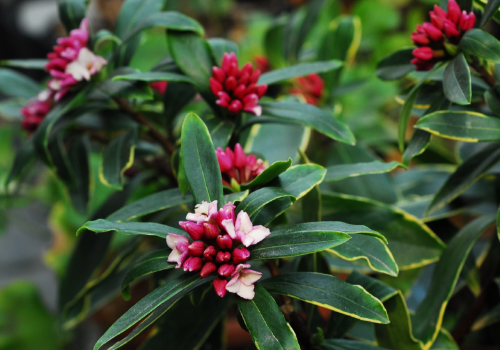
How to care for Daphne odora 'Aureomarginata' after flowering:
1. Increase light and lower temperature
When they bloom, they bloom very profusely. At this time, placing them in a place with light can make the floral fragrance more intense. Add brilliance to splendor. At the same time, appropriately lowering the temperature of their living space to about 5°C can extend the flowering period and let Daphne odora 'Aureomarginata' display its beauty for a longer time.
2. Prune branches and leaves
This flower has a strong ability to sprout, so after flowering it can be pruned appropriately to make its appearance more graceful and enhance its growth vigor. Therefore, after they flower, scissors can be used to remove branches and leaves that are poorly developed, too densely grown, or detrimental to the overall appearance, making them look more shapely.
3. Avoid pests and diseases
When Daphne odora 'Aureomarginata' blooms, the roots can give off a rather pleasant smell, which easily attracts ants, earthworms, and others, and they may be eaten by them, so pest control should be carried out. In addition, viral mosaic disease can also threaten the normal growth of Daphne odora 'Aureomarginata' after flowering; this disease causes its leaves to develop spots and become deformed, making normal flowering and growth impossible. Therefore, once symptoms of mosaic disease are found, the roots should be dug out and removed in time, and burned to prevent spread.
Do you still have any questions about the care of Daphne odora 'Aureomarginata'?
How to care for Daphne odora 'Aureomarginata' in winter
Winter care methods for Daphne odora 'Aureomarginata'
Placement location
After Frost's Descent, Daphne odora 'Aureomarginata' should be moved indoors for care. During the day, place it at a south-facing window to receive sunlight; at night, move it to a place indoors with a higher temperature, and do not place it by the window, to avoid frost damage from excessively low temperatures. In winter, ensure the indoor temperature is above 5°C, and open the window for ventilation on clear days.
Fertilizing requirements
The potting soil of Daphne odora 'Aureomarginata' may contain no base fertilizer, and liquid fertilizer should be applied frequently as a top dressing. However, note that raw fertilizer and concentrated fertilizer are taboo, and ants and earthworms must not appear in the potting soil (although earthworms help enhance soil fertility, having earthworms in household potted plants is still a bit disgusting). When fertilizing, it is better to be dilute than concentrated.
The liquid fertilizer is mainly chosen as soybean water or potassium dihydrogen phosphate solution. If the fertilizer is too concentrated, water promptly, watering several times in succession, letting the fertilizer flow out from the bottom of the pot to reduce fertilizer damage, then place the pot in a ventilated place and let the potting soil dry as quickly as possible.
Watering method
In winter, Daphne odora 'Aureomarginata' grows relatively slowly, so watering should be based on the situation. If the leaves are upright and pointing upward, it means water and fertilizer are normal; if the leaves droop, it means too much or too frequent watering. Once the cause is found, correct it promptly.
If root rot is caused by excessive watering, handle it promptly: remove the plant from the pot in time, cut off the rotten roots, rinse with fungicide, and then replant. Of course, to help the plant recover as quickly as possible, part of the upper leaves can be cut off to reduce nutrient consumption.
What to do if Daphne odora 'Aureomarginata' drops buds in winter
The flowering period of Daphne odora 'Aureomarginata' is mainly in winter, but the winter environment is harsh, and improper care can easily lead to bud drop. Preparations should be made in advance, and attention should be paid to the following points:
Temperature control
Daphne odora 'Aureomarginata' likes warmth and is not tolerant of strong light. Excessively strong sunlight and low temperatures can both cause bud drop. In addition to controlling temperature, note that in a stuffy environment Daphne odora 'Aureomarginata' is very prone to mosaic disease, which can cause massive bud drop, so Bordeaux mixture should be sprayed promptly for prevention and control.
Fertilizing
After the beginning of autumn, attention should be paid to fertilizing, applying thin fertilizer frequently, all the way until the flower buds bloom. Before the flower buds form, mainly use phosphorus fertilizer; after the flower buds form, it can be switched to potassium dihydrogen phosphate solution for foliar spraying, or for root drenching, and the fertilizer water should be sprayed evenly over both the front and back sides of the leaves. In this way, before winter arrives, the flower buds will already be growing firmly on the branches, and there is no need to worry about bud drop!