What are the planting methods for potted peonies?
Planting methods for potted peonies. Peonies are generally grown in open ground; if grown in pots, the following points must be noted in order to produce large and brightly colored flowers.
(1) For pot cultivation, choose varieties with strong adaptability, an earlier flowering period, and good flower form, such as Luoyang Hong, Er Qiao (chrysanthemum type), Zhao Fen (crown type), and other varieties. For the plant, it is best to choose a 3-year-old small peony grafted onto herbaceous peony rootstock, or a division-propagated seedling with 3 to 5 branches. After potting, it may not produce good flowers the first year, but after 1 to 2 more years of growing on, it will bloom year after year.
(2) For the flower pot, a bucket-style clay pot is best. For the potting soil, use a mixture of cake fertilizer and sandy loam, or a culture soil made by mixing thoroughly 1/3 well-rotted manure, 1/3 garden soil, and 1/3 coarse sand. The best time for potting is from late September to early October. Before planting, air-dry the peony roots for 1 to 2 days so the roots become soft and easy to plant, and cut off dead branches and overly long roots; apply charcoal to the wounds or disinfect with a 1% sodium sulfate solution (about 5 minutes) to prevent infection by pathogens. Before planting, cover the drainage hole at the bottom of the pot with a piece of broken tile, then spread 3 to 5 cm of small stones to aid drainage. When transplanting, straighten the roots, then fill in soil in layers and press firmly with the hands so the roots make close contact with the potting soil; cover with soil up to the root crown, press firmly, and leave about 3 cm of rim above. After planting, water, place in partial shade to recover, and after recovery move to normal management.
(3) In North China and other places, the weather is cold. Around the Start of Winter, move the plant indoors and place it in a sunny spot in a cold room; keep the room temperature at 0°C. Around Qingming the following year, move it outdoors and keep it in a wind-sheltered, sunny place. In summer, prevent exposure to scorching sun. Xing
(4) Whether watering is done properly is a key issue in the success or failure of potted peonies. After moving outdoors in early spring, first apply 1 round of fertilizer, then water thoroughly; after the water seeps in, loosen the soil and maintain the moisture of the potting soil until buds appear. If the potting soil is too dry, water lightly once more until flowering, and afterward it is best to keep the potting soil consistently moist. During continuous rainy days in summer, promptly pour out any accumulated water in the pot to prevent root rot. Before winter begins, water thoroughly once and apply well-rotted dilute fertilizer water. When peonies leaf out in early spring, apply liquid fertilizer 1 to 2 times; after flowering, apply liquid fertilizer another 1 to 2 times; in the dog days, apply a dry fertilizer once (about 50 grams per pot), which helps flower bud differentiation. The above is an introduction to the planting methods for potted peonies.
How do you plant potted peonies? Planting methods for potted peonies
Many people like to grow peonies, so do you know how to plant potted peonies? Next, the editor will introduce the planting methods for potted peonies in detail.
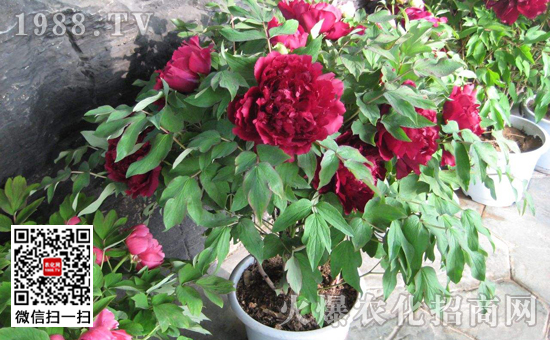
Planting methods for potted peonies:
1. Planting time. The most suitable time to plant potted peonies is from September to early October; planting too early can easily cause autumn growth, while planting too late causes slow root growth and poor plant growth, and in severe cases can cause the peony to wither after flowering the following year.
2. Before planting the peony seedling, be sure to air-dry it for 1 to 2 days so its roots become soft, making pruning and planting easier. Before that, it is best to place a piece of tile over the drainage hole at the bottom of the flower pot to prevent soil loss, then spread 2 to 5 cm of small stones to help drainage.
3. Watering. Because potted peony seedlings are relatively small, watering must be done a little sparingly, but they must not dry out; watering more at one time can better promote the growth of the peony, while watering too much can cause root rot in peonies.
4. Fertilizing. Peonies are best given topdressing starting in the spring of the second year; it is best to use sesame, peanut, or bean cake soaked in water and fermented before use, as this can promote the growth of the peony flowers.
5. Disease control. Peonies have very few diseases; as long as targeted pesticides are used to control them, these diseases can be effectively avoided.
Planting methods for potted peonies in the low latitudes of the south
In the area south of the Yangtze River, most soils tend to be acidic. With high temperature and high humidity, rainfall is 1100—1700mm, mainly from spring rain, plum rain, and typhoon rain, among which plum rain is 400—600mm, and air humidity is close to 80%. The soil is rich in iron and aluminum but low in calcium and magnesium, with very little soluble salt and carbonate content, especially a serious deficiency of exchangeable bases. This makes the environmental, climatic, and soil factors of the area south of the Yangtze River completely different from most peony-producing areas. In addition, misleading information from forced potted flowers on the market and from seedling sellers at the least suitable planting times has caused many flower lovers who are fond of peonies to lose confidence in growing peonies. In order to let this king of flowers, known for its national beauty and heavenly fragrance, be accepted by flower lovers in the vast southern region, bloom well, and enter popular cultivation, the author will put forward some personal views and suggestions on growing potted peonies in the low latitudes of the south.
1. Growing soil and containers
Because peonies are suited to neutral or weakly alkaline soil, if the growing soil is acidic, cuttlebone can be added (the cuttlefish is a mollusk, and this is a back bone in the center of the back of the flesh, rich in calcium carbonate, and also containing calcium phosphate, magnesium salts, and other nutrients needed for peony growth and development). The growing soil should be 100 parts sandy loam, 2 parts cuttlebone, and 1 part rotted oil-and-fat fertilizer (animal fats and oils — internal organs and trimmings placed in a sealed container and exposed to sunlight) thoroughly mixed, then sealed and sun-fermented. For the growing container, a clay pot is the first choice, followed by purple sand. If a ceramic pot is chosen, the drainage hole must be large enough, and a layer of palm fiber or similar material should be added to the pot wall to help drainage and aeration.
2. Seedlings and potting
For seedlings, give first priority to varieties adapted to the south, such as Heilou Zi, while for varieties with rich flower colors, choose locally adapted Zhongyuan dwarf peony, Yangshan peony, purple-spotted peony, as well as varieties from the southwest and abroad. Except for broken roots and diseased or injured roots, the original root system of the seedling generally must not be cut (the root system stores the nutrients needed for growth and development, cut wounds easily rot, and wound healing consumes nutrients). The best time for potting is from late September — October. When potting, coil the root system in the container, fill with soil, press firmly, and then water thoroughly to settle the roots.
3. Daily management
Peonies need a dormant period when the temperature is below 4 degrees. If local conditions are not suitable, the peony can be moved to a higher place to overwinter; for every 500 meters increase in altitude, the temperature drops by 3 degrees. During dormancy, water so that the soil dries and then becomes moist again. After sprouting, sufficient water is needed; controlling water during the flowering period can prolong the flowering period. In summer, watering in the early morning is best; in autumn, control water to prevent autumn growth. If there is little potting soil, spray outside the roots once a month after sprouting; during the growing period, water with oil-and-fat fertilizer liquid once a week; in winter, apply oil-and-fat fertilizer once in holes. When fertilizing, follow the principle of light fertilizer applied frequently. During the dog days, plum rain period, and typhoons, the peony can be moved under the south-facing eaves or to a balcony to prevent unnecessary losses such as excessive water evaporation, nutrient loss, and broken branches and leaves. If the goal is to concentrate nutrients or improve appearance, the sprouting soil buds, leaf buds, axillary buds, and withered branch tips should be cut off as early as possible, except for new branches or new buds used for bonsai. Pest and disease control: insect pests are generally few; after sprouting, spray once with mancozeb, and during the growing period spray once every two weeks with fungicides such as carbendazim and thiophanate-methyl. Pay attention to the occurrence of physiological diseases.