How to Plant Wintersweet Trees? Detailed Explanation of Planting Methods and Techniques
How to plant wintersweet trees. Wintersweet is a deciduous shrub native to Jiangsu, Zhejiang, Anhui and other places in China. It likes slightly acidic soil and has a long history of cultivation in China. It is a winter flower with excellent color and fragrance, with a flowering period lasting as long as 3 months. It can be grown in the open ground or as a potted bonsai. The flowers can be used to extract aromatic oil and serve as a medicine for detoxifying and promoting salivation; the flower bud oil can treat scalds, and the roots and stems can relieve coughs and serve as an antiasthmatic medicine.
Wintersweet likes sunlight and tolerates slight shade. It likes warmth but is relatively cold-hardy; as long as the winter temperature does not drop below minus 15°C, it can overwinter safely. It is suited to loose, deep, well-drained neutral or weakly acidic sandy loam, and dislikes clay and saline-alkali soil. It is drought-tolerant, hence the saying "a wintersweet will not die of drought," but wintersweet fears waterlogging, so a high, dry, sunny spot should be chosen for cultivation.
Wintersweet is a large shrub and should be pruned every year according to the tree's shape. There are generally two crown types, namely the clump type of seedling plants and the single-trunk type of grafted plants. The clump-type crown has many branches, a large number of flowers, and poor ventilation and light penetration, so thinning and shaping are the main approach; the single-trunk type has fewer flowers, good ventilation and light penetration, and a graceful tree form, so pruning should take care to maintain the original characteristics of the crown.
For potted wintersweet, after October select a small plant with plump flower buds, plant it with the soil ball, and place it in a cool place for care. After flowering, cut off the thin and weak branches, and cut back the current year's branches leaving 2-3 pairs of buds, then later pinch off the tips leaving 2-3 pairs of leaves. After the crown has taken shape, only appropriate thinning or short pruning is needed. Repot once every 2-3 years. The above is an introduction to how to plant wintersweet trees.
Wintersweet tree prices 2015, how to plant wintersweet trees
✿ Related reading recommendations
✿ Yimi flower pictures ✿ Is datura poisonous ✿ Jade plant growing methods and precautions
(◕‿◕✿) For flower bonsai and plant cultivation, please follow the Meilele Flower Bonsai section!
.....
The wintersweet tree is also known as yellow plum blossom, fragrant plum blossom, fragrant plum, and dry-branch plum. It is a plant of the genus Chimonanthus in the family Calycanthaceae. It likes a sunny, well-lit environment and is relatively cold-hardy; it can be grown in the open ground anywhere the temperature stays above minus 15 degrees. Today the editor will introduce its planting methods and the price of wintersweet trees.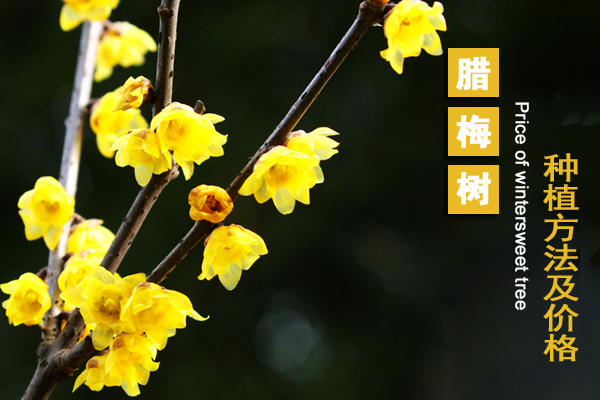
.....
Open-ground planting
Before introducing the price of wintersweet trees, let us first understand its planting. For planting wintersweet trees, choose neutral or slightly acidic sandy soil with deep soil layers, shelter from wind, sun exposure, and good drainage, and generally plant before spring bud break. For small seedlings, use a spacing of 30 cm × 50 cm between plants and rows. For large seedlings to be planted permanently in a courtyard, the tree hole should be 60-70 cm in diameter, with decomposed manure, bean cake, etc. placed at the bottom as base fertilizer. After covering the base fertilizer with a layer of soil, place the wintersweet plant with its soil ball into the hole, fill with soil, firm it by treading, and water.
.....
.....
Pot planting
For potted planting of wintersweet trees, choose loose, fertile, well-drained sandy soil as the growing medium, place a layer of gravel over the drainage hole at the bottom of the pot or tub, and in early winter each year select a small plant with plump flower buds, dig it up with the soil ball, and plant it in the pot. After flowering, it can be displayed for viewing. Normally keep it outdoors in a sunny place for care.
.....
.....
For potted wintersweet trees, no additional fertilizer or water is applied in the early stage after potting. In spring, apply leaf-promoting fertilizer. Repot and change the soil once every 2-3 years, carried out after the flowers fade in spring, and at the same time replace 1/3 of the potting soil.
Watering:For routine watering, it is best to keep the soil in a half-moist state. In the rainy season, pay attention to drainage to prevent water accumulation in the soil. In dry seasons, replenish water in time. During the flowering period, keep the soil moderately dry and do not water too much. For potted wintersweet in spring and autumn, do not water until the potting soil is dry; in summer, water once each morning and evening, with the amount controlled according to how dry or moist the potting soil is.
.....
.....
Fertilizing:After the flowers fade each year, apply a fully decomposed organic fertilizer once. During the growing season from the emergence of new leaves in spring to June, apply decomposed cake fertilizer water once every 10-15 days. During the flower bud differentiation period in July-August, apply a mixed liquid of decomposed organic fertilizer and phosphorus-potassium fertilizer. After autumn, apply organic fertilizer once more. After each fertilization, water and loosen the soil in time to keep the soil loose. Do not fertilize during the flowering period.
.....
.....
Now that we understand the planting methods for wintersweet trees, let us talk about the price of wintersweet trees. Wintersweet is suitable for old-trunk bonsai as well as flower arranging and shaping art, and is an ideal precious flower and tree for winter flower viewing. It is even more widely used in urban and rural landscaping. So what is the price of wintersweet trees? Wintersweet tree prices vary with size, region, and sales volume. Generally, the price of small seedlings is 1-5 yuan, and the price of a wintersweet tree with a trunk diameter of 10 cm is about 5000 yuan.
.....
.....
Wintersweet relieves summer heat and promotes salivation, and regulates qi and relieves cough. It is used for summer-heat restlessness, thirst, whooping cough, liver-stomach qi pain, and burns from water and fire. Wintersweet is not only an ornamental flower and tree; its flowers contain various aromatic substances such as linalool, borneol, eucalyptol, pinene, and sesquiterpene alcohols, and it is one of the fragrant flowers used to make high-grade scented tea. The high-grade spice refined from it is worth 1000 grams on the international market at a price equivalent to 5000 grams of gold.
.....
Wintersweet blooms in the depths of winter when all other flowers have withered, braving the cold and defying the frost, expressing the character of the Chinese nation that never yields in the face of brute force, and giving people spiritual inspiration and enjoyment of beauty. It is good for courtyard planting and is also suitable for old-trunk bonsai as well as flower arranging and shaping art, and is an ideal precious flower and tree for winter flower viewing. Today the editor's introduction to the price and planting methods of wintersweet trees ends here. Thank you all for reading.
How to graft wintersweet trees? Wintersweet tree grafting techniques
[Nursery stock grafting] How to graft wintersweet trees? Wintersweet tree grafting techniques
[Expert answer] Wintersweet tree grafting techniques:
1. Old root grafting: The cut grafting method is slightly better than the approach grafting method. One month before cutting, first remove the top shoot so that nutrients concentrate in the middle part of the branch. The scion should not be cut too deep; exposing the xylem slightly is appropriate. Cut off the rootstock 3-6 cm above the ground. Do not cut the rootstock too deep. After grafting, bind with hemp. Finally, at the graft site, mound broken soil into a steamed-bun shape until the top of the scion is covered. The soil is best half-dry and half-moist. After one month, remove the mounded soil to help the buds grow out, and at the same time cut off the suckers on the rootstock. If the weather is bad, the soil should still be mounded up.
2. Rootstock grafting: The rootstock and scion must have affinity, and it is best if they are varieties of the same family and genus, with basically consistent thickness. Most importantly, the "cambium" must be aligned, as only then can the graft survive. Be sure to bind and fix it well with plastic strips to prevent the scion from moving. There are many grafting methods, mainly divided by scion form into root grafting, bud grafting, and branch grafting. For grafting wintersweet, dog-claw wintersweet or wild wintersweet can be used as the rootstock, red-heart plum or seedling wintersweet can also be used as the rootstock, and tiger-hoof wintersweet can be used as the scion; seedlings can also be used.
[Editor's concluding remarks] At present, there are very few rootstocks on which wintersweet trees can be grafted. Generally, grafting can only be done on old roots, that is, grafting wintersweet onto wintersweet. The specific grafting methods have been introduced in detail above by the editor of First Agricultural Economics. Friends who have wintersweet that needs grafting can try it themselves. We hope this article is helpful to you, and thank you for your attention to and support of our website.