What are the cultivation methods for potted plum blossoms?
Cultivation methods for potted plum blossoms. Plum blossoms like sunny and well-ventilated environments, love fertilizer, fear waterlogging, are relatively cold-tolerant, but are extremely weak in tolerance to toxic gases. Potted plum blossom techniques are relatively complex, and cultivation management must be meticulous, with even more attention needed for watering and fertilizing. Plum blossoms must be watered promptly and in appropriate amounts; master the rule of not watering when dry, and avoid over-wetness, with moist potting soil being ideal. Both over-dryness and over-wetness will cause leaf drop and affect bud formation and flowering. Generally, watering can follow these points:
(1) From April to June, plum blossoms have just sprouted and do not need much water, so watering once every few days is sufficient; afterward, as temperatures rise and branches and leaves grow, the amount of water should gradually increase. To prevent excessive vegetative growth of branches and leaves, the potting soil should be kept on the dry side during this stage. On rainy days, it is best to lay the pot on its side to avoid waterlogging, and extra care should be taken during the plum rain season.
(2) From July to September, due to strong light, high temperatures and high evaporation, in addition to one thorough watering every afternoon, individual dry pots should be given supplementary water in the morning. During this stage, water when the soil is dry to prevent leaf drop from dryness.
(3) From October to March of the following year, as temperatures move from cool to cold, watering goes from once a week to once every other day, then to once every few days. During this stage, the principle is to keep the potting soil moist. During the flowering period, water should be slightly increased and never cut off entirely; during full bloom, water should be controlled to prolong the flowering period.
Reasonable fertilization can promote plum blossom flowering, make the plants grow vigorously and extend their lifespan. During the year, potted plum blossoms can be fertilized several times. In early January, when the plum blossoms are in bud and about to open, a quick-acting fertilizer should be applied once to promote flowering. This fertilizer must not be too concentrated to avoid fertilizer burn, and care should be taken to water once the next morning.
In April, apply one topdressing to support spring leaf growth and branch development. From mid-to-late June to early July, 10 days after new branches stop growing, quick-acting phosphorus and potassium fertilizers such as superphosphate and potassium chloride can be applied together with irrigation to promote flower bud formation. This fertilizer must not be applied too early; applying it too early often causes new buds to continue growing, which is unfavorable for flower bud formation. In early August, plum blossoms root for the second time, and to promote flower bud enlargement, one topdressing mainly containing phosphorus and potassium can be applied. After early September, to achieve robust flower buds, it can be applied another 1 to 2 times. Fertilization should stop during the dog days, and no fertilizer should be applied during the flowering period. These are the cultivation methods for potted plum blossoms.
Cultivation methods for potted plum blossoms
Plum blossom (méi huā), the flower of the plum tree, is a plant in the subgenus Prunus of the Rosaceae family. It blooms before the leaves emerge in deep winter, with five petals and various colors such as white, red and pink. The leaves are broadly ovate to ovate. It is a famous ornamental plant and is the city flower of Nanjing, Wuhan, Wuxi, Meizhou and other places. It is mainly divided into two categories: flowering plum and fruiting plum; it can be planted singly, in clusters, in groups, or in pots. It has good medicinal value: the flower buds can stimulate the appetite and relieve stagnation, promote fluid production and resolve phlegm, invigorate blood and detoxify; the roots, ground into powder, can treat jaundice. The flower language of the plum blossom is “strength, loyalty, elegance”.
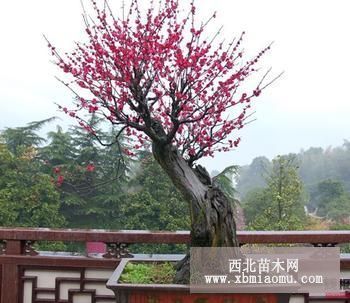
Potted plum blossoms are mainly propagated by grafting, commonly using cut grafting and bud grafting. The rootstock is wild peach, mountain peach or apricot. The old trunk bark of apricot is red, so when grafting red plum, the flower and bark colors are coordinated. Cut grafting: cut grafting mostly uses one- or two-year-old rootstock. At the end of March (in a cold room) or early April (in the open field), cut off the upper part of the rootstock 3—5 cm above the ground. The scion uses a vigorous one-year-old branch, cut to 5—6 cm long, with at least 3 buds retained. On both sides outside the lowest bud, make downward slanting cuts into a duck-bill shape. Open a 3 cm long slit on one side of the rootstock. Insert the scion into the rootstock slit so that the two are closely joined, then bind with plastic film tape. Or use polyester tape to stick it tightly. Finally, cover the scion with a small plastic bag, tying the bag opening below the graft union, so it can be checked frequently through the film. After it survives, remove the binding material. Bud grafting: bud grafting is carried out in August and September, generally using the “T” shaped method. First make a horizontal cut 1—1.5 cm above the scion bud, then from 1 cm below the bud make a flat cut forward and downward, and gently peel off the wood inside the bark layer of the cut bud (in recent years, bud grafting with a little wood attached has been used) and hold it in the mouth. Make a horizontal cut on the rootstock 5 cm above the soil surface, then make a vertical cut downward from the center of the cut, forming a “T” shape, then gently peel open the bark and insert the prepared scion into the bark of the “T” opening. The grafted bud must be pressed firmly, with the upper end closely joined to the upper end of the rootstock “T” opening, and finally bind well with plastic film strips or polyester adhesive tape. Check survival after one week; if the petiole falls off at a touch and the bud point is green and plump, it indicates survival. The following spring, cut off the top of the rootstock 5—6 cm above the graft union; the scion will sprout quickly. Afterward, pay attention to cutting off rootstock sprouts. When repotting or planting in a pot, plant appropriately deeper so that the graft union is lowered as much as possible, and bind according to growth vigor to guide it into a graceful shape.
For potted plum blossoms, pay attention to three aspects: watering, light and fertilizing. Trace elements such as ferrous sulfate can be supplemented in appropriate amounts to prevent yellowing of leaves caused by iron deficiency in plum blossoms. Watering
Watering should follow the principle of watering when dry and stopping when wet, not watering when dry, and watering thoroughly when watering. On rainy days, tip the pot promptly to avoid water accumulation. When new branches grow to 20-25 cm, attention must be paid to properly withholding water so that the potting soil is on the dry side, inhibiting new shoot elongation and promoting flower bud differentiation. Watering during the dog days is key; at this time, insufficient watering can easily cause leaf drop and affect flower bud formation. During the vigorous growth period, water once a day. After autumn turns cool, the amount of watering should gradually decrease to help the branches mature.
Temperature and light
Plum blossoms like a sunny and well-ventilated environment and cannot tolerate long-term shade. Only by providing sufficient light, giving them the conditions for photosynthesis, can they obtain adequate nutrition, and thus grow robustly and produce abundant, large and brightly colored flowers.
Fertilizing
Plum blossoms do not like heavy fertilizer. When new shoots grow to about 5 cm, a thin fertilizer solution of crushed bone and sesame paste can be applied once to promote robust branch growth. When leaves emerge, fertilizer and water should be sufficient; generally apply a thin liquid fertilizer once a month to promote lush branches and leaves. When branches grow to 20-25 cm, fertilizer and water should be moderated. In late summer and early autumn, apply topdressing twice to promote flower bud differentiation. After each fertilization, pay attention to timely watering and loosening the soil to keep the potting soil loose, which benefits root development.
During the growing season, if yellowing of leaves caused by iron deficiency is found, a 0.1% ferrous sulfate solution can be applied along with watering.
Precautions for cultivating potted plum blossoms
1. For potted plum blossoms, tile pots and earthenware pots with good permeability are best, and purple clay pots are also acceptable. Place a layer of crushed charcoal pieces or crushed hard plastic foam pieces at the bottom of the pot. The substrate is best a fertile, lightly clayey soil; old mountain soil, pond mud and vegetable garden topsoil can be mixed as potting soil. When planting, mix a little bone meal and nitrogen-phosphorus-potassium compound fertilizer into the soil as base fertilizer. Planting should be shallow without exposing the roots; deep planting makes flowering difficult. After planting, place in half shade and water thoroughly once; after 10 days, switch to normal management. Repot and change the soil once every 2~3 years after flowering.
2. Plum blossoms like moisture and fear waterlogging, so watering must be timely and appropriate. In winter and early spring during the flowering period, it is best to keep the potting soil slightly moist at all times. After all flowers have faded, water thoroughly once; do not water when not dry. Frequently spray water on the branches, leaves and nearby ground in the evening. During the plum rain season, strictly control water; wait until the edges of old leaves curl slightly and tender branches wilt slightly before watering. Repeat this several times to force new shoots to stop growing, which helps flower bud differentiation. When the dog days arrive, drain and prevent waterlogging on rainy days; on sunny days water once in the morning, and if the soil is dry in the evening water again, to prevent leaf drop from excessive dryness and dehydration. After September, gradually reduce the amount of watering, watering once every 1~2 days in the afternoon. In October, flower buds begin to develop into flower buds, the leaves have fallen, and water demand is not great; water when the soil is dry, and slightly dry but moist potting soil is sufficient.
3. Plum blossoms like fertilizer and are also tolerant of barren soil. Do not fertilize during the flowering period. After the flowers fade, apply a nitrogen-phosphorus-potassium compound fertilizer once to promote recovery. When new shoots grow to 3~5 cm, do not fertilize if growth is good; if growth is poor, apply a nitrogen-phosphorus-potassium compound fertilizer once. When new shoots grow to about 18 cm, stop fertilizing. In late June and early July, spray a 0.2% potassium dihydrogen phosphate solution once each time to promote flower bud differentiation. In late autumn after leaf drop and bud appearance, apply a nitrogen-phosphorus-potassium compound fertilizer or 0.2% potassium dihydrogen phosphate solution once to promote flower bud development and opening.
4. Plum blossoms are sun-loving plants and should be placed in a sunny, well-ventilated place, avoiding drafty openings. They like warmth and are cold-tolerant. In winter they need low-temperature stimulation to bloom abundantly and grow lushly. In places where the lowest winter temperature is above -12℃, they do not need to be moved indoors for winter; placing them in a wind-sheltered, sunny spot is sufficient. If you want them to bloom during the Spring Festival, move them 20 days before the festival to a low-temperature room at 5~10℃, and place them inside a south- or west-facing window to receive more sunlight. After flowering, move them to a place at 0~5℃, where they can stay in bloom for 1 month; too high a temperature causes early fading.
5. Plum blossoms have strong sprouting and branching ability, are tolerant of pruning, and old trees are easy to rejuvenate. After flowering, shorten the branches that have bloomed, leaving only 2~3 buds at the base. Cut off all weak, diseased and dead branches. For crossing branches and overlapping branches, cut off one of each; thin out overly dense areas. When new shoots grow to 20 cm, pinch the tips to control growth and concentrate nutrients toward flower bud differentiation; overly long new shoots instead result in sparse flowers. Through pruning, not only is the plant shape beautiful, but ventilation and light penetration are also good, making it less susceptible to pests and diseases. 6. During high-temperature and drought conditions in mid-to-late June, plum blossoms may develop anthracnose. In July, with high temperatures, high humidity and poor ventilation, powdery mildew may occur. Attention to ventilation and light penetration can prevent both diseases. If diseased branches and leaves are found, cut them off and burn them, and spray with thiophanate-methyl or carbendazim for treatment. The main pest of plum blossoms is aphids, which can be killed by spraying an 80% dichlorvos emulsifiable concentrate 1500-fold solution or by burying carbofuran in the soil so that the plant becomes toxic and kills them. It is worth noting that plum blossoms are allergic to phosphorus-containing pesticides, and such pesticides must not be used. They have poor resistance to toxic gases such as sulfur dioxide; in places with serious air pollution, they grow poorly and may even die.
This concludes the introduction to cultivation methods for potted plum blossoms. If netizens have better supplements, please add them in the comments.
Cultivation methods for plum blossoms and potted plum blossoms
This article mainly introduces the cultivation methods of plum blossoms and the cultivation methods of potted plum blossoms. The plum blossom is the longest-lived woody flowering plant among China's traditional famous flowers. Many ancient plum trees still survive in China today; they are historical witnesses to the brilliant culture of the motherland. There are many varieties of plum blossoms, including purple plum, red plum, white plum, Jiang plum, double-petaled plum, potted plum and tall plum trees, more than two hundred kinds in total.
For plum blossom propagation, seeds are often sown to grow seedlings, which are then grafted; methods such as cuttings and layering can also be used. Cutting propagation is carried out in spring. Cut vigorous two-year-old branches as cuttings and insert them in sandy soil, keeping the cutting medium moist; the survival rate can reach more than 90%. For layering propagation, in spring select branches near the ground, ring the bark, then bury them in soil and keep the soil moist. After the ringed part has rooted, cut it away from the mother plant and plant it out. Air layering can also be used for propagation.
Apart from large trees planted in the ground, plum blossoms are usually grown in pots, cultivated as bonsai, and can even be developed into old plum stumps. Plum blossoms have a characteristic: the more withered and old the branches and trunk, the more they display a rugged and wonderful appearance. The maintenance methods for potted plum blossoms differ from those of other potted plants, and cultivation management should follow their characteristics. After flowering, immediately prune and shape: for branches that have bloomed, leave 2 to 3 buds and remove the rest, and place the pruned plum stump in sunlight for 5 to 7 days, with special attention to exposing the roots to the sun. After sunning, pot it; when potting, dip the soil ball portion in dilute human urine and manure before planting.
For the preparation of potting soil, mix one third rice husk ash with two thirds river mud, add human urine and manure, stir evenly, expose to sunlight, then sift and set aside. Place tile pieces and stones at the bottom of the pot to facilitate drainage, then fill in coarser soil, then plant the plum stump and firm the soil around the roots.
When potting, do not water; after 3 to 4 days, water once; after 7 to 10 days, water once a day; after survival, water 1 to 2 times a day from May to August. The soil should not be too wet, and waterlogging must be avoided.
Plum blossoms like fertility. During the branch and leaf growth period, nitrogen fertilizer is preferable. From August to September, complete fertilizer should be applied. After October, apply more phosphorus fertilizer, concentrating it around the roots every half month to promote flowering.
Growing potted plum blossoms at home is not very difficult, but to make plum blossoms bloom abundantly and colorfully year after year, the following maintenance techniques must be mastered:
Placement location: Plum blossoms like sun, so they must be placed in a sunny, well-ventilated place.
Watering: Plum blossoms are very afraid of water accumulation, so the amount of watering should be flexibly controlled according to weather changes and growth conditions. Generally, the principle is to keep the potting soil moist and not water when dry.
Fertilizing: Plum blossoms like fertilizer. After the flowers fade each year, organic fertilizer should be placed at the bottom of the pot. During the growing period, apply thin fertilizer once every half month to promote strong growth. Before flower bud formation, it is best to apply more phosphorus fertilizer.
Pruning: Plum blossoms form flower buds on new growth of the current year, so after the flowers fade each year, prune promptly, shortening old flowering branches and leaving 2 to 3 buds, and take care to make the buds grow outward. Crossing branches, parallel branches, overlapping branches, opposite branches, water sprouts, as well as overly dense and weak branches that affect the beauty of the tree shape should be thinned out.
Repotting: Plum blossom bonsai is generally repotted once every 1 to 2 years, preferably after flowering. When repotting, remove about one third of the old soil, cut off dead roots, shorten overly long old roots, and replace with humus-rich leaf mold mixed with rice husk ash and sandy soil, so that the potting soil is both fertile and loose and drains well.