How to grow variegated Schefflera arboricola? A detailed guide to cultivation methods
Cultivation methods for variegated Schefflera arboricola. Potted variegated Schefflera arboricola plants grow 30-80 cm tall, with upright stems and compact branches. The palmately compound leaves have long petioles, with 5-9 leaflets that are leathery, deep green and glossy, inlaid with irregular yellow blotches. The plant has an elegant form, a strong sense of layering and three-dimensionality, and high ornamental value.
Pots of various materials can be used to grow variegated Schefflera arboricola. If using a more attractive but less breathable plastic or porcelain pot, place a layer of crushed hard plastic foam blocks at the bottom to enhance air permeability and drainage and prevent root rot. Schefflera arboricola grows best in loose, fertile, slightly acidic sandy soil. You can mix leaf mold, garden soil and sand at a ratio of 5:3:2, then add some nitrogen-phosphorus-potassium compound fertilizer to make the potting soil. Repot and change the soil once each spring before budding. If the plant has grown too tall and is out of proportion with the pot size, you can heavily prune it at this time.
Variegated Schefflera arboricola grows best under conditions of high air humidity and moist but not waterlogged potting soil. During the growing season, water frequently and often mist the branches and leaves. This not only increases air humidity and benefits its growth, but also removes dust, keeping the leaves fresh and bright. During the winter dormant period, use water close to room temperature and water and mist once every 10 days. During the growing season, apply a nitrogen-phosphorus-potassium liquid fertilizer or compound fertilizer about once every half month. Avoid applying nitrogen fertilizer alone, otherwise the yellow blotches tend to disappear and the ornamental value decreases. Do not fertilize in midsummer or severe winter.
Schefflera arboricola originally grows in the subtropical forests of Guangdong and Fujian in China. It likes a warm, semi-shady environment. For those kept indoors for viewing year-round, place it in a well-ventilated spot with plenty of scattered light. It is even better if it can receive 3-4 hours of slanted sunlight each day. If kept in too much shade for a long time, not only do the yellow blotches tend to disappear and the leaves become dull and lusterless, but the growth also becomes weak and spindly, reducing its ornamental value. For those placed outdoors, avoid strong direct sunlight around midday from June to September. Its most suitable growing temperature is 14-30°C. In winter, it can overwinter outdoors in places where the minimum temperature stays above 0°C. Below 0°C, it should be brought indoors to overwinter, and it is enough to keep the room temperature above 5°C.
Schefflera arboricola blooms white fragrant flowers in winter and produces dark green spherical fruits. For propagation by cuttings, from May to June cut branches about 10 cm long as cuttings, remove the lower leaves, dip them in sulfur powder or plant ash, then insert them into plain sandy soil. Place in a shady spot and mist frequently to keep moist. Roots and new leaves appear in about one month, and after another month they can be potted with soil for planting. The above is an introduction to the cultivation methods for variegated Schefflera arboricola.
Cultivation methods and precautions for variegated Schefflera arboricola
Variegated Schefflera arboricola is commonly propagated by cuttings, layering and sowing.
Cutting propagation technique
From a mother plant that has grown for several years, cut off one-year-old branches 6-8 cm long, or take branches cut during repotting or spring heavy pruning as cutting material. Remove the leaves from the part to be inserted, and insert the cuttings into a plastic flower pot 15-20 cm in diameter using perlite pre-soaked in water as the substrate. Add a tray at the bottom of the pot to catch the leachate. Insert 3 cuttings or a single cutting per pot. Roots will form about one and a half months after cuttings are taken. After inserting, water frequently to keep moist. After inserting, place in a low-light spot indoors and strengthen fertilizer and water management. After rooting, apply nutrient solution; replenish 100 ml of solution per pot once a week.
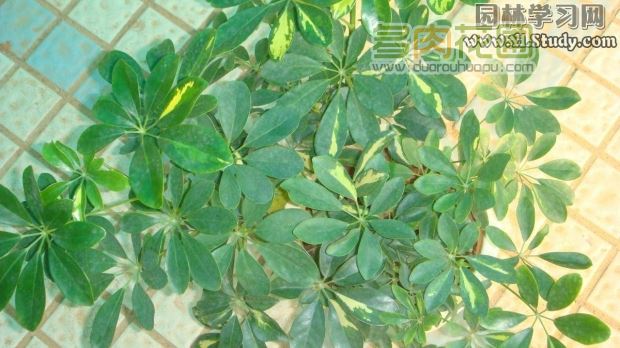
1. Habits
It likes a warm, hot and humid climate, grows fast, and is propagated by seeds. The suitable growing temperature is 20°C to 30°C, and in winter it should not be lower than 5°C. If the temperature is below 0°C, the plant will be frozen and drop its leaves, but if the stem is intact, new leaves will sprout again the following spring. Schefflera arboricola likes moisture and fears dryness. Under conditions of high air humidity and sufficient soil moisture, the stems and leaves grow luxuriantly. However, too much water causing waterlogging will lead to root rot. If the potting soil lacks water or is alternately wet and dry for a long time, leaf drop will occur. Schefflera arboricola has a certain tolerance for temporary drought and dry air. Schefflera arboricola has a wide range of adaptability to light and can grow under full sun, half sun or semi-shade. However, the intensity of light has a certain relationship with leaf color: under strong light the leaf color tends to be lighter, while under semi-shade the leaf color is deep green. Under bright light, the colors of variegated varieties are more vivid. The soil should preferably be fertile, loose and well-drained sandy loam. For potting soil, use a mixture of peat soil, leaf mold and coarse sand.2. Propagation techniques
Variegated Schefflera arboricola is commonly propagated by cuttings, layering and sowing.Cutting propagation technique
From a mother plant that has grown for several years, cut off one-year-old branches 6-8 cm long, or take branches cut during repotting or spring heavy pruning as cutting material. Remove the leaves from the part to be inserted, and insert the cuttings into a plastic flower pot 15-20 cm in diameter using perlite pre-soaked in water as the substrate. Add a tray at the bottom of the pot to catch the leachate. Insert 3 cuttings or a single cutting per pot. Roots will form about one and a half months after cuttings are taken. After inserting, water frequently to keep moist. After inserting, place in a low-light spot indoors and strengthen fertilizer and water management. After rooting, apply nutrient solution; replenish 100 ml of solution per pot once a week.Note: Do not add water on the day the solution is replenished, so as not to affect the concentration of the nutrient solution. For pot cutting propagation, take 6-inch to 8-inch pots, block the bottom holes with small stones, and fill with perlite or sieved clean river sand, with the perlite or sand surface 1 cm below the pot rim. If using perlite in the pot, it is best to press a layer of river sand on top (to increase firmness). At this point, cut 10 cm-12 cm cuttings from a mature variegated Schefflera arboricola plant, cut the bottom into a slanted shape, and if rooting powder is available, dip a little; it is also fine without it. Insert 2/3 of the cutting into the sand or perlite, 3-4 cuttings per pot. After inserting, water thoroughly and place the pot in a plastic basin or other container filled with water. The water level in the container should always be kept above 1/2 the height of the cutting pot. Then place a large transparent plastic cover over the cutting pot and put it in a bright spot with scattered light, keeping the temperature at 15°C-25°C. After 30-40 days, the cuttings develop root systems. At this point, the Schefflera arboricola seedlings can be transplanted into 6-inch to 8-inch pots. The potting soil should be filled with a fertile nutrient soil thoroughly mixed from sieved high-quality farm fertilizer, humus soil and fine sand at a ratio of 3:2:1. After planting, water thoroughly, place in semi-shade for 7 days, then move to a bright spot for management.For water propagation, take a large empty Coca-Cola bottle or a stemmed glass jar or canning jar, rinse it clean, fill it with clean water (tap water), and fix the cut variegated Schefflera arboricola cuttings in the bottle (with the bottom of the cuttings 1 cm away from the bottle bottom). Each bottle can hold 2-3 cuttings. Cover with a transparent plastic bag, place in a bright spot, and keep the temperature at 15°C-25°C. After 30-35 days, white roots 0.5 cm-1 cm long grow from the bottom of the cuttings. At this point, they can be removed and potted according to the method above.Pests and diseases:There are harm from leaf spot disease and anthracnose, scale insects, red spider mites, thrips and leaf miners.Landscape uses:The plant is compact, and the crown is neat and graceful, so it can be used for ornamental purposes or as a screening tree species in gardens.