How to Grow Golden-Edged Lucky Bamboo? Teaching You the Correct Cultivation Methods
How to grow golden-edged lucky bamboo. Currently, more and more vendors are supplying lucky bamboo in the flower market. There are two varieties of lucky bamboo: one with entirely green leaves, and another with golden-yellow leaf edges, also known as golden-edged lucky bamboo, with the latter being more expensive. This golden-edged lucky bamboo, after being cut into segments and arranged into a multi-layered pagoda shape, resembles a "pagoda" or an "incense burner" or the classical instrument "sheng." As a gift for relatives and friends, it symbolizes "prosperity and wealth, bamboo bringing peace."
Golden-edged lucky bamboo (Dracaena sanderiana) originates from the Americas and the Congo region. It prefers warmth and tolerates moisture, but fears cold and avoids direct sun exposure. It can be grown in soil as a potted plant, with 1-3 stems per pot, placed on a desk or table in a room. It can also be grown in water, with 1 to several stems per vase, placed on a table for viewing. It can also be cut into segments and tied into a plate-like shape for water cultivation, placed in living rooms and other locations.
In terms of care, when they are in the optimal growing environment of 20-30°C, soil-grown plants should be given additional fertilizer 1-2 times per month, using organic fertilizer; water-grown plants should likewise have nutrient solution added 1-2 times per month, but organic fertilizer should be avoided, and the water should be changed every 2-3 days to prevent mosquito breeding. Also, after winter arrives, when the temperature drops below 8°C and the plant enters dormancy, it needs to be moved indoors for frost protection and warmth, to prevent leaf scorching or freezing to death. If any frozen or rotten stems are found in the arrangement, they should be removed promptly to prevent spread and harm to other plants. The above is an introduction to how to grow golden-edged lucky bamboo.
How to Grow Golden-Edged Lucky Bamboo: Precautions for Growing Golden-Edged Lucky Bamboo
Golden-edged lucky bamboo is a type of lucky bamboo, said to be named for the ring of pale yellow on the edges of its leaves, also called bordered lucky bamboo. Its beautiful appearance combined with its auspicious name makes this type of lucky bamboo one of the top choices for home greenery. So, how do you grow golden-edged lucky bamboo?
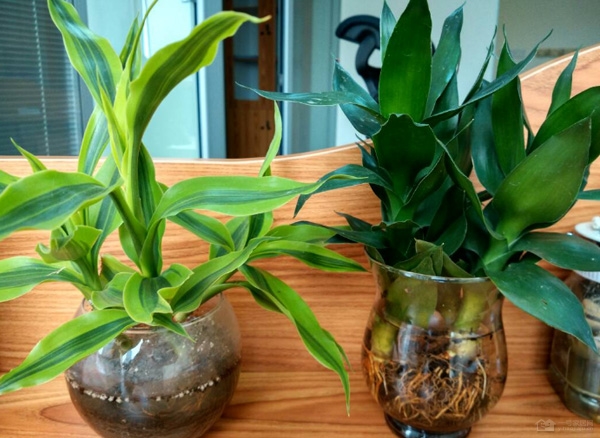
Golden-edged lucky bamboo originates from western Africa. It is a perennial evergreen shrub that prefers high temperature and high humidity environments. It likes weak light and cannot tolerate direct sun exposure. The optimal growing temperature is 20-28°C. It prefers fertile, moist soil.
Propagation Methods
Golden-edged lucky bamboo is generally propagated by cuttings. The best time for cuttings is during the rainy season in June-July. Select mature branches, cut them into 10 cm pieces, insert them into coarse sand. Under a temperature of 25-30°C, roots will form in about 25-30 days, and they can be transplanted into pots after 2 months. During the growing period, keep the potting soil moist, spray water to increase air humidity, fertilize once every half month, repot every April-May, and prune the whole plant to encourage new branch growth. In summer when growth is vigorous, provide appropriate shade and water frequently, not allowing the potting soil to dry out.
Cultivation Methods
The cultivation methods for golden-edged lucky bamboo require attention to five aspects: soil, humidity, light, fertilizer, and pests and diseases.
Soil
Golden-edged lucky bamboo has good adaptability and can grow in clay and sandy soil, but grows best in loose, fertile, well-draining sandy soil rich in humus. It can be made by mixing 1 part plant nutrient soil, 1 part leaf mold, and 1 part river sand. For home cultivation, a mixture of leaf mold and river sand or cinder ash can be used as the growing medium. Repot every 2 years, and choose foliage plant potting soil.
Light
Golden-edged lucky bamboo likes light but avoids direct summer sunlight. For home care, it can be placed under a south-facing window or on a balcony, only avoiding direct sunlight in summer. In other seasons, it is best to provide some light, otherwise the golden-yellow stripes in the middle of the leaves will fade and disappear, severely reducing its ornamental value.
Humidity
The optimal growing temperature for golden-edged lucky bamboo is between 20-30°C, and the overwintering temperature should preferably be kept above 10°C, as it cannot tolerate low-temperature frost damage. During growth, it needs a certain amount of air humidity, otherwise the leaf color becomes dull and glossiness decreases. During the growing period, frequently spray the plant with clean water, and if conditions permit, it is best to increase moisture humidity in the environment.
Fertilizer
Golden-edged lucky bamboo does not have strict fertilizer requirements. During the growing period, either chemical fertilizer or organic fertilizer solution can be applied, but when applying chemical fertilizer, use small amounts multiple times, and water promptly after fertilizing. Additionally, when repotting and changing soil each year, add a certain amount of decomposed organic fertilizer as a base fertilizer to ensure good growth.
Pests and Diseases
Golden-edged lucky bamboo commonly suffers from leaf spot disease, stem rot, and root rot. It can be sprayed multiple times with 100-fold Bordeaux mixture. Pest damage includes thrips and scale insects, which can be sprayed with 50% omethoate emulsifiable concentrate at 1000-fold dilution.
Precautions
1. Change the water frequently. If an unusual odor is detected, change the water immediately.
2. If the leaves turn yellow, check whether there is insufficient light or excessive fertilization.
3. If there are rotten leaves or rotten roots, remove them promptly.
4. Do not place it near electrical appliances. For example, do not place lucky bamboo next to a TV or in a place where air conditioning blows constantly, to avoid the leaf tips and edges drying out.
Suitable temperature and appropriate humidity are important conditions for the growth of golden-edged lucky bamboo. Therefore, daily care for golden-edged lucky bamboo should focus on these two factors.
Golden-Edged Lucky Bamboo Pictures, Golden-Edged Lucky Bamboo Hydroponics, How to Grow Golden-Edged Lucky Bamboo, Golden-Edged Lucky Bamboo Price
Golden-Edged Lucky Bamboo
Golden-edged lucky bamboo, also known as bordered bamboo dracaena, originates from Congo and Cameroon. It is an evergreen shrub with slender, upright stems, branching at the base, reaching 1.5 m in height and 40 cm in width. The leaves are slightly wavy, curved, and lanceolate, 15-25 cm long, with yellow longitudinal bands on both sides of the midrib on the leaf surface. It prefers high temperature, high humidity, and a sunny environment. It is not cold-tolerant, tolerates pruning, and should avoid intense direct light in summer. Loose sandy loam soil is best, and the winter temperature should not be below 10°C.Golden-Edged Lucky Bamboo Pictures
Golden-edged lucky bamboo, also known as bordered bamboo dracaena, originates from northern Myanmar and was introduced to Zhanjiang in the 1980s by the South Subtropical Crops Research Institute of the Chinese Academy of Tropical Agricultural Sciences. It prefers high temperature, high humidity, and a sunny environment. It is not cold-tolerant, tolerates pruning, and should avoid intense direct light in summer. Loose sandy loam soil is best, and the winter temperature should not be below 10°C.
Golden-Edged Lucky Bamboo Price
The price of golden-edged lucky bamboo is around 1, and wholesale is about 0.4.
How to Grow Golden-Edged Lucky Bamboo
Daily Care
Fertilizer: Does not have strict fertilizer requirements. During the growing period, either chemical fertilizer or organic fertilizer solution can be applied, but when applying chemical fertilizer, use small amounts multiple times, and water promptly after fertilizing. Additionally, when repotting and changing soil each year, add a certain amount of decomposed organic fertilizer as a base fertilizer to ensure good growth.
Soil: The dracaena has good adaptability and can grow in clay and sandy soil, but grows best in loose, fertile, well-draining sandy soil rich in humus. It can be made by mixing 1 part plant nutrient soil, 1 part leaf mold, and 1 part river sand. For home cultivation, a mixture of leaf mold and river sand or cinder ash can be used as the growing medium. Repot every 2 years, and choose foliage plant potting soil.
Light: The dracaena likes light but avoids direct summer sunlight. For home care, it can be placed under a south-facing window or on a balcony, only avoiding direct sunlight in summer. In other seasons, it is best to provide some light, otherwise the golden-yellow stripes in the middle of the leaves will fade and disappear, severely reducing its ornamental value.
Humidity: The optimal growing temperature is between 20-30°C, and the overwintering temperature should preferably be kept above 10°C, as it cannot tolerate low-temperature frost damage. During growth, it needs a certain amount of air humidity, otherwise the leaf color becomes dull and glossiness decreases. During the growing period, frequently spray the plant with clean water, and if conditions permit, it is best to increase moisture humidity in the environment.
Golden-Edged Lucky Bamboo Hydroponics
Hydroponic Methods
Hydroponic lucky bamboo can be grown from cuttings in water, or by the root-washing method. The root system of lucky bamboo is orange-yellow, making it extremely attractive in hydroponics. Whether using the cutting method or the root-washing method, select healthy, upright stems with leaves. When cutting, cut at a smooth angle near the base of the stem node to facilitate water and nutrient absorption. Then remove the leaves at the base. In the early hydroponic stage, change the clean water once a day. After about 2 weeks, fibrous roots will grow. After rooting, change the water once a week. If the water quality is clean, the water-changing interval can be extended.
After rooting, a small amount of compound fertilizer can be applied. Compound fertilizer sold on the market contains many impurities, which may affect plant growth. Use less rather than more, and if conditions permit, it is best to use a dedicated flower nutrient solution.
If indoor dust is heavy, frequently clean the leaf surface to keep the leaves glossy, to avoid affecting leaf photosynthesis. When the temperature is high, frequently spray water on the leaves to maintain humidity. Do not place lucky bamboo in sunlight, otherwise scorched edges are likely to occur.
Related Encyclopedia
Pocket scale non-woven bag rush pith bamboo shoot crab claw red rice note3 ykk zipper ybs zipper large mountain cherry climbing rose wild senna winter plum green pine wristwatch Omega Longines famous watch children's building blocks flint cymbidium rolletii curling iron soursop